
Vandaag of morgen in huis

Kwaliteit gegarandeerd

Welkomstaanbiedingen ontgrendelen: GRATIS bezorging | Tot 80% korting | Gratis 30 dagen JoyPlus-proefperiode
Download de app
An electric food chopper can take much of the chopping work off your hands. Vegetables, herbs, nuts, meat, dips and pesto can all be prepared more quickly at the touch of a button. However, not every model is suitable for daily use. A small bowl can be inconvenient for a family, while a large glass bowl can take up too much space in a compact kitchen.
When comparing models, do not focus solely on wattage or an attractive product claim. The key differences are often found in capacity, blade construction, controls, cleaning and operating time.
A 500 ml chopper may have a maximum bowl capacity of 500 ml, while the permitted quantity of ingredients may be lower. The Kenwood Easy Chop CHP61, for example, has a 500 ml bowl and a stated filling capacity of 225 grams. So check both the total capacity and the recommended quantity per preparation.
For one-person households or small portions, a mini food chopper is often sufficient. Families will benefit more from a model with a capacity of 1 litre or more. When choosing a 1-litre food chopper, also consider its dimensions: a larger bowl requires more storage space.
An 800-watt motor sounds appealing, but the result also depends on the blades, the shape of the bowl and how the ingredients are added. A powerful food chopper is not automatically suitable for prolonged continuous use. Several compact models, including the Kenwood CHP61 and Melissa Mini Food Chopper, specify a maximum operating time of around 30 seconds per cycle.
Cut hard or large ingredients into smaller pieces beforehand and use short pulses. This reduces the strain on the motor and usually produces a more even result.
A food chopper may be suitable for chopping, mixing or puréeing, but functions such as grinding, crushing ice or processing liquids depend on the model. Check the product manual before using coffee beans, ice, raw meat or hot ingredients.
An electric kitchen blender is sometimes used as a similar search term, but a food chopper and a blender work differently. A food chopper is primarily intended for solid ingredients and smaller quantities. A blender is generally designed for liquid preparations.
Power is measured in watts. The range includes models from 200 to 800 watts. Lower power levels are often practical for herbs, soft vegetables and small quantities. For nuts, meat or larger portions, a motor rated between 450 and 800 watts may be more suitable, provided the specified operating time is respected.
Pay attention to these points:
A food chopper with a glass bowl feels sturdy, is transparent and is less likely to discolour when used with ingredients such as pesto or beetroot. Glass does make the appliance heavier, however. The Kenwood Easy Chop+ CHP62 has a 600 ml glass bowl. The Bear QSJ-D03W5 uses a 2-litre glass bowl, while the Rommelsbacher MZ 800 has an extra-large 2.7-litre glass bowl.
Plastic bowls are generally lighter and easier to move. For each model, check whether the bowl is BPA-free and dishwasher-safe. The stated capacity may differ from the practical filling capacity.
Stainless steel blades are standard on a kitchen food chopper. Do not just look at the number of blades; consider their design as well. The Rommelsbacher MZ 800, for example, has a blade with nine stainless steel blades and 22 speed settings. Other models use two or four blades and two speed settings.
A dishwasher-safe food chopper saves time, but check exactly which parts may be placed in the dishwasher. For many appliances, this applies only to the bowl, lid and blades. The motor base, plug and cable must never be immersed in water.
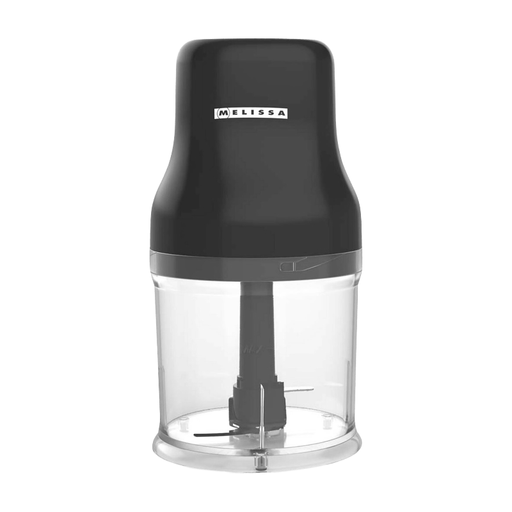
Why it suits this profile: This compact model is designed for small quantities of vegetables, fruit, herbs and nuts. The 500 ml bowl takes up very little space on a kitchen worktop.
The product information states that it has one speed and a maximum operating time of 30 seconds. This makes its limits clear and helps prevent you from using a compact appliance like a heavy-duty food processor.
200 watts, stainless steel blades, non-slip feet, and a dishwasher-safe bowl and blades according to the product information.
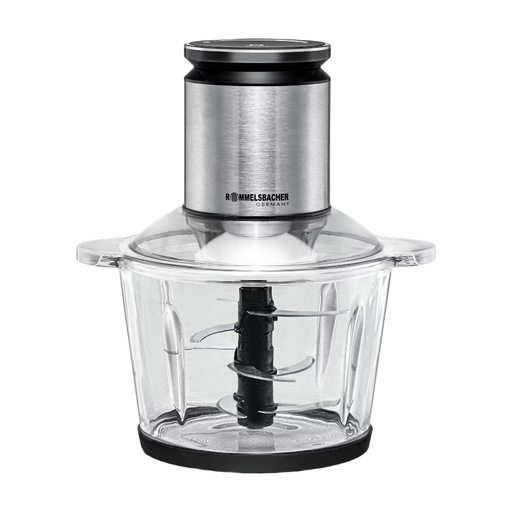
Why it suits this profile: The spacious bowl and adjustable speed suit keen home cooks who regularly prepare a range of foods, from raw vegetables and dips to pesto and herb salt.
The 2.7-litre capacity means you do not have to process larger portions in several small batches. The product information also specifies 22 speed settings rather than making only a general speed claim.
800 watts, a 2.7-litre glass bowl, nine stainless steel blades and removable dishwasher-safe parts according to the product description.
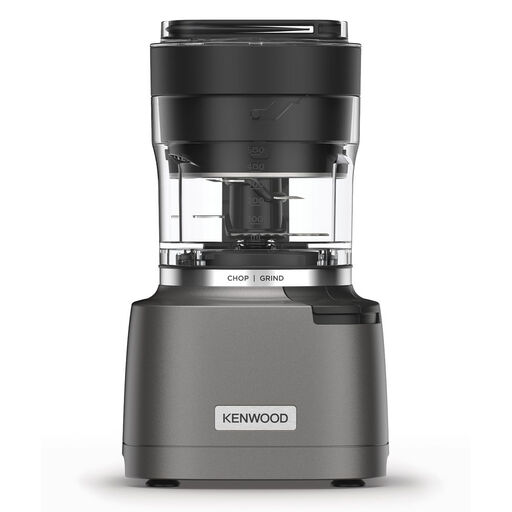
Why it suits this profile: This model combines chopping and grinding. It is suitable for users who want to process coffee, whole spices or other dry ingredients as well as vegetables and herbs.
The separate grinding cup makes it clear what the additional function is intended for. This means you do not have to use the same bowl for wet and dry ingredients.
800 watts, two speed settings, a 500 ml chopping bowl and a separate stainless steel grinding cup; several parts are dishwasher-safe according to the product information.

Why it suits this profile: The two 0.6- and 2-litre bowls allow you to prepare both small portions and larger quantities without having to buy two appliances.
You do not need to use the large bowl for a small quantity. The product information also specifies two separate blade sets, allowing ingredients to be processed separately.
300 watts, two glass bowls, two speed settings and dishwasher-safe bowls according to the product description.
We have put together a complete, up-to-date list of products that fully meet these strict selection criteria and the applicable European safety regulations.
A food chopper usually uses very little electricity per preparation because it runs for a short time. Correct use often has the greatest impact on its service life:
Take extra care with meat and nuts and follow the recommended quantities. A food chopper for vegetables and meat is suitable only when this is stated in the product information. The same applies to a food chopper for nuts and herbs: hard ingredients can place more strain on the motor and blades than soft vegetables.
That depends on the model. Check whether meat is specifically mentioned in the product description or manual. Cut the meat into small pieces, remove hard bones and do not exceed the maximum quantity. Use short pulses instead of running the appliance continuously.
A fixed service life cannot be guaranteed in advance. Correct use, avoiding overfilling, regular cleaning and complying with the maximum operating time all help to reduce wear. Also check the warranty terms; for the models mentioned, a statutory warranty period of at least two years is generally stated, unless different manufacturer’s terms apply.
A mini food chopper generally has lower power and a smaller bowl. This can be practical for small portions, but electricity consumption per preparation mainly depends on the short operating time. If you need to make several small batches, you may actually spend more time. Choose based on your usual portion size rather than wattage alone.
