
Vandaag of morgen in huis

Kwaliteit gegarandeerd

Welkomstaanbiedingen ontgrendelen: GRATIS bezorging | Tot 80% korting | Gratis 30 dagen JoyPlus-proefperiode
Download de app
An electric food chopper can save considerable time when chopping onions, vegetables, herbs, nuts and meat. Yet many people buy an appliance that does not match their portion sizes or ingredients in practice. A small bowl is convenient for pesto, but less suitable for preparing a family meal. A high wattage may sound appealing, but it does not tell the whole story about performance or operating time.
As a Joybuy Product Recommendation Officer, I filter the most important product specifications and compare them with the most common purchasing pitfalls. This helps you make a more informed choice between a mini chopper, kitchen chopper, food processor, herb and coffee grinder or electric meat grinder.
A motor rated at 800 watts sounds more powerful than one rated at 400 watts, but the result also depends on the blades, bowl design, pulse control and permitted operating time. A compact 200-watt appliance may be suitable for coffee beans or herbs, while a chopper for meat and vegetables needs greater capacity and a robust drive system.
So do not check the wattage alone. Also consider:
A 1-litre bowl does not always mean that you can process 1 litre of ingredients at once. Solid ingredients need some spare room to move evenly. For liquid preparations, there is often a separate maximum fill level as well.
For one or two people, a mini chopper of around 500 to 830 ml is often practical. Families should generally consider a model with a capacity of 1 litre or more. If you regularly prepare larger quantities of mince, a dedicated electric meat grinder may be more suitable.
Sharp blades and hard-to-reach edges can make cleaning unnecessarily difficult. Check whether the bowl, lid and blade assembly can be removed. Also verify whether the components are dishwasher-safe. The motor base should generally never be immersed in water.
According to SEVERIN’s product description, a glass bowl does not absorb odours or stains. A plastic bowl is usually lighter, but for daily use, check whether the material is BPA-free and which cleaning method the manufacturer recommends.
For soft vegetables, herbs, cooked ingredients and baby food, straightforward controls are often sufficient. For nuts, harder vegetables or meat, an appropriate blade design and short pulses are more important than a high wattage alone.
A chopper with stainless steel blades is worth considering if you process a range of ingredients. Pay attention to the blade shape and number of blades, too. According to the product information, the IAGREEA MS-25JM08 uses three curved stainless steel blades positioned at different heights. This may help distribute ingredients more evenly throughout a deep bowl, although the result still depends on the quantity and the size of the pieces.
Use this guide as a starting point:
Always check whether the stated capacity refers to the total bowl volume or the maximum fill level.
A multifunctional chopper can chop, mix and purée. Some models come with multiple bowls, whisks or grinding containers. This is useful if you want one appliance to handle several tasks, but accessories also require additional storage space and cleaning.
An electric coffee grinder with an adjustable grind setting is a better choice for users who mainly prepare coffee. A standard chopper does not automatically perform like a coffee grinder. Check the product description before processing coffee beans, spices or hard ingredients.
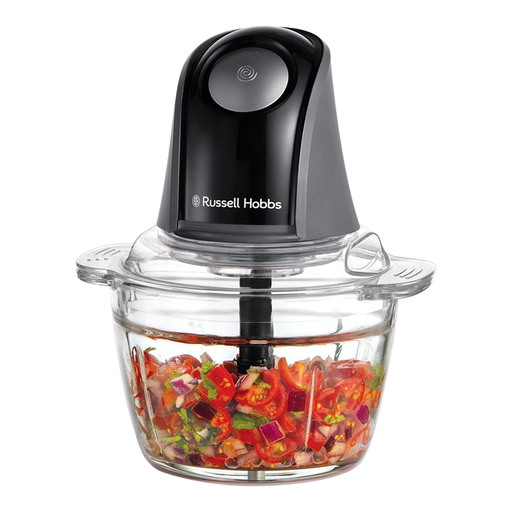
Why it is a good fit: A compact choice for students, smaller households and everyday portions of herbs, vegetables, nuts or meat.
The product information lists a 500 ml capacity, allowing you to match portion sizes in advance. It is operated with one large button.
200 watts, stainless steel blades, a non-slip base, cord storage and dishwasher-safe components according to the product details.
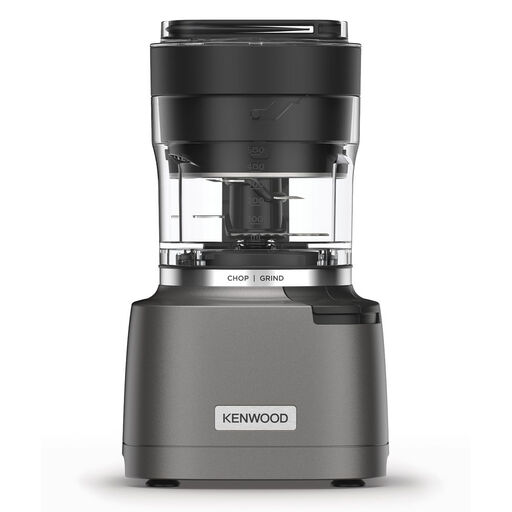
Why it is a good fit: For coffee enthusiasts and home cooks who want to combine chopping and grinding in one compact kitchen appliance.
The two separate bowls make it easier to process coffee, herbs and other ingredients separately.
800 watts, two speed settings, a 500 ml chopping bowl and a stainless steel grinding container. According to the product information, several components are dishwasher-safe.

Why it is a good fit: Designed for larger quantities of vegetables, meat, purée and baby food, with bowls that nest inside one another.
The product information lists three separate stainless steel bowls with capacities of 1.8, 2.2 and 2.5 litres. Before use, check the recommended cycle time of no more than 30 seconds.
350 watts, two pulse settings, a non-slip ring and one triple curved blade assembly for use with the three bowls.
Browse a current selection of electric kitchen grinders with different capacities, functions and applications.
An herb and coffee grinder is designed for small quantities. According to the product specifications, the Cecotec TitanMill 200 has a power rating of 200 watts and a capacity of 50 grams. The Aigostar CG-200 lists 200 watts and a 60-gram capacity. Both models operate in short pulses; follow the specified rest time to help prevent overheating.
For minced meat, models with multiple grinding discs are more practical. The CHEFFANO MG097 and Monsga G100 come with different plates and accessories for products such as sausages and kibbeh. According to the product description, the Tefal HV8 NE6888 is designed for larger quantities and includes three grinding discs. For claims of this kind, always consult the full manual and check the capacity and operating conditions.
An electric food chopper is covered by the standard statutory consumer rights applicable in the European Union. Any additional warranty varies by brand and product page.
That depends on the product specifications. Some kitchen choppers are suitable for small quantities of meat, while an electric meat grinder is specifically designed for this purpose. Check the blade material, bowl capacity and permitted ingredients before using the appliance.
For herbs and small portions, 170 to 200 watts may be sufficient. For vegetables, nuts and smaller quantities of meat, you will typically see models rated at around 300 to 500 watts. Wattage is not an independent measure of the final result; blade design, pulse control and fill level all matter.
Energy consumption depends on the wattage and the short operating time. A 400-watt appliance running for one minute theoretically uses around 0.0067 kWh. The actual cost is therefore usually minimal, although the precise amount depends on your energy contract and how frequently you use the appliance.
