
Vandaag of morgen in huis

Kwaliteit gegarandeerd

Welkomstaanbiedingen ontgrendelen: GRATIS bezorging | Tot 80% korting | Gratis 30 dagen JoyPlus-proefperiode
Download de app
An electric fan heater can quickly make a bedroom, study or office more comfortable. But a high wattage doesn’t tell you everything. A 2000W model can provide powerful heat, but it may also use more electricity and be less suitable for a small, poorly ventilated room. What’s more, claims such as ‘heats up quickly’, ‘quiet’ and ‘energy-efficient’ aren’t always measured in the same way.
So focus on the combination of power, controls, noise, safety and where you plan to use it. Below, we cover the main buying pitfalls and offer a practical selection of models.
Brands sometimes say that a heater produces warm air within seconds. According to information from PELONIS, Xiaomi and DREO, for example, their ceramic heaters start producing warm air after around two to three seconds. That doesn’t automatically mean the whole room will reach the desired temperature in that time.
The actual time it takes to warm up depends on:
So treat a claim of ‘heating in 3 seconds’ as the time it takes to start producing warm air, not a guarantee that the whole room will be heated.
At full power, an electric heater 2000W theoretically uses 2 kWh per hour. At an electricity rate of, for example, €0,30 per kWh, that works out at around €0,60 per hour. The exact cost depends on your energy tariff and how often the thermostat switches the heating element off.
A lower-powered 1500W model may be enough for a bedroom or home office, while 2000W can provide heat more quickly in a larger or colder room. Models rated at 3, 5 or 9 kW are generally intended for more intensive use, such as in a workshop or on a building site, and may not be suitable for a standard socket or small living space.
A heater with overheat protection and tip-over protection may switch off automatically if there’s a problem. These are useful extra features, but they’re no reason to leave the heater unattended or cover it.
Always place a fan heater:
A CE mark indicates that the manufacturer has declared the product to meet the relevant EU requirements. It isn’t a general quality rating. Check the manual, manufacturer’s details and warranty terms too.
A compact 1000 to 1500W heater may be enough for a room of up to around 10 m², depending on the insulation. Many consumers choose 1500 to 2000W for rooms of around 15 to 20 m². Treat the room size stated by a brand as a guide, not a guarantee.
A PTC ceramic heater uses a ceramic heating element. PTC stands for Positive Temperature Coefficient: the electrical resistance changes as the element gets hotter. As well as checking for PTC technology, look at the actual power, heat settings and thermostat controls.
A heater with a thermostat can help maintain the set temperature by switching the heating element on and off at intervals. This can limit electricity use compared with heating continuously on the highest setting, but it doesn’t guarantee a particular percentage saving.
Look out for these practical features:
A quiet fan heater is especially useful in a bedroom, study or office. Manufacturers sometimes quote noise levels of between 25 and 50 dB. According to DREO’s own product information, certain models have a stated range of 25–42 dB; OmniHeat lists settings from 38 dB. Only compare measurements if they were taken using the same method.
A portable model with a handle is handy if you want to move the heater between the living room, bedroom and office. Check the dimensions too, so you can leave enough space between your compact electric heater and any walls or furniture.
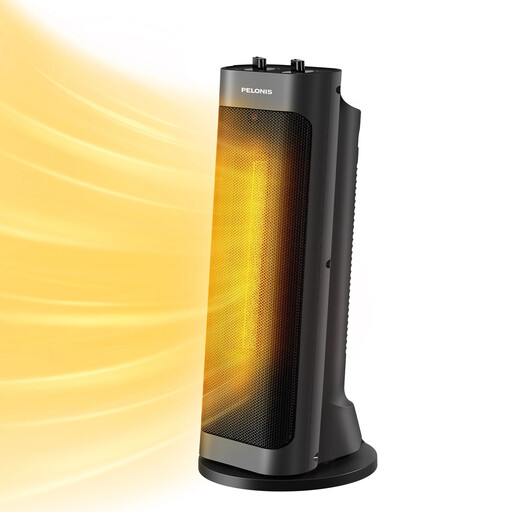
Why it suits this profile: This portable model combines 2000W of power with four heat settings, an adjustable thermostat and 70° oscillation. The product specifications list it as suitable for use in a bedroom, living room, study or office, among other spaces.
The specifications cover more than just fast heating: they also set out the available controls, plus overheat and tip-over protection. Check the recommended room size, though: the product information lists both 10 and 15 m².
2000W PTC element, 70° oscillation, adjustable thermostat, carry handle, and tip-over and overheat protection.
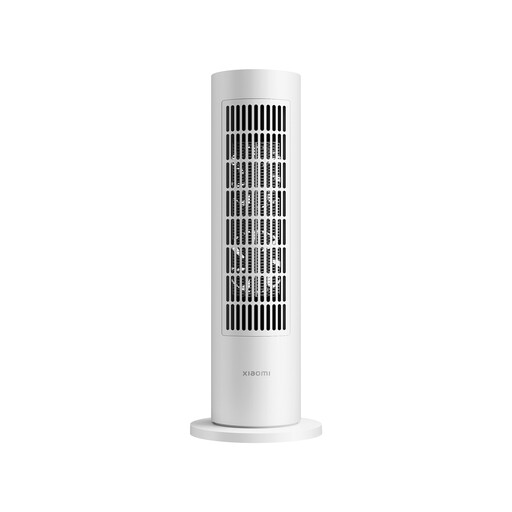
Why it suits this profile: Its tower design takes up relatively little floor space. The product specifications also list app and voice control, a thermostat, a timer and 70° oscillation.
As well as a claim about fast heating, the product information gives specific details about automatic shut-off and tip-over protection. The Mi Home app is needed for the full range of smart features, according to the product information.
2000W power, PTC technology, app control, thermostat, timer, 70° oscillation and a stated weight of 2,2 kg.
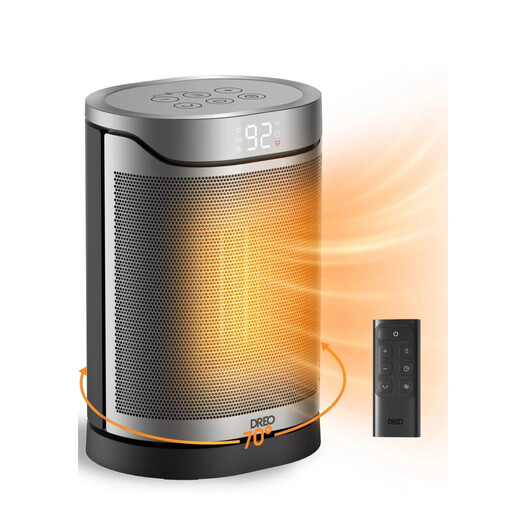
Why it suits this profile: According to the product specifications, this model is designed for a bedroom, office or living room of around 10 to 20 m². Its lower power rating may suit people who don’t want to heat continuously at 2000W.
The product information lists three power settings, a thermostat range of 5–35°C and a stated noise level of 25–42 dB. The claim of up to 40% savings comes from DREO itself and depends on how and where the heater is used.
1500W PTC heating, 12-hour timer, remote control, 70° oscillation, tip-over and overheat protection, and a compact design.
We’ve put together a complete, up-to-date list of products that meet these strict selection criteria and the applicable European safety requirements.
It can be, provided the model is suitable for the size of the room and is placed in a clear, stable spot. Ideally, choose a model with a thermostat, timer and stated low noise level. Don’t run the heater while it’s covered, and always follow the instructions. Take extra care if using it while you sleep: automatic safety features don’t replace supervision or correct use.
At full power, a 2000W model uses around 2 kWh per hour. Calculate the cost using: 2 × your electricity rate per kWh. A thermostat can stop the element from running continuously at full power. Actual consumption therefore varies depending on the room, temperature setting and insulation.
Its lifespan depends on how often it’s used, dust, ventilation and storage. Only clean the appliance when it’s switched off, cool and unplugged. Stop using the heater if it has been dropped, shows visible damage, or produces smoke or a burning smell. Store it somewhere dry and check the cable, plug and air vents before each heating season.
