
当日/次日达

品质保障

开启新人专享福利: 全场免邮 | 低至 2 折 | 免费试用 30 天 JoyPlus 会员
下载 Joybuy
An electric cooking pot is useful if you have limited space, do not use a full kitchen or want to prepare a quick one-pot meal. Students, single people, couples and busy professionals use this compact cooking solution for ramen, pasta, soup, rice, hotpot and simple stews.
However, not every mini electric cooking pot is equally practical in everyday use. An attractive price or promise of “fast cooking” tells you little about the capacity, controls or cleaning requirements. Pay particular attention to these common pitfalls.
A 1000-watt appliance can heat up faster than one rated at 300 or 600 watts, but the result also depends on the amount of water, the pan’s construction and the heat control. For a small portion of noodles, 600 watts may be sufficient. For a larger pan of soup or hotpot, more power is more practical.
A multifunctional electric pan with two or three settings is often more flexible than a model with only an on/off switch. A low setting helps with gentle heating, while a high setting is suitable for boiling or bringing food up to temperature quickly.
A cooking pot with a non-stick coating can make cleaning easier, but the coating requires careful use. Metal spatulas, scouring pads and high heat can damage the surface. Also check whether the inner pot is removable and whether the appliance itself must not be immersed in water.
Some models mention a food-grade, Teflon or marble-effect coating in the product description. This is information provided by the seller or manufacturer; it is not a guarantee that every cooking problem will be avoided. Always follow the supplied instructions.
A capacity of 1 litre is suitable for a small portion or one person. A capacity of 1.2 to 1.6 litres provides more room for ramen, soup or an individual hotpot. For two people or several ingredients at once, 2.4 to 2.6 litres may be more convenient.
Take the maximum fill level into account. The Plodon 2-litre model, for example, states that the pan should not be filled beyond around two thirds to reduce the risk of boiling over. A larger capacity does not therefore mean that you can fill the pan completely.
An electric ramen cooker with a rotary dial or slider is easy to operate. Do check that the pan is suitable for the way you intend to cook. An appliance mainly designed for boiling and stewing is not automatically suitable for intensive frying.
Measure the available space on your desk, worktop or shelf beforehand. Do not look only at the pan’s diameter; also consider the handle length and the height with the lid on.
A portable electric cooking pan is handy for a student room, office or campsite, but pay attention to:
“Portable” does not mean that the appliance works without electricity. For travelling and camping, you will need a suitable power supply.
Look for features such as automatic switch-off, overheating protection and dry-boil protection when they are actually listed in the product information. These features can make the appliance more practical to use, but you should always stay nearby while it is cooking.
On many models, the housing, plug and power base must not be placed in water. Allow the pan to cool completely first, unplug it from the mains and clean it only according to the instructions. A glass lid can become hot during cooking and should not be placed directly under cold water.
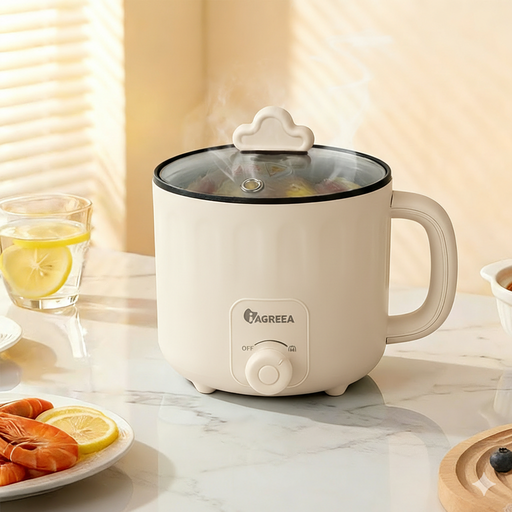
Why it suits this profile: According to the product description, this model offers a 1.6-litre capacity, 600 watts of power and simple one-button operation. This makes it suitable for students or single people who want to prepare ramen, soup, noodles and small one-pot meals.
The capacity and power are clearly stated. The product description also mentions automatic switch-off and dry-boil protection; check the manual for details of how these features work.
1.6-litre capacity, 600 watts, non-stick coating and a compact size of approximately 17 × 15 cm according to the product information.
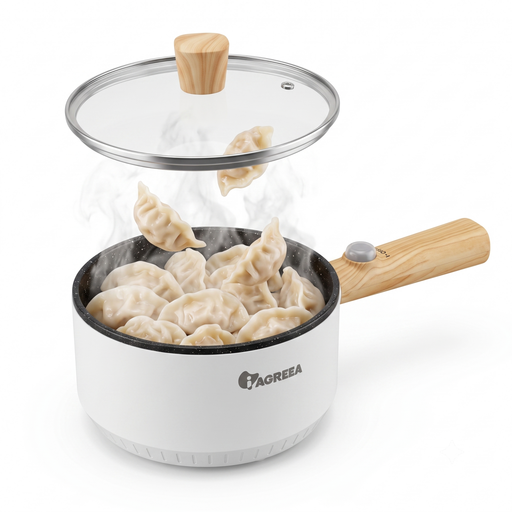
Why it suits this profile: According to the product description, this model combines 500/1000 watts, a glass lid, a detachable EU cable and a marble-effect non-stick coating. It is an interesting option for anyone who wants greater control when preparing ramen, hotpot, soup and stir-fries in a small kitchen.
The two heat settings mean you do not have to use the same power level for every dish. The product information also mentions overheating and dry-boil protection.
1000 watts, two power settings, glass lid, detachable cable and a 1.2-litre capacity.
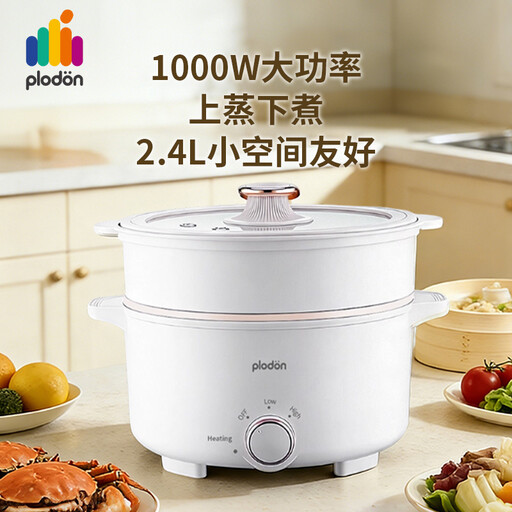
Why it suits this profile: According to the product description, the 2.4-litre capacity is aimed at couples and small households. The included steamer allows you to steam and cook at the same time, making it suitable for soup, pasta, hotpot and side dishes.
The dual temperature control allows for gentle simmering and fast cooking. The product information also warns not to immerse the appliance and to allow the pan to cool first.
2.4 litres, 1000 watts, two heat settings, non-stick coating and a detachable steamer.
We have put together a complete, up-to-date list of products that fully meet these strict selection criteria and the applicable European safety regulations.
For everyday use in a student room, a mini electric cooking pot with a capacity of 1 to 1.6 litres is usually sufficient. If you often cook for two people, it is better to consider 2.4 litres. A 6-litre model, such as the Fritel Pasta-Rice Cooker RC 1377, falls outside the compact category but may be useful for larger portions and steaming. The product information lists 1100 watts, three functions, a removable bowl and a PFAS-free inner pot.
Yes, models with sufficient capacity and a high heat setting can be used as an electric ramen cooker or noodle pot. Add ingredients gradually and allow for foaming. Do not automatically use the pan as a deep-fat fryer unless the manufacturer explicitly permits it.
Consumption depends on the power rating and how long the appliance is used. A 600-watt appliance switched on for 20 minutes theoretically uses around 0.2 kWh. A 1000-watt model uses approximately 0.33 kWh over the same period. The actual figure varies depending on thermostat control and heating time.
Usually not. The inner pot can sometimes be removed or rinsed, but the electrical housing, plug and power base must not be immersed. Unplug the appliance, allow everything to cool and follow the product’s specific cleaning instructions.
