
Vandaag of morgen in huis

Kwaliteit gegarandeerd

Welkomstaanbiedingen ontgrendelen: GRATIS bezorging | Tot 80% korting | Gratis 30 dagen JoyPlus-proefperiode
Download de app
Grinding fresh coffee beans can make a big difference to ease of use and flavour. However, not every electric coffee grinder is suitable for every brewing method. A compact blade grinder is handy for grinding coffee occasionally, but usually offers less control than a burr coffee grinder. Espresso drinkers also have different requirements from those who mainly make filter coffee or French press.
As a Joybuy Product Recommendation Officer, I filter the key product specifications and set marketing claims aside. Below, you’ll find what to look for, which common pitfalls are often overlooked and which models suit different user profiles in the Netherlands.
A 200-watt motor may sound powerful, but wattage does not automatically indicate how evenly coffee beans are ground. A blade grinder works in short pulses, and the grind size depends on how long you grind. This makes it harder to achieve the same particle size every time.
A burr coffee bean grinder grinds the beans between two grinding surfaces. The distance between these burrs determines the grind size. This generally gives you more control, particularly for espresso and pour-over.
A product title may mention several brewing methods, but always check the number of settings and the type of burrs. A model without grind-size adjustment is less suitable if you want to switch between espresso, moka pot, filter coffee and French press.
Also pay attention to the difference between fixed settings and stepless adjustment. With 34 settings, as on the HiBREW G3, you can fine-tune the grind more precisely than with a model offering just three positions. A stepless ring, such as the one on the STARSEEKER E55 Pro, offers even more intermediate settings. According to the brand’s product description, this adjustment is designed for highly precise control; that is a product specification, not a guarantee of a particular flavour result.
A large hopper may seem practical, but it is not always necessary for home use. If you make one or two cups at a time, a compact coffee grinder that is easy to clean may be more useful. A capacity of 50 to 70 grams is suitable for small portions. For a household, home office or small office, 210 to 250 grams may be more convenient.
Also check whether ground coffee can be removed easily from the container. Residual powder can mix with the next batch and make maintenance more difficult.
For filter coffee and French press, a wide selection of coarser settings is important. For espresso, a fine, precisely adjustable grind is particularly relevant. So don’t just look for the word “burr”; also check the available settings and recommended use.
An electric coffee grinder for home use does not automatically need to be large. Think about how much coffee you make each day:
According to the listed specifications, the Rommelsbacher EKM 200 has a bean hopper of approximately 250 grams and controls for 2 to 12 cups. The HiBREW G3 has a 210-gram bean hopper, a 100-gram ground coffee container and 34 grind settings.
Measure the available space before ordering. According to the product specifications, the HiBREW G3 measures 110 × 165 × 320 mm. It is relatively narrow, but its height could be an issue beneath a kitchen cupboard. A compact coffee grinder such as the De’Longhi KG210 is 13 cm wide and 14.5 cm high, according to the product information.
Also look for:
According to the operating instructions, the Cecotec TitanMill 200 has a maximum continuous operating time of one minute, followed by at least ten minutes of cooling. The Butler grinder is specified for a maximum of 30 seconds of continuous use. Always follow the instructions for your chosen model and unplug it before cleaning.
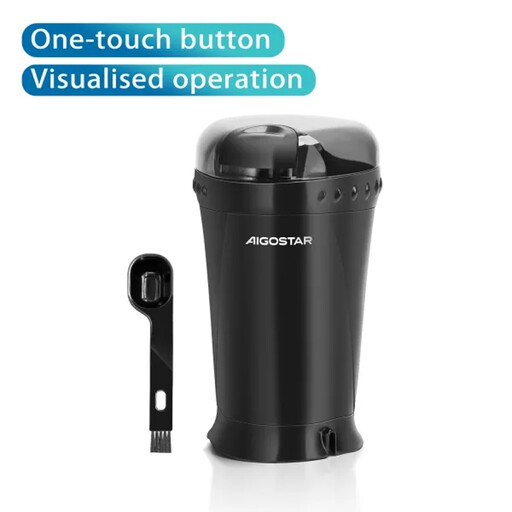
Why it’s a good fit: A straightforward choice for anyone who occasionally wants to grind coffee beans, herbs or other dry ingredients at home without lots of settings.
The 60-gram capacity and one-button operation make it clear that this is a pulse grinder, not a finely adjustable espresso grinder.
200 watts, stainless steel blades, 60-gram capacity and a compact size of 108 × 105 × 180 mm.
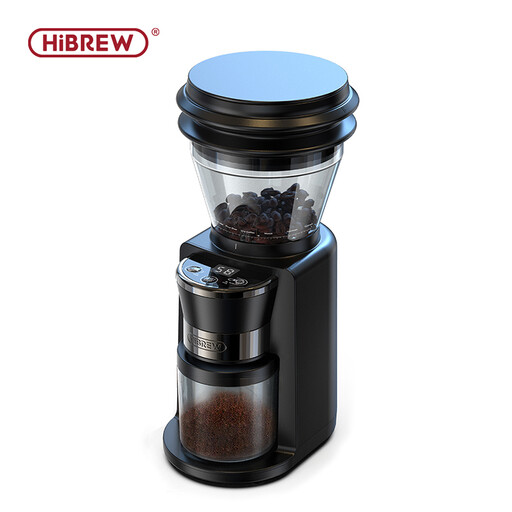
Why it’s a good fit: For home baristas who regularly switch between espresso, Turkish coffee, pour-over and other brewing methods.
The 34 settings provide specific information about the available adjustment options, rather than just making a general espresso claim.
Conical burrs according to the product information, 34 settings, 210-gram bean capacity and a weight of 1.6 kg.
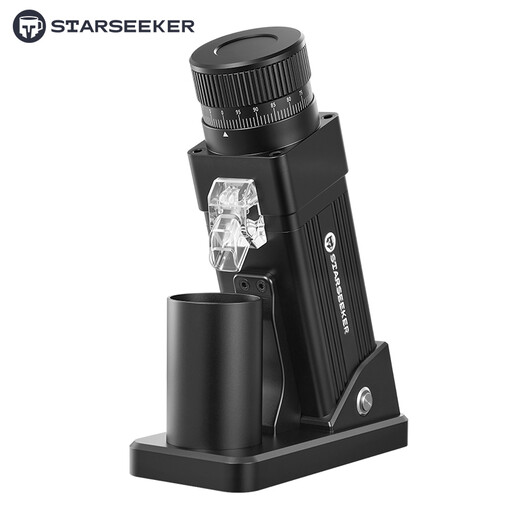
Why it’s a good fit: For users who want plenty of adjustment and are looking for a metal grinder for espresso and pour-over.
The product specification states that it has stepless adjustment in increments of 0.01 mm. This makes the type of control on offer clear.
55 mm titanium-alloy conical burr according to the product description, aluminium housing and removable outlet.
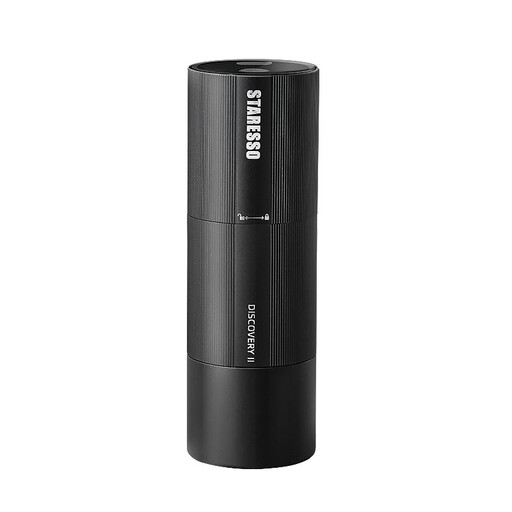
Why it’s a good fit: For home workers, travellers and anyone with limited worktop space who still wants an electric burr grinder.
It is a rechargeable model, so you are not entirely dependent on having a socket available on the worktop.
1000 mAh battery, USB-C charging, metal housing and adjustable grinding for espresso, pour-over and French press.
Browse our current selection of electric burr coffee grinders and compare grind settings, capacity, size and controls.
That depends on the burrs and the available settings. For espresso, it is best to choose a model with burrs and multiple fine settings or stepless adjustment. A blade grinder can reduce beans to a smaller size, but usually offers less consistency when producing a very fine grind.
Its lifespan depends on how it is used, how well it is cleaned and the maximum operating time per cycle. Do not grind wet beans, do not exceed the stated capacity and allow the motor to cool down when instructed to do so in the manual. Clean removable parts with a dry brush and never immerse the motor housing in water.
A single grinding session usually takes only a short time. Energy consumption per cup is mainly determined by the motor power and operating time. A 110-watt model that runs briefly may use less energy in practice than a 200-watt model that needs to pulse for longer. For a fair comparison, therefore, consider both values rather than looking at wattage alone.
