
Vandaag of morgen in huis

Kwaliteit gegarandeerd

Welkomstaanbiedingen ontgrendelen: GRATIS bezorging | Tot 80% korting | Gratis 30 dagen JoyPlus-proefperiode
Download de app
An electric citrus juicer can make juicing oranges, lemons and grapefruits much easier. However, not every model is suited to the same kitchen or frequency of use. A compact lemon juicer works perfectly for a single glass, whereas a family is more likely to need a larger jug, pulp control and parts that are quick to clean.
What's more, the product name doesn't always tell the full story. So keep an eye out for the following pitfalls before you make a purchase.
A higher wattage doesn't automatically mean a citrus juicer extracts more juice from each piece of fruit. The pressing cone, rotation direction, strainer and operation all play a part too. A model with automatic left and right rotation can press the fruit in different ways, but the actual yield also depends on the size and ripeness of the fruit.
A jug holding over a litre is handy for several people, but it takes up more space on the worktop and requires more cleaning afterwards. For one or two glasses a day, a citrus juicer with a jug of around 0.7 litres may be sufficient. Also check whether the jug is removable and has a clear measurement marking.
Check which parts are removable and how the motor base should be cleaned. An electric citrus juicer should generally not be fully submerged in water. With a citrus juicer that's easy to clean, a removable strainer, pressing cone and collection bowl are particularly important. Also look out for crevices where pulp can get stuck.
If you want smooth juice, a separate strainer or multiple pulp settings are beneficial. A citrus juicer with pulp control gives you more control over the texture. Some models automatically separate pulp from the juice. This is practical if you want to set different preferences for different family members.
For a family, a collection bowl of around 0.7 to 1.4 litres is useful, depending on how much juice you make at a time. A wide feed chute reduces the amount of chopping needed. However, do check whether the citrus fruit still needs to be halved or peeled. A standard citrus juicer usually works with halved fruit; a slow juicer or centrifugal juicer can also process other types of fruit and vegetables, but often requires more preparation.
Look for a stable base, non-slip feet and an operation that doesn't leave the juicer running unnecessarily long. Food-contact parts must be suitable for contact with food. A mention such as BPA-free in the product information indicates what the manufacturer states about the material; always check the manual and safety information as well.
An electric orange juicer with moving parts should come with clear instructions: unplug it before disassembly and cleaning, keep fingers and utensils away from moving parts, and do not submerge the motor base. A citrus juicer for home use is generally intended for short juicing sessions, not for unlimited continuous use.
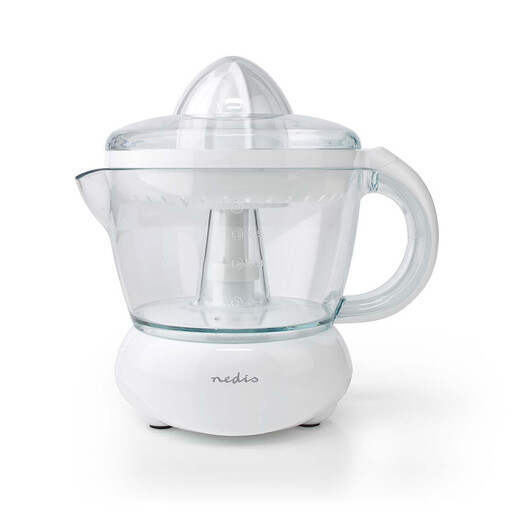
Why this fits the profile: This compact model is designed for daily juicing of oranges, lemons or grapefruits and has a jug of around 0.7 litres. The operation activates the juicer when you press down on the fruit.
The transparent jug has a measurement scale and is removable. This means you can see the amount of juice and clean the collection bowl separately.
25 W power, automatic left and right rotation, compact dimensions of 15 x 20 x 19 cm and a removable jug.
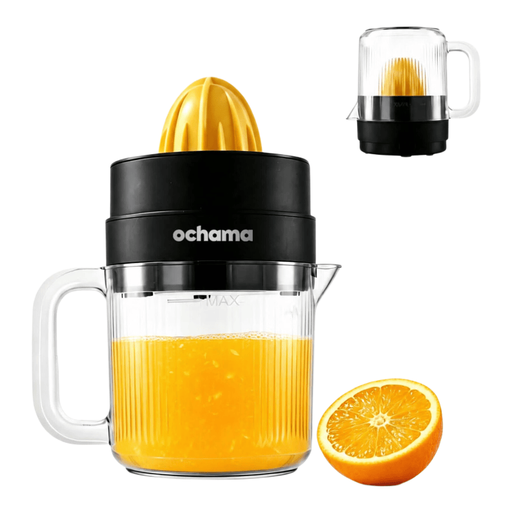
Why this fits the profile: The 1.4 litre capacity suits households that want to prepare several glasses of juice at once. The operation is electric and the design does not use traditional cutting blades.
The product information mentions a simple construction with removable parts and pulp and juice separation. This makes control and cleaning more straightforward.
30 W power, 1.4 litre capacity, suitable for oranges, lemons, mandarins and pomegranates according to the product description.

Why this fits the profile: This is a slow juicer for users who want to process certain vegetables and other fruit in addition to citrus. The wide feed chute and separate collection containers suit larger preparations.
According to the product information, the parts are removable and suitable for cleaning with warm water. The manual also states a maximum continuous usage time of 10 minutes.
150 W power, 130 mm feed chute, juice beaker with scale up to 600 ml, pulp container of 836 ml and overheat protection.
A citrus juicer for oranges is usually the simplest choice if you mainly use citrus fruit. You halve the fruit, press it onto the cone and collect the juice. A fruit press or centrifugal juicer is more versatile, but generally has more parts, a different cleaning routine and specific limitations for hard or fibrous ingredients.
A slow juicer processes ingredients using a slow-turning system. Peel citrus fruit according to the manual and remove pips or hard parts when instructed. Never use ice cubes or unsuitable ingredients if the manufacturer advises against it.
We've put together a full, up-to-date list of products that fully meet these strict selection criteria and comply with current European safety regulations.
First, unplug it from the mains. Then remove the pressing cone, strainer, jug and any other removable parts. Rinse them according to the manual and wipe the motor base clean with a slightly damp cloth. Allow all parts to dry before reassembling the citrus juicer.
The lifespan depends on frequency of use, cleaning and following the recommended work cycles. Let the motor cool down when the manual advises it and do not use damaged cables or parts. With a standard lemon juicer, the pressing cone and drive mechanism are most important; with a slow juicer, the filter and auger components also come into play.
The consumption depends on the power and usage time. A 25 W model running for a few minutes uses relatively little energy per juicing session. A 150 W appliance can process more types of ingredients, but doesn't automatically use more electricity if you use it for shorter periods. So look at both the wattage and your daily usage.
