
Vandaag of morgen in huis

Kwaliteit gegarandeerd

Welkomstaanbiedingen ontgrendelen: GRATIS bezorging | Tot 80% korting | Gratis 30 dagen JoyPlus-proefperiode
Download de app
An electric citrus juicer can make squeezing oranges, lemons and grapefruits easier. However, models vary significantly in terms of operation, capacity and cleaning. A low price does not always reflect the running costs or everyday convenience. Conversely, extra features are not automatically useful for your household.
Pay particular attention to these three common pitfalls:
A wide feed opening that turns out not to suit your fruit
Some appliances have a spacious feed opening but are actually designed for smaller pieces of fruit or pre-cut ingredients. Always check the diameter in millimetres rather than relying solely on the marketing term “extra wide”.
A pulp setting without clear options
An adjustable sieve sounds useful, but a single fixed filter setting offers little control over the texture of the juice. If people in your household have different preferences, it is better to look for a citrus juicer with a pulp setting or several filter settings.
Parts that are difficult to clean
Juice, pulp and pips can quickly collect around the sieve and spout. An appliance where only the jug is removable may therefore require more maintenance than expected. Check whether the parts can be removed and whether the manual confirms that they are dishwasher-safe.
For one glass at a time, a compact jug of around 0.7 litres is sufficient. Families will often benefit more from a 1-litre reservoir or larger. Also consider the appliance’s dimensions. A model that stays on the worktop every day needs to fit between kitchen cupboards and other appliances.
An electric orange juicer with a wide feed opening can reduce preparation time. According to the product specification, the Bear CZJ-A04B1 has an opening measuring 110 mm. This is relevant for users who want to process whole or large citrus fruits. However, always check the permitted types of fruit and the instructions before use.
Not everyone drinks juice in the same way. A citrus juicer for oranges and lemons with an adjustable filter can therefore be more practical than an appliance with a single sieve. The Bear has five pulp settings and a separate pulp and juice separation system.
Another option is a model with two different reamers. This allows the reamer to fit small lemons or larger oranges more closely. That can make operation easier, but it does not mean that every model is suitable for processing large quantities one after another.
Wattage is only one part of the comparison. A citrus juicer is usually activated by pressing the fruit down. More important is whether the appliance stands securely, how long it can run continuously and how easy it is to take apart.
An easy-to-clean citrus juicer should ideally have:
Be aware of the difference between a citrus juicer and a centrifugal juicer for citrus fruit. A traditional citrus juicer uses a reamer and is primarily intended for citrus fruit. A slow juicer or centrifugal juicer can process more types of fruit and vegetables, but is often larger, more expensive and more complicated to clean. If you only want to juice oranges, lemons and grapefruits, a citrus juicer is usually the simpler choice.

Why it suits this profile: One-button operation, a compact design and a wide opening are practical for households that want to make fresh juice without much preparation.
The 110 mm diameter is clearly specified. There are also five pulp settings, so you are not restricted to a single filter setting.
110 mm-wide feed opening, five pulp settings, non-slip feet and removable parts. The product specification states that the materials that come into contact with food are BPA-free.
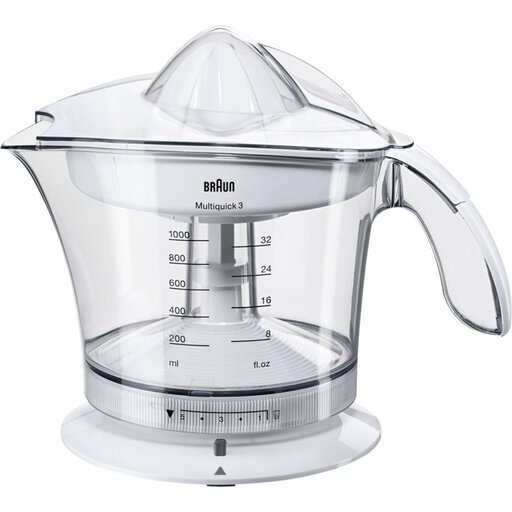
Why it suits this profile: This model is ideal for users who value a measuring scale, a 1-litre jug and familiar, straightforward pressure operation.
Start-stop operation eliminates the need for extra buttons while juicing. According to the product specification, selected parts are dishwasher-safe; consult the manual for details.
1-litre jug with measuring scale, reamer that rotates clockwise and anticlockwise, adjustable pulp sieve and cord storage.
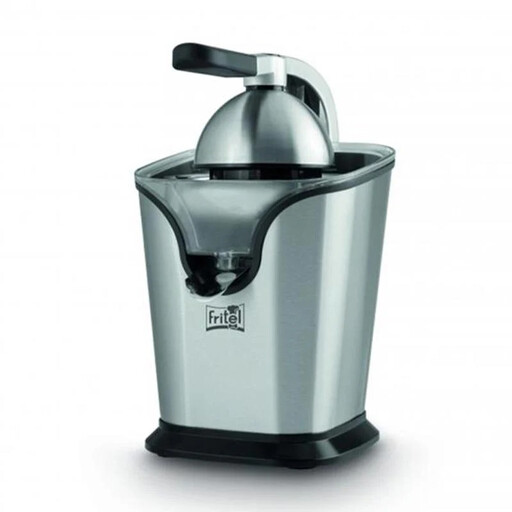
Why it suits this profile: The lever operation and two reamers are suitable for anyone who regularly juices different citrus fruits and wants to use less hand pressure.
The two reamers are designed for different fruit sizes. The anti-drip spout helps reduce dripping when pouring.
100 watts of power, two interchangeable reamers, pulp filter, anti-drip spout and removable parts that, according to the product information, can be put in the dishwasher.
We have compiled a complete, up-to-date list of products that fully meet these strict selection criteria and the applicable European safety regulations.
Most citrus juicers have relatively low power ratings, such as 20, 25, 40 or 100 watts. Actual energy consumption depends on how long the appliance is used. As juicing usually takes only a short time, the running time matters more than the maximum wattage alone. Always follow the recommended duty cycle in the manual.
This varies by model and component. The Braun MPZ9 and FRITEL CP 4177 are stated to have certain removable parts that are dishwasher-safe. The motor base must not be immersed in water. Before cleaning for the first time, check the manual, particularly for plastic components.
Service life depends on how often the appliance is used, how it is cleaned and whether the maximum operating time is observed. Allow the motor to cool down when instructed in the manual, and stop using the appliance if you notice unusual noise, smells or vibrations. In the European Union, statutory conformity guarantees also apply; check the terms for the specific product and seller.
