
People who slice firm cheese
You regularly want to slice several pieces of firm cheese. Graef specifically mentions firmer cheese for the SKS500 and SKS110; check the guidance for the exact model.


If you want to slice firm cheese electrically, choose a model whose manufacturer specifically lists it as suitable for that use: Graef mentions firmer cheese for the SKS500 and SKS110, but this is not an independent test of every type of cheese. Then consider how much cleaning, worktop space and finger protection you need. For a few slices of mature or extra-mature cheese, a manual cheese plane may also be enough.
You regularly want to slice several pieces of firm cheese. Graef specifically mentions firmer cheese for the SKS500 and SKS110; check the guidance for the exact model.
You’re making a small portion and want to clean up quickly afterwards. Ritter lists a removable carriage for the compact⁷, while Graef lists a removable blade for the SKS500.
You want to get as close as possible to keeping your hands away from the rotating blade. Compare the food holder, finger guard and controls on the specific model; Severin and Ritter list these features for the models mentioned.
Start with the type of cheese, then consider cleaning, the distance from the blade and the storage space available. If you only need a few slices, a manual cheese plane may also be a practical option.
| Consideration | What should you check? | Who should prioritise this? |
|---|---|---|
| Suitability for firm cheese | Check whether the manufacturer specifically mentions your type of cheese and which blade comes with the model. | If I want to slice several pieces of firm cheese, I look for an explicit mention of this use, rather than just the general word ‘cheese’. Around 31% of consumers prioritise suitability for firm cheese. |
| Cleaning after making a small portion | Check the manual to see how the blade and carriage can be removed and cleaned. | After an evening class, I want to make a small portion without spending unnecessarily long on the clean-up. Around 31% of consumers give quick cleaning top priority. |
| Distance from the blade | Check the food holder, finger guard and operating instructions for the exact model. | When feeding cheese into the slicer, I want to keep my fingers away from the rotating blade. Around 23% of consumers say finger safety is their main concern. |
| Worktop and storage space | Measure the space on your worktop, as well as the extra room the carriage needs during use. | In a small kitchen, I want to be able to put the appliance away after use without it taking up permanent space on my worktop. Around 15% of consumers prioritise limited worktop space. |
For the Graef SKS500 and SKS110, the manufacturer specifically mentions firmer cheese. This is not an independent test of every hard or crumbly type of cheese.
Before buying, check the instructions and the blade supplied with the exact model.
The Joybuy product listing for the Clatronic MA 3585 states 500 W in the title and 150 W in the specification table; Clatronic lists 150 W.
Compare the full model number with the manufacturer’s specification, and don’t rely on a contradictory title.
The blade and carriage come into contact with food. If the appliance has previously been used for raw food, cleaning it thoroughly is especially important to prevent cross-contamination.
Follow the manual when cleaning parts that come into contact with food. The Netherlands Nutrition Centre advises keeping raw and cooked food separate and washing utensils thoroughly between uses.
The SKS500 and SKS110 are worth considering if you’re looking for the manufacturer to explicitly state that a model is suitable for firmer cheese.
The compact⁷ is a compact electric food slicer for home use; Ritter lists cheese as a suitable food and specifies a removable carriage.
The AS 3915 is an adjustable food slicer with a carriage, food holder and finger guard.
The MA 3585 is a metal food slicer that the manufacturer lists as suitable for slicing cheese.
These electric slicers are options to consider if you want to slice cheese. For each model, check whether the manufacturer mentions your specific type of cheese and how to clean the parts that come into contact with food.
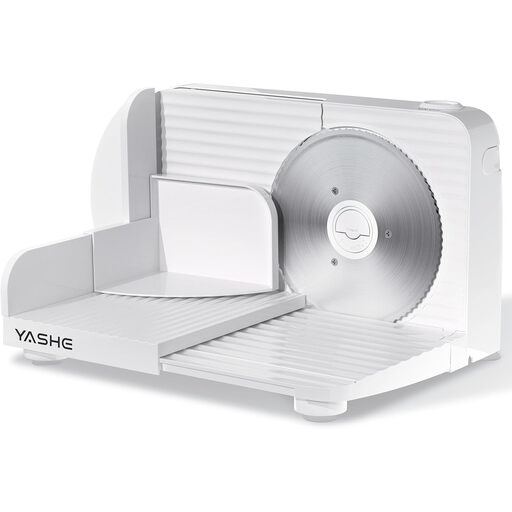 Image unavailable
The product title lists cheese as a suitable food; check the guidance for this model to see whether it’s suitable for your type of firm cheese.
The title states 180 W, a thickness setting of 0–15 mm, a 17 cm stainless steel blade and a foldable design.
Check the product information to see which parts can be removed for cleaning.
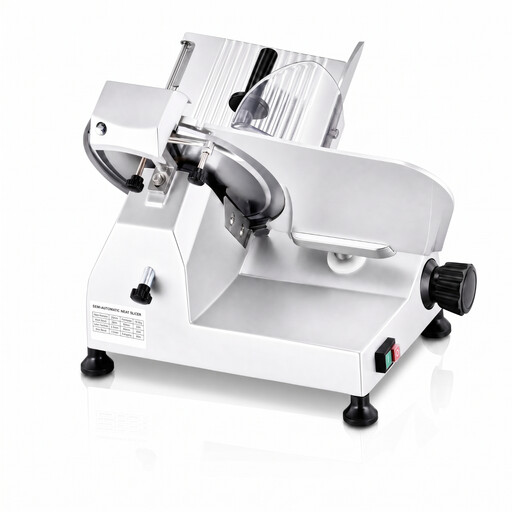 Image unavailable
An option to consider if you want to slice firm cheese; check whether the information for this model matches your type of cheese.
The product title states 240 W, a 25.4 cm carbon steel blade and a thickness setting of 0–12 mm.
Before buying, check which parts are removable and how to clean them according to the instructions.
 Image unavailable
An electric food slicer to consider if easy cleaning after making a small portion is important to you. Check the information about the carriage and suitability for your type of cheese for this model.
No, that statement doesn’t confirm that a machine can handle every type of firm cheese. Graef specifically mentions firmer cheese for the SKS500 and SKS110; the Ritter and Clatronic models mentioned list cheese in general. Check the manual for the exact model and the type of cheese you want to slice.
Follow the instructions for your model on switching it off and removing any parts. The Netherlands Nutrition Centre advises keeping raw and cooked food separate and washing utensils thoroughly between uses.
No. According to the Dutch Government, there is no fixed statutory guarantee period in the Netherlands: you’re entitled to a product that works properly, depending on what you could reasonably expect. A manufacturer’s guarantee may be offered on top of this; if a product is faulty, contact the retailer.
The applicable requirements depend, among other things, on the appliance and the product rules in force. The Netherlands Food and Consumer Product Safety Authority (NVWA) states that the Low Voltage Directive applies to electrical equipment with a rated AC voltage between 50 V and 1.000 V. For appliances covered by the rules, the Dutch government describes CE marking and the EU declaration of conformity as the manufacturer’s responsibilities; a product listing on its own doesn’t prove that an individual item meets all the requirements.
If the product is faulty, contact the retailer and refer to your rights under Dutch statutory guarantee law; the Dutch Government states that there is no fixed statutory guarantee period. Also check the terms of any additional guarantee and ask about servicing for the exact model.