
Home baker who wants slices cut to size
If you bake your own bread, compare the blade and adjustment range with the slice thickness you want. Also check that your loaf will fit in the machine.


Choose an electric slicer with a serrated blade suitable for bread and an adjustable thickness range that covers the slice thickness you want. A foldable model can be handy if you want to put it away after a weekend lunch. A larger all-purpose slicer may offer a wider range or other uses, but you’ll need to consider the worktop and storage space it requires. Also check the dimensions, cleaning instructions and product information for the exact model you’re buying.
If you bake your own bread, compare the blade and adjustment range with the slice thickness you want. Also check that your loaf will fit in the machine.
If you mainly use the machine for weekend lunches, check how much space it takes up in use and how you can store it afterwards. A foldable model may be a suitable option, depending on the specific model.
If ease of use and cleaning are your main priorities, compare the food holder, stability and which parts the manual says can be removed. Features vary by model.
Start with the slice thickness you want and the dimensions of your loaf. Then compare the space the machine takes up, how it operates and how it is cleaned. These features can help you decide whether a compact foldable model or a larger all-purpose slicer is better suited to your needs.
| What to consider | What should you check? | Who should pay particular attention? |
|---|---|---|
| Slice thickness and blade | Compare the stated range in millimetres with your preferred slice thickness, and check whether the exact model comes with a serrated bread blade. | If I slice homemade bread, I want to be able to set the thickness I need. Around 36% of consumers in this decision-making context put slice thickness first. |
| Storage and worktop space | Check the dimensions both in use and when stored, and see whether parts such as the carriage can be removed. | If I want to put the machine away after a weekend lunch, available cupboard and worktop space matters. Around 29% of consumers in this decision-making context put storage first. |
| Operation and stability | Check the food holder, any finger guard, the position of the switch and the instructions for stable use. | If I feed bread towards a powered blade, I want to know how the food holder and controls are designed. Around 21% of consumers in this decision-making context prioritise safe, stable operation. |
| Cleaning | Check which parts the manual says can be removed and how to clean them safely. | If I want to clean the machine after slicing, I want to know in advance how to reach crumbs and removable parts. Around 14% of consumers in this decision-making context put cleaning first. |
The stated slice thickness is an adjustment setting, not a guarantee that every loaf will produce identical slices. Loaf size, crust and crumb structure are all reasons to check the space available for the food you’re slicing.
For an electric slicer covered by the applicable regulations, check the CE marking and product information for the specific model. The marking is not proof of independent testing.
Wattage doesn’t tell you what slice thickness you can set or which blade is included. FRITEL states a range of 0–15 mm for the SL 3070; ritter gives a maximum of around 20 mm for the E 16. These are manufacturer specifications, not results from comparative testing.
For your bread, first compare the blade type, adjustment range and space available for the food you’re slicing.
A foldable design doesn’t automatically make a machine suitable for every slice thickness you want. The manufacturer states a maximum of 15 mm for the FRITEL SL 3070, while ritter gives around 20 mm for the E 16.
First decide how thick you want your slices, then compare the stated range for the exact model.
The Dutch government says there is no fixed statutory warranty period in the Netherlands. If a product is faulty, the retailer is your point of contact; any manufacturer’s warranty is in addition to your rights.
Read the terms of any extended warranty and compare them with your statutory rights.
FRITEL describes the SL 3070 as a foldable electric bread slicer.
ritter describes the E 16 as a metal all-purpose slicer with an angled support surface.
DOMO describes the DO521S as an all-purpose slicer for bread and other listed foods.
The manufacturer lists a serrated blade and an adjustable slicing range for the white SKS110.
Magimix sells the T190 in the Netherlands as a multifunctional slicer.
These products are options for electric bread slicing, including foldable and non-foldable slicers. Compare the blade, slice thickness, space required and product information for each model before choosing.
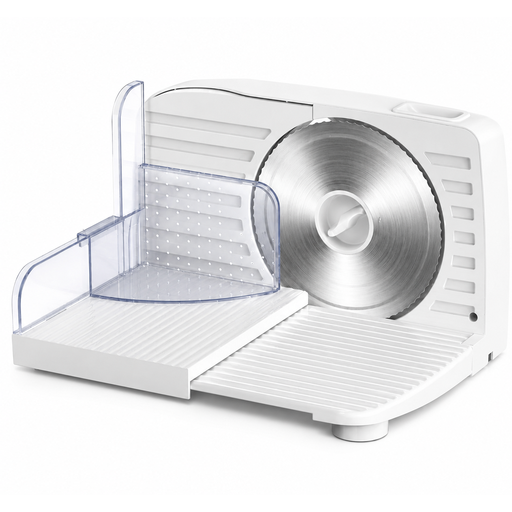 No image available
An option if you want to slice bread with an adjustable range of up to 15 mm.
Listed in the product name: 250 W, 0–15 mm and 2 blades; it doesn’t specify the type of either blade.
 No image available
An option if you’re considering a non-foldable electric slicer; check that the exact model suits your preferred slice thickness and available space.
The product name lists a metal construction, an angled design and a DC motor with electronic speed control.
 No image available
An option if you’re looking for a multifunctional slicer; check the slice thickness and dimensions you need for your bread.
The product name lists a removable carriage and a glass base.
 No image available
A foldable option if you want to put the machine away after use.
Listed in the product name: serrated blade, 0–15 mm, Ø 17 cm and 100 W.
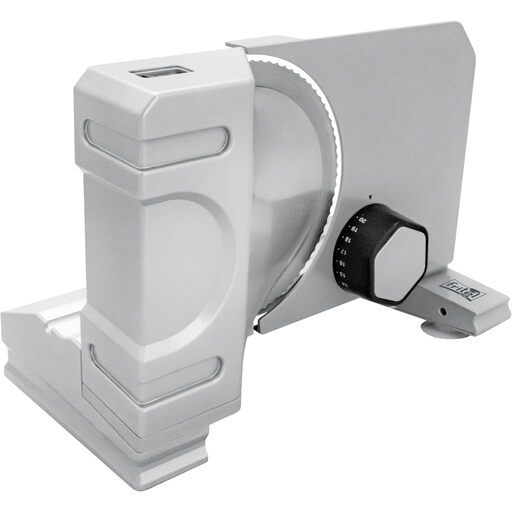 No image available
An option if you want to slice bread and other foods at different thicknesses; check that the stated range suits the way you’ll use it.
Listed in the product name: 0–20 mm, Ø 19 cm, 150 W, a universal blade and an angled carriage. The product description states a maximum of 10 minutes of continuous use, followed by 30 minutes to cool down.
Start with a model that specifies a serrated blade for bread, then compare its adjustment range with the slice thickness you want. FRITEL lists a serrated blade and 0–15 mm for the SL 3070; ritter lists a serrated blade and a maximum of around 20 mm for the E 16. These are manufacturer specifications, not a guarantee that every loaf will produce the same slicing results.
Switch off the appliance and unplug it before removing or cleaning any parts. Then follow the manual for your model. FRITEL lists a removable blade and carriage for the SL 3070; ritter says to unplug the E 16 before dismantling or cleaning it.
CE marking is compulsory for electrical products covered by the applicable Dutch regulations. The Netherlands Food and Consumer Product Safety Authority states that testing is not routinely compulsory for this product group, so CE marking is not proof of independent testing. Check the marking and product information for the specific model.
No. According to the Dutch government, there is no fixed statutory warranty period in the Netherlands; you’re entitled to a product that meets what you can reasonably expect from it. If there’s a fault, contact the retailer. A manufacturer’s warranty is additional.