
Vandaag of morgen in huis

Kwaliteit gegarandeerd

Welkomstaanbiedingen ontgrendelen: GRATIS bezorging | Tot 80% korting | Gratis 30 dagen JoyPlus-proefperiode
Download de app
An electric bread slicer can be handy for homemade bread, baguettes, cheese and cold meats. You get even slices more quickly and need to put in less effort than with a standard kitchen knife. However, not every home slicer is suitable for daily use. Some models take up more space than expected, while others offer few adjustment options or unclear safety features.
As a Joybuy Product Recommendation Officer, I filter the most important product specifications from the marketing text. This way, you can compare a bread slicer, electric meat slicer or multi-function slicer on the points that really matter in practice.
A higher wattage doesn’t automatically mean a device is better suited to your needs. A 100-watt motor can be sufficient for bread, cheese and cold meats in a domestic kitchen, whereas a food processor with 300 or 500 watts is intended for a different type of preparation. So also look at the blade, the drive mechanism, the maximum slice thickness and the stability of the appliance.
A compact slicer is nice in a British kitchen, but always check the dimensions in both folded and unfolded positions. A foldable slicer can save space, but it must be fully and stably unfolded during use. Also look out for a removable carriage, drip tray and crumb tray. These parts make cleaning easier.
A serrated blade stays sharp, even when the machine is small. So check whether the model has a safety switch, food holder and removable carriage. Unplug the appliance before removing the blade or cleaning parts. A lock or child-safe on/off switch is useful, but doesn’t replace supervision and safe use.
For sandwich slices, a range of 0-15 mm is suitable if you want to switch between thin and thicker slices. A thin setting works well for soft cold meats or cheese, while thicker-cut bread is less likely to fall apart. Check whether the adjustment is stepless or in fixed steps. With models offering a range up to 20 or 23 mm, you get more room for thick pieces of bread and larger portions.
A blade with a diameter of 17 cm is common on compact electric bread slicers. The diameter partly determines how much space you have for a loaf or other product. A slicer with a serrated blade is especially suitable for bread, because the serrations can cut through a crust. For cold meats and cheese, a smooth blade can be more practical. Some more advanced models therefore come with multiple blades.
Don’t just check the length, but also the depth and height. A device around 37 centimetres long can quickly take up a lot of space on a narrow worktop. Non-slip feet and a sturdy surface help to limit movement during slicing. A foldable model is handy for a kitchen cupboard, but only store it once the blade has stopped and the appliance has been unplugged.
A removable stainless steel blade, a detachable carriage and a drip tray reduce leftover crumbs and cutting residue. Always follow the manual for cleaning. Not every part is dishwasher-safe. Do not use water on the motor housing and never touch the cutting edge directly.
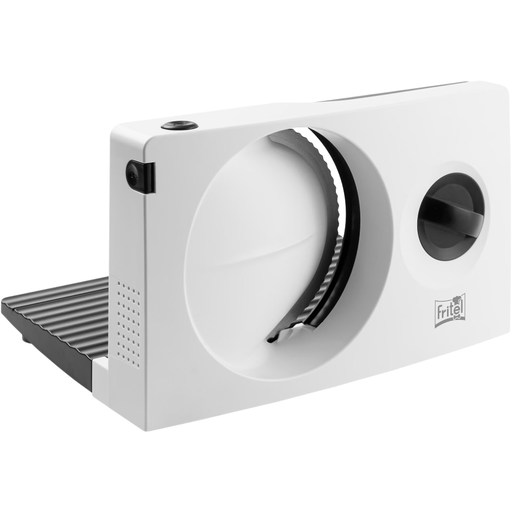
Why this fits the profile: This model is aimed at home use and homemade bread. The machine has a slice thickness of 0-15 mm, a 17 cm serrated blade and a foldable design.
The product specifications mention a child-safe on/off switch, removable carriage and drip tray. This means the most important safety and maintenance points can be checked in advance.
100 watts, slice thickness 0-15 mm, serrated stainless steel blade and a foldable size of approximately 36.7 x 22.2 x 10.8 cm.

Why this fits the profile: Suitable for those who regularly slice bread, meat and cheese and value a metal construction, a larger cutting width and multiple adjustment options.
The product description mentions a serrated blade for bread and a smooth blade for meat and cheese, among other things. An adjustable speed is also listed, allowing you to match the appliance to the product.
Fully metal construction, slice thickness up to 23 mm, removable carriage and electronic speed control according to the product description.

Why this fits the profile: For households that want to slice not only bread, but also cheese, cold meats, vegetables and fruit with one compact machine.
According to the product information, the SL 3110 has a removable carriage with a residue holder, a serrated stainless steel blade and a foldable design. This supports maintenance and storage, as long as you follow the safety instructions.
100 watts, blade diameter 170 mm, slice thickness 0-15 mm and dimensions of approximately 37.5 x 23 x 14.5 cm.
We have compiled a full, up-to-date list of products that fully meet these strict selection criteria and comply with current European safety regulations.
Place the machine on a stable, dry and level surface. Set the slice thickness before switching the appliance on and use the food holder for smaller pieces. Gently push the bread or meat along the blade; forcing it can cause the product to shift. Switch the machine off, unplug it from the socket and wait until the blade has stopped before removing the carriage or blade.
An electric bread slicer is not the same as a food processor. An electric meat slicer is intended for slicing larger pieces of cold meats, whereas a food processor breaks ingredients into smaller pieces. If you want to slice both bread and meat, check whether the model is explicitly suitable for that purpose. The term slicer for bread and meat alone doesn’t tell you how many types of blades or what capacity are included.
Yes, many models are designed for this, especially when they have a serrated blade and an adjustable slice thickness. Allow very fresh, soft bread to cool sufficiently first. This helps preserve the structure better and reduces crumb build-up around the carriage.
The consumption depends on the motor power and the duration of use. A 100-watt model theoretically uses 0.1 kWh per hour the motor runs. In practice, the motor is usually only switched on for short periods. You can calculate the cost using: consumption in kWh × your current electricity rate.
That depends on use, cleaning and storage. A removable blade can make maintenance easier, but wear is still possible. Check the warranty, available parts and cleaning instructions when purchasing. An appliance that is stored dry and safely after use prevents unnecessary strain on the blade and motor.
