
For slicing crusty bread
If you want to slice a firm, whole loaf just before guests arrive, compare the blade and adjustable thickness settings. Graef and FRITEL specify a wavy or serrated blade for bread on certain models.


First, choose an electric slicer whose manufacturer specifies a serrated or wavy bread blade. Then check the adjustable slicing thickness and the space needed for the bread and carriage. A foldable model can be handy if you want to put the machine away after use; a fixed model needs a permanent spot. Manufacturer specifications describe the model, but they are not an independent slicing test.
If you want to slice a firm, whole loaf just before guests arrive, compare the blade and adjustable thickness settings. Graef and FRITEL specify a wavy or serrated blade for bread on certain models.
If you don’t use the machine every day and want to put it away after use, compare its folded dimensions with your available cupboard space, as well as the room it needs while slicing. FRITEL and ritter describe foldable models.
If you’re considering one machine for bread and other foods, check which blades come with the exact model and how to clean them. Severin specifies an additional ham blade for the AS 3915.
Start with the bread blade and the thickness you want. Then compare the available working space, storage dimensions, and the instructions for safe use and cleaning.
| What to consider | What should you check? | Who is this important for? |
|---|---|---|
| Bread blade for a crusty loaf | Check the blade type and which blades are included as standard with the exact model. | If I’m slicing a firm loaf just before guests arrive, I want to know whether the blade supplied is suitable for the crust. Around 33% of consumers rank the bread blade as their top priority. |
| Adjustable slicing thickness | Compare the stated adjustment range and controls; separately check whether your loaf will fit on the carriage. | If you want to slice bread ahead of guests arriving, look for a range that suits your preferred thickness. Around 27% of consumers prioritise this adjustment feature. |
| Working space and storage | Measure both your storage space and the worktop area needed for the machine, carriage and loaf. | If I want to put the machine away after occasional use, it still needs to fit on my worktop while I’m slicing. Around 20% of consumers say storage is their main consideration. |
| Controls and cleaning | Check the food holder, switch and cleaning instructions for the exact model. | If you want to use the moving blade carefully or use the machine for different foods, take the safety and cleaning instructions into account. Around 20% of consumers prioritise safe, hygienic use. |
The power rating doesn’t tell you which blade is included or what slicing thickness you can select. Manufacturers specify these features separately.
Check the bread blade, adjustment range and space needed for the loaf first. Don’t treat the power rating as proof of better slicing performance.
According to the manufacturer, the ritter markant⁷ is 10.5 cm wide when folded and 26.5 cm wide when in use. You’ll also need room for the carriage to move.
Measure your storage space and worktop separately, then compare both with the dimensions of the exact model.
Voedingscentrum warns that pathogens can spread to other food via equipment that has been in contact with raw food.
Keep raw products separate from bread that will be eaten straight away. Clean used parts according to the instructions before slicing anything else.
ACM ConsuWijzer explains that your statutory rights exist alongside any warranty offered by the retailer or manufacturer.
Check what your statutory rights and the retailer’s terms already cover before considering additional protection.
The SKS100 is a fixed multi-purpose slicer for anyone looking for a wavy bread blade.
The SL 3110 is a foldable option for anyone who slices bread occasionally and wants to put the machine away.
The markant⁷ is a foldable slicer with a serrated bread blade.
The DO523S is a foldable option for anyone who wants to slice bread and other foods.
The AS 3915 is an option if you’re considering a second blade for other slicing jobs as well as bread.
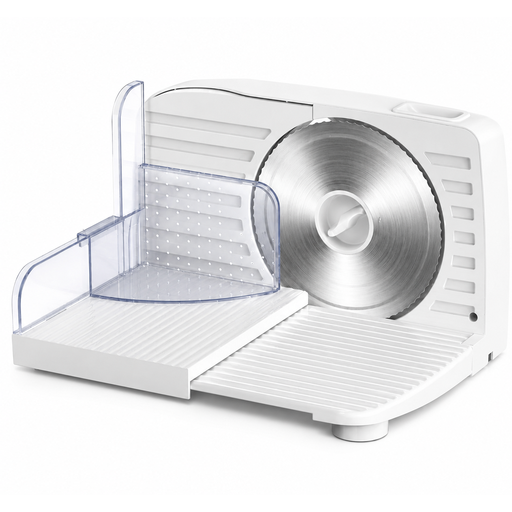
These Joybuy products are electric slicers for bread or a range of slicing tasks. For each model, check that the blade and adjustable thickness settings are suitable for crusty bread.
 No image available
The product name refers to bread slicing and adjustable thickness; compare the range with the thickness you want to serve.
Adjustment range: 0–15 mm. Two blades. Power: 250 W.
 No image available
The product name describes an electric slicer. Check whether the model on offer is suitable for crusty bread and your preferred slicing thickness.
 No image available
An option to consider if you’re looking for one machine for different slicing tasks. For crusty bread, check which blade and slicing thickness come with the model on offer.
The product name specifies a metal construction, removable carriage and glass base.
 No image available
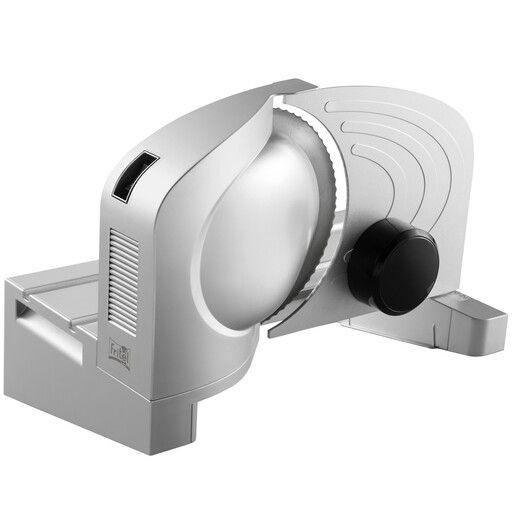
The product name specifies bread slicing and a serrated blade; compare the adjustment range with your preferred slicing thickness.
Adjustment range: 0–20 mm. Blade diameter: 17 cm. Power: 160 W. The title specifies a carriage angled at 15°.
 No image available
The product name specifies a serrated bread blade and a foldable design, which may suit you if you want to put the machine away after use.
Adjustment range: 0–15 mm. Blade diameter: 17 cm. Power: 100 W.
It depends on the instructions for the model. The blade on the FRITEL SL 3110 is removable, according to FRITEL, but it isn’t dishwasher-safe. Switch off the machine and follow the model-specific instructions before removing any parts.
Keep raw products separate from bread that will be eaten straight away. Voedingscentrum recommends using clean kitchen utensils and washing knives thoroughly with hot water between tasks to prevent cross-contamination.
No. ACM ConsuWijzer explains that your statutory rights exist alongside any warranty from the retailer or manufacturer. What you can reasonably expect from a product under normal use is relevant; the retailer is responsible for providing an appropriate solution if a product is faulty.
According to the Netherlands Food and Consumer Product Safety Authority, electrical equipment with a rated AC voltage of 50–1000 V falls under the Low Voltage Directive. The relevant safety requirements and CE marking requirements apply to equipment within this range. Check the product information and safety instructions for the model on offer; a CE mark is not an independent performance test.