
A loaf with a firm crust for guests
If you want to slice several pieces during a get-together, consider the blade, the space available for the loaf and the adjustable slice thickness.


For bread with a firm crust, first consider the blade type, the space available for the loaf and the slice thickness you want. Graef says the SKS110’s serrated blade is suitable for hard crusts, but that does not guarantee a particular result with every loaf. A larger model may offer more room, while a foldable one may be easier to store. Also check the controls, the instruction manual and the CE marking on the specific appliance.
If you want to slice several pieces during a get-together, consider the blade, the space available for the loaf and the adjustable slice thickness.
If the thickness you want depends on the bread or how you plan to serve it, the stated adjustment range is a useful point of comparison.
If you have limited storage space, compare foldable models and check which parts the manual says can be removed.
Good for: a large loaf and plenty of worktop space. DOMO lists a 22 cm blade and a maximum food height of 16 cm for the DO522S.
Trade-off: the stated width of the DO522S is 42 cm, so measure the space available on your worktop too.
Good for: anyone who wants to put the appliance away after use. Severin and FRITEL list foldable models with adjustment ranges of up to 15 mm.
Trade-off: being foldable does not tell you whether a large loaf will fit on the carriage. Check the usable space and the slice thickness you want.
Good for: anyone who also wants to cut thicker slices. Graef lists a continuously adjustable 0–20 mm setting for the SKS110; ritter gives an adjustment range of up to around 20 mm for the E 16.
Trade-off: ritter specifies a five-minute operating cycle for the E 16. Follow the model-specific instructions if you’re slicing a lot of bread in one go.
| What to consider | What should you check? | Who should pay extra attention? |
|---|---|---|
| Crust and space for the loaf | Check the blade and the maximum height or feed capacity of the specific model, then compare these with your loaf. | If I want to slice a firm loaf for guests, I look at both the blade and whether the loaf will fit comfortably on the carriage. Around 33% of consumers prioritise crust and loaf size. |
| Slice thickness | First decide on the thickness you want, then compare it with the adjustment range of the exact model. | If I want to adjust slices to suit the bread and how it will be served, I check that the settings allow for this. Around 27% of consumers prioritise their preferred slice thickness. |
| Controls and safety | The NVWA states that CE marking is mandatory for electrical appliances. Check the marking and safety information for the specific appliance. Also check which carriage and end-piece holder are specified. | If I’m working with a rotating blade and want to handle the last piece of bread too, I want to know what safety features and accessories the manual recommends. Around 20% of consumers prioritise safe operation. |
| Storage and cleaning | Compare how much space the appliance takes up during use and when stored. Clean or remove parts only as instructed in the manual. | If I have limited cupboard space and want to clean the machine after a get-together, I look at how it stores and which parts can be removed. Around 20% of consumers prioritise storage and cleaning. |
Wattage and blade diameter do not provide a like-for-like practical measure of how well different models slice the same hard-crusted loaf.
Start with the type of blade, the size of your loaf, the slice thickness you want and the space on your worktop.
A foldable base can make storage easier, but it does not tell you how much space there is on the carriage.
Check the usable space for the loaf and compare it with the dimensions of the bread you want to slice.
DOMO describes the DO522S as a larger slicer that can also be used for bread. Compare the stated capacity if you want to slice a taller loaf.
The SKS110 is worth considering if you’re comparing serrated blades and adjustment ranges of up to 20 mm.
The AS 3912 is an option to compare if you’re looking for a foldable slicer with adjustable slice thickness.
The E 16 is a metal slicer with a serrated blade and a manufacturer-specified adjustment range of up to around 20 mm.
The SL 3110 is an option to compare if you’re looking for a foldable slicer with a serrated blade.
This Joybuy selection includes electric slicers whose product information mentions bread or adjustable slice thickness. Before use, check the dimensions, the parts supplied and the safety information for the exact model.
 No image available
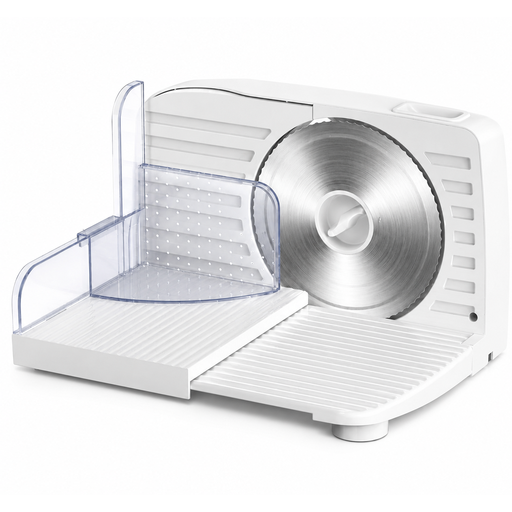
This foldable model is worth considering if you want to store the slicer away after use.
The product name specifies a 17 cm stainless steel blade, an adjustment range of 0–15 mm and a power rating of 180 W.
 No image available
A general option to compare if you’re looking for an electric bread slicer.
The product name specifies two blades and an adjustment range of 0–15 mm.
 No image available
This electric slicer is worth comparing if you want to assess a model for bread based on its specific features.
 No image available
The product name specifies a removable carriage, which may be useful when checking how to clean the machine according to the manual.
The title specifies a metal construction and a glass base plate.
 No image available
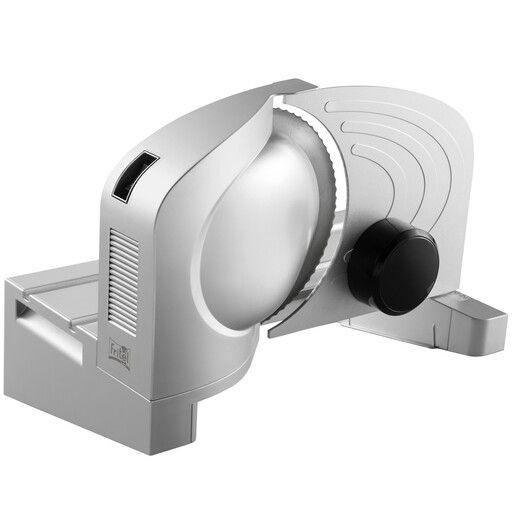
A model with a serrated blade to compare if you want to slice bread. Check that the stated settings suit your preferred slice thickness.
The product name specifies an adjustment range of 0–20 mm, a 17 cm blade, 160 W and a carriage set at a 15° angle.
Compare the height and shape of your loaf with the space the manufacturer specifies for the food, and check the carriage. DOMO lists a maximum height of 16 cm for the DO522S; this measurement does not automatically apply to other models.
Follow the operating time and any required breaks in the manual for the exact model. ritter specifies a five-minute operating cycle for the E 16; this is not a general limit for all slicers.
Switch off the machine and unplug it before removing or cleaning any parts, then follow the model’s manual. ritter explicitly instructs you to do this for the E 16.
According to the Netherlands Food and Consumer Product Safety Authority, CE marking is mandatory for electrical products. Check the marking and safety information for the specific appliance; a general product description does not confirm that a particular model complies.
In the Netherlands, a product must be of satisfactory quality, and the seller must provide a solution if a fault is justified. The Dutch Government states that there is no fixed statutory guarantee period; the outcome depends, among other things, on the fault, how the product has been used and what you could reasonably expect from it.