
For anyone who wants to slice crusty bread
You want even slices of crusty bread after an evening class. Compare the blade type, adjustable thickness and carriage space; specifications can’t predict exactly how your bread will be sliced.


A serrated blade, adjustable slice thickness and a carriage that fits your loaf are all important when choosing an electric bread slicer for crusty bread. A fold-away model is handy if you’re short on storage space; for larger loaves, pay extra attention to the stated feed-through dimensions and the space it takes up on your worktop. None of the specifications mentioned can, on its own, prove how a machine will slice your bread. Safe use and cleaning are important too.
You want even slices of crusty bread after an evening class. Compare the blade type, adjustable thickness and carriage space; specifications can’t predict exactly how your bread will be sliced.
You want to slice a few pieces and then put the appliance away. A fold-away model could work well, as long as your loaf fits within the stated dimensions.
After a long day, you want to use the slicer with control and be able to clean it easily. Check the carriage, food holder and switch, and unplug the appliance before cleaning, following the instructions in the manual.
First, check that your loaf will fit on the carriage and decide what slice thickness you want to set. Then consider how much space you have and how you’ll clean the appliance after use.
| What to consider | What should you check? | Who is this important for? |
|---|---|---|
| Crust and slice thickness | Check the blade type, thickness range and stated maximum height of the food to be sliced for the exact model. | After an evening class, I want to slice crusty bread to my preferred thickness. Around 33% of consumers take crust and slice thickness into account. |
| Operation | See how the switch works and whether a food holder is included; follow the instructions for your model. | When I’m slicing late in the evening, I want to be mindful of where I place my hands and use the appliance with control. Around 27% of consumers put safe operation first. |
| Storage | Compare how the appliance folds and stores with the space you have available; also check that your loaf will fit on the carriage. | With limited cupboard space, I want to be able to put the slicer away easily after cutting a few slices. Around 20% of consumers put storage first. |
| Cleaning | Check whether the blade and carriage can be removed, and follow the cleaning instructions for the exact model. | After slicing, I want to be able to remove crumbs and food residue carefully. Around 20% of consumers put cleaning after use first. |
Blade size or wattage alone won’t tell you whether your loaf will fit on the carriage or how the appliance will cut through a particular crust.
Compare the exact model with the dimensions of your loaf and the slice thickness you want. Don’t treat manufacturer claims as comparative slicing tests.
A fold-away slicer still needs cleaning after use. If the model has removable parts, make sure you know how to take them off and put them back safely.
Before you buy, check how to remove the blade and carriage and which parts come with the exact model. The DOMO manual for the DO523S recommends cleaning after every use and says to unplug the appliance first.
Allow time for cleaning. If you need to replace model-specific parts, check that they’re available for your model.
In the Netherlands, the Dutch government says there is no fixed statutory warranty period of two years. If a product is faulty, contact the seller; a manufacturer’s warranty is separate from your statutory protection.
Keep your proof of purchase and check what additional cover a warranty provides beyond your statutory rights.
The SL 3110 is a fold-away all-purpose slicer for foods including bread; the SL 3080 is a different model with a different stated thickness range.
The fold-away DO523S and the larger DO522S involve different trade-offs when it comes to storage and loaf size.
The E 16 is a slanted metal model worth comparing if you’re looking for variable slice thickness.
According to the manufacturer, the AS 3912 has a folding base plate for compact storage.
The S52200 is a metal model worth comparing if you have the space and want a wide range of slice thicknesses.
These Joybuy products are electric slicers for anyone looking to slice bread and considering features such as adjustable thickness, storage, operation or cleaning. Compare the stated features with your loaf and kitchen space.
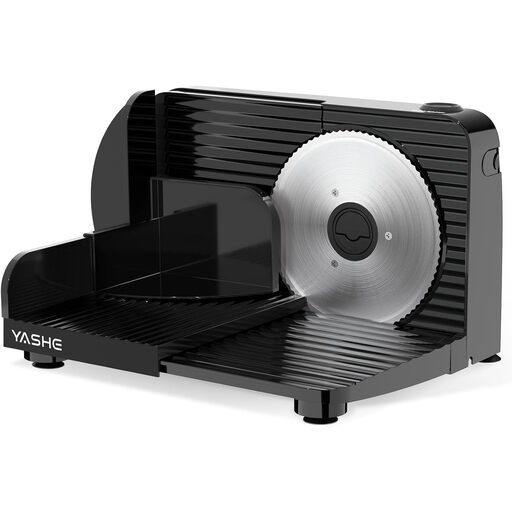 Image unavailable
A foldable model for anyone looking to save space after use and adjust the slice thickness.
17 cm blade; adjustable thickness of 0–15 mm; 180 W power; stainless steel blade, according to the product name.
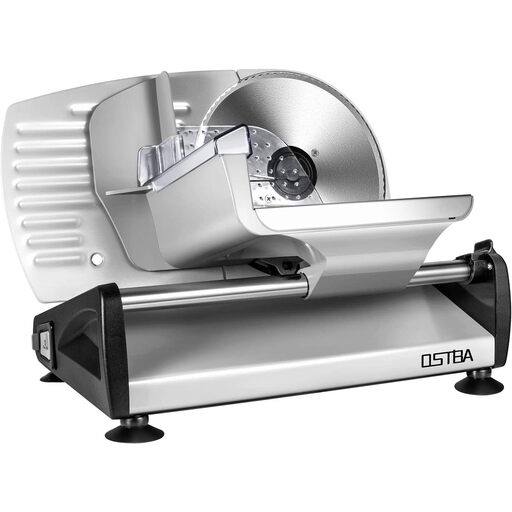 Image unavailable
A model worth comparing if the stated blade diameter and adjustable slice thickness matter to you.
19 cm blade; adjustable thickness of 0–15 mm; child lock; 150 W power.
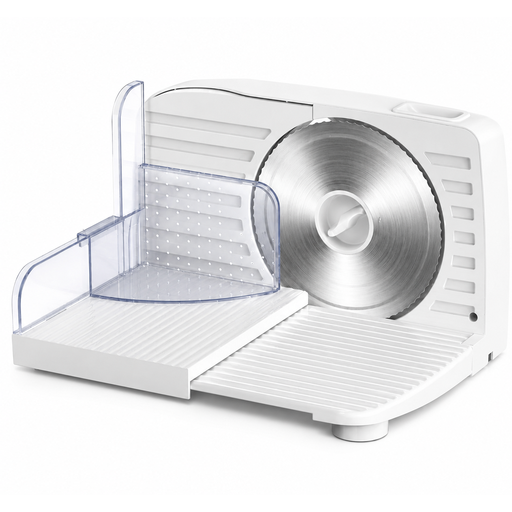 Image unavailable
A model worth comparing if you’re looking for adjustable slice thickness and two blades.
Adjustable thickness of 0–15 mm; two blades; 250 W power.
 Image unavailable
A model worth comparing if a metal construction and removable carriage suit the way you use and clean the appliance.
Metal construction; removable carriage, according to the product name.
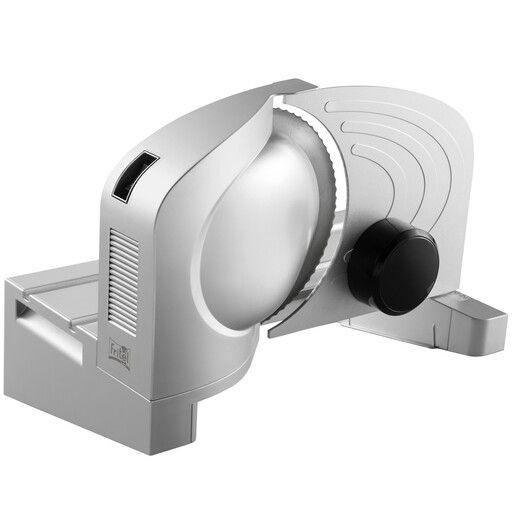 Image unavailable
A model worth comparing if you’re looking for a serrated blade, an angled carriage and a wider stated thickness range.
Adjustable thickness of 0–20 mm; 17 cm blade; 160 W power; 15° angled carriage, according to the product name.
Compare the height and shape of your loaf with the feed-through dimensions of the exact appliance. DOMO lists a maximum height of 15 cm for the DO523S and 16 cm for the DO522S; these dimensions don’t guarantee that every loaf shape will fit.
Follow the manual for your model. The DOMO manual for the DO523S recommends cleaning after every use, instructs you to unplug the appliance first and says not to immerse it in water. Don’t apply these model-specific instructions to other appliances without checking.
In the Netherlands, you should contact the seller if a product is faulty. According to the Dutch government, the statutory warranty has no fixed two-year period; a manufacturer’s warranty is separate from your statutory protection.
The Netherlands Food and Consumer Product Safety Authority states that CE marking is compulsory for electrical products. The NVWA describes the requirements of the Low Voltage Directive for electrical equipment with a rated AC voltage of 50V to 1000V. Check the product information for the version you’re buying; CE marking doesn’t indicate how well the machine slices bread.