
Crusty bread slicer
You mainly want even slices of bread with a firm crust, so you’re comparing the blade shape, carriage and adjustable slice thickness.


For crusty bread, start by choosing a model whose manufacturer specifies a serrated or scalloped blade. Then check whether the bread will fit on the carriage and whether you can set your preferred slice thickness. In a shared kitchen, safe operation, accessible parts for cleaning and storage space also matter. Manufacturer specifications can help you weigh up your options, but they aren’t a comparative slicing test.
You mainly want even slices of bread with a firm crust, so you’re comparing the blade shape, carriage and adjustable slice thickness.
You share the worktop and appliance with others, so ease of use, safety features and storage all play a part in your choice.
After use, you want to be able to reach crumbs and food-contact parts, and clean the machine safely.
Start by checking that your bread will fit on the carriage and that the slice thickness suits you. Then compare safe operation, the worktop and storage space available, and how the parts can be cleaned.
| What to consider | What should you check? | Who is this important for? |
|---|---|---|
| Crust and slice thickness | Check the specified blade shape and diameter, carriage space and adjustable slice-thickness range for the exact model. | If I want to slice bread with a firm crust and need a particular slice thickness, I’ll look at the blade and settings; around 29% of consumers put crust and slice thickness first. |
| Safe use in a shared kitchen | Check which version has a food holder, finger guard, safety switch or locking carriage. | When several people in the household use the machine, I want the controls and carriage to be straightforward to use; around 29% of consumers make safe operation their top priority. |
| Worktop space and storage | Measure the space available while the machine is in use, the room needed for the carriage to move and the place where the appliance will be stored. Check whether the model folds away. | If I share a worktop with others, I want to be able to put the machine away after use without it getting in the way while I’m slicing; around 21% of consumers prioritise limited kitchen space. |
| Cleaning and maintenance | Check which parts can be removed and follow the model-specific instructions for switching off, unplugging and cleaning. | After everyone has used it, I want to remove crumbs and leave the machine clean for the next person; around 21% of consumers put easy maintenance first. |
Power alone doesn’t tell you how well a machine slices bread. For the Clatronic MA 3585, the manufacturer and the specifications on a Joybuy product page state 150 W, while the shop title says 500 W.
Compare the model number and specifications with information from the manufacturer. Also consider the blade, carriage and slice thickness you need.
Folding the machine away can make storage easier, but when it’s in use there still needs to be room for the machine, the bread and the moving carriage.
Measure both the storage space and the available worktop, and check the size of your bread before choosing a model.
An accessible blade is sharp. Cleaning while the machine is plugged in or the blade is moving poses an unnecessary risk.
In a shared kitchen, agree on who will clean the machine and follow the model’s instructions. Unplug it before cleaning.
The SL 3070 is a folding bread slicer for anyone who wants to put the appliance away after use.
The SKS100 is a food slicer to consider if a locking carriage is important to you.
The T190 is a larger food slicer for anyone who wants the option of setting a thicker slice.
The DO521S is a food slicer with a food pusher and removable blade.
The MA 3585 is a metal food slicer with a scalloped blade and food holder.
These Joybuy products are electric food slicers for bread, with different slice-thickness settings and designs for shared use and storage.
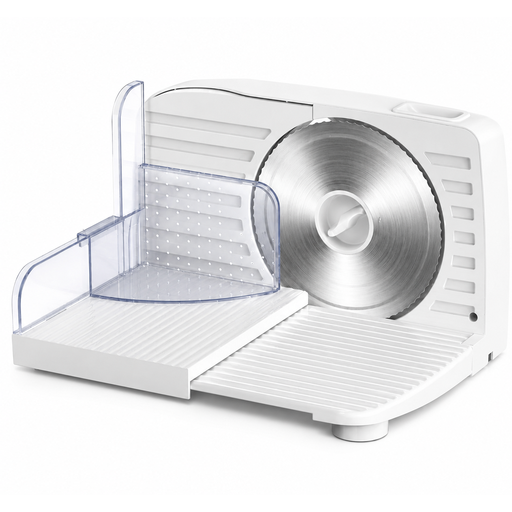 No image available
An option to consider if you want to slice bread with an adjustable slice thickness.
The product title specifies 250 W, a setting of 0–15 mm and two blades.
 No image available
An option if you want a serrated blade for bread and a removable carriage.
The product information specifies a slice thickness of up to 20 mm and a removable carriage.
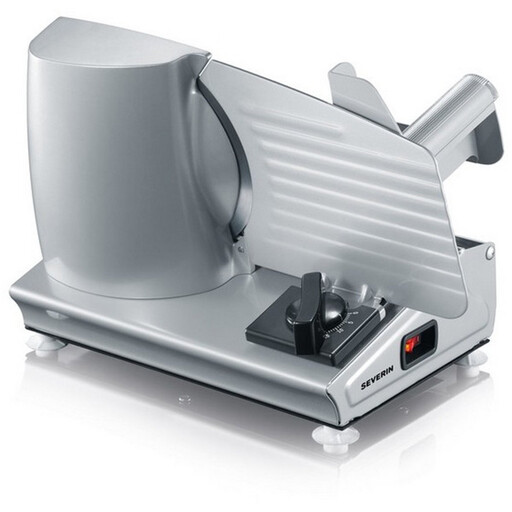 No image available
An option if you want to slice bread with adjustable slice thickness and a finger guard is important to you.
The product information specifies a serrated blade for bread, a setting of 0–15 mm and a finger guard. According to the product information, this model is not suitable for children.
 No image available
An option if you’re looking for a bread slicer that folds away after use.
The product information specifies a serrated blade of Ø 17 cm, a slice thickness of 0–15 mm, a removable carriage and a safety on/off switch.
 No image available
An option if you want to slice foods other than bread too, and need a wide slice-thickness range.
The product information specifies a slice thickness of 0–20 mm, a blade of Ø 19 cm and 150 W. According to the product information, use the motor for no more than 10 minutes at a time, then let it cool for 30 minutes.
Let warm or very soft bread cool first, then check that it fits on the carriage. The baker’s trade handbook lists product temperature, crust and crumb firmness as factors affecting slicing quality; this doesn’t predict the results you’ll get from a particular domestic model.
Switch the machine off, unplug it and never clean it while the blade is moving. Follow the instructions for your chosen model when removing the blade and carriage; a removable blade is still sharp.
No. According to ACM ConsuWijzer, your statutory rights exist alongside the manufacturer’s warranty. If a product breaks sooner than you could reasonably expect under normal use, the seller must offer an appropriate remedy at no cost; there is no fixed general two-year period for the statutory warranty.
Electrical equipment that falls within the applicable voltage limits of Directive 2014/35/EU and is placed on the market in the EU must meet the requirements of that directive. EUR-Lex gives limits of 50–1,000 V AC and 75–1,500 V DC. Check the power supply and marking for the specific version; a CE marking is not a comparative quality test.