
Batch bakers making several loaves
If you slice several loaves one after another, it’s worth considering the carriage, food holder and recommended running time. Magimix and Ritter list these model features for the T190 and E 16 respectively.


Start with a serrated blade designed for bread and an adjustable slice thickness that suits the slices you want to store. Then check the recommended running time per session, the carriage and the cleaning instructions. A foldable model can save storage space, while a larger one needs more room to work. Manufacturer specifications are useful for comparing models, but they are not an independent assessment of slicing performance.
If you slice several loaves one after another, it’s worth considering the carriage, food holder and recommended running time. Magimix and Ritter list these model features for the T190 and E 16 respectively.
Look for a serrated blade designed for bread and enough adjustment to achieve your preferred slice thickness. Ritter says a smooth blade is unsuitable for baked goods, particularly crusty bread; Graef specifies a serrated blade for the SKS110.
Compare the space needed to use the machine with the space available to store it afterwards. Fritel describes the SL 3070 as foldable; according to Magimix, the T190 measures 285 × 395 × 280 mm and weighs 5.7 kg.
First choose the blade and slice thickness that suit your bread. Then compare the permitted running time, cleaning requirements and storage space available.
| What to consider | What should you check? | Who should give this more weight? |
|---|---|---|
| Crust and slice thickness | Check that the blade is suitable for bread and find out what slice thickness the exact model can be set to. | If I’m slicing bread with a firm crust, I want a suitable blade and slices at my preferred thickness. Around 33% of consumers prioritise this. |
| Running time per session | Check the recommended running time and any breaks for the specific model in its manual. | When slicing several loaves one after another, I want to know how long I can use the machine for according to the manual. Around 27% of consumers focus mainly on session length. |
| Safe handling and cleaning | Check the food holder, controls and cleaning instructions for the exact model. | I want to be able to handle bread remnants and clean the machine according to the instructions. Around 20% of consumers rank this above their other buying concerns. |
| Working and storage space | Measure the space available and compare it with the model’s dimensions and carriage. | If worktop or cupboard space is limited, I want to know in advance where the machine will fit during and after use. Around 20% of consumers prioritise space. |
A control setting doesn’t automatically tell you how long an appliance can run continuously. Ritter specifies a duty cycle of 5 minutes for the E 16.
For the exact model, compare the recommended running time and breaks with how long you need to slice your loaves.
The maximum slice thickness and usable carriage also determine whether a model is suitable for your bread. Fritel specifies a maximum of 15 mm for the SL 3070, Graef specifies a maximum of 20 mm for the SKS110, and Magimix specifies a maximum of 28 mm for the T190. These are the manufacturers’ specifications for those models.
As well as checking the blade and slice thickness, make sure your bread will fit on the carriage.
For the Clatronic MA 3585, the Joybuy title found lists 500 W, while Clatronic and the specifications table on that Joybuy page state 150 W.
Before choosing a version, check any conflicting information against the full model name and the manufacturer’s documentation.
Fritel describes the SL 3070 as a foldable bread slicer, making it worth considering if compact storage is important to you.
According to Magimix, the T190 is designed for bread and other foods, and has an extra-wide carriage.
Graef describes the SKS110 as a compact all-purpose slicer with a serrated blade, also designed for bread with a firm crust.
The E 16 is a good reminder to check the recommended running time for the exact model when slicing several loaves.
Clatronic describes the MA 3585 as a metal all-purpose slicer, suitable for foods including bread.
This selection features electric slicers suited to slicing bread, adjusting slice thickness or saving storage space. Check which features apply to your needs for each version.
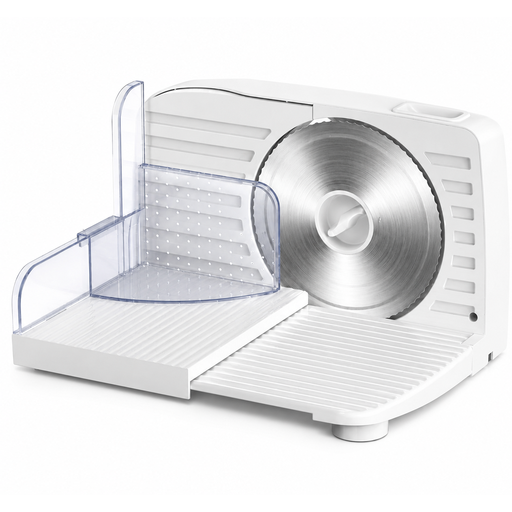 No image available
An option to consider if you’re looking for an electric slicer with adjustable slice thickness for bread.
The product name specifies 250 W, a setting of 0–15 mm and 2 blades.
 No image available
Worth a look if you’re considering an electric slicer for slicing bread.
 No image available
An option to consider if you’re looking for an electric slicer with adjustable slice thickness for bread.
The product name specifies a removable carriage and a glass base.
 No image available
The product name mentions bread slicing and a foldable design, making it worth a look if you want to save storage space.
The product name specifies a serrated blade, 0–15 mm, Ø 17 cm and 100 W.
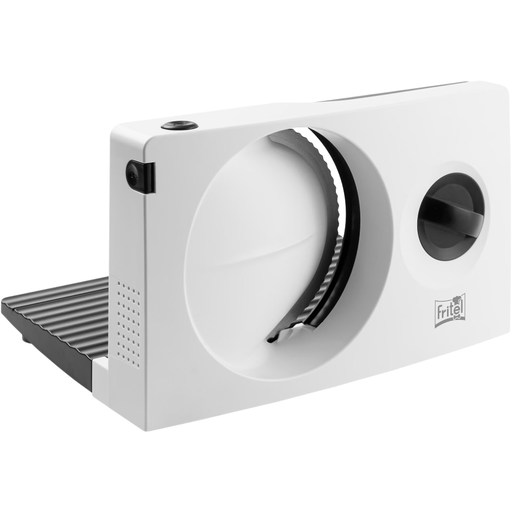 No image available
A foldable model to consider if you want to save space after slicing.
Fritel specifies a 170 mm serrated blade, a food holder and a slice thickness of 0–15 mm for the SL 3070. The product name also specifies 100 W.
Ritter says a smooth blade for ham and sausage is unsuitable for baked goods, especially crusty bread. Check that the blade supplied with the exact model is designed for bread.
That depends on the model and the running time given in the manual. Ritter specifies a duty cycle of 5 minutes for the E 16; for other models, follow their own running-time and break instructions.
Unplug the machine before removing any parts or cleaning it, and follow the manual for the exact model. Ritter explicitly instructs users to unplug the machine before dismantling and cleaning it.
Freeze the bread in portions you’ll need later. The Voedingscentrum recommends freezing bread in portions and notes that it can become drier if frozen for longer. Follow suitable storage advice for homemade bread too.
Yes. The Netherlands Food and Consumer Product Safety Authority states that CE marking is compulsory for electrical consumer products. CE marking is not the result of testing each individual appliance, and does not in itself prove that a particular item is safe.