
Vandaag of morgen in huis

Kwaliteit gegarandeerd

Welkomstaanbiedingen ontgrendelen: GRATIS bezorging | Tot 80% korting | Gratis 30 dagen JoyPlus-proefperiode
Download de app
Homemade bread, cheese, cold meats and vegetables can be tricky to slice evenly with an ordinary kitchen knife. An electric bread and meat slicer can save time and make it easier to adjust the thickness for a sandwich, sharing platter or hot meal. However, not every model is designed for the same tasks.
When comparing models, look beyond the wattage or an appealing product photo. Slice thickness, the blade, safety and ease of cleaning are what really determine whether a bread slicer or meat slicer remains easy to use every day.
A higher wattage doesn’t automatically mean a machine is suitable for every task. A 100 or 150-watt motor may be perfectly adequate for regularly slicing bread and cold meats, while more intensive use calls for closer attention to the drive, cooling and operating time.
So, as well as checking the power, find out:
For example, the Fritel SL 3710 is specified for a maximum of 10 minutes’ continuous use, followed by 30 minutes to cool down. This is useful information for households that want to slice a lot of food in one go.
A serrated blade is handy for bread with a hard crust, but it isn’t always the best choice for thin slices of meat or soft cheese. A smooth blade generally gives a different slicing experience from a serrated bread knife.
A versatile slicer is therefore worth considering if:
According to the product specifications, the Severin AS 3915 comes with two blades: a smooth blade for fine slices and a serrated blade for bread. Always check the instruction manual for approved uses.
A slicer has a sharp, fast-moving blade. A low-cost or compact housing isn’t automatically unsafe, but check that the appliance has a finger guard, food holder, non-slip feet and a safety switch.
A foldable model can be handy in a UK kitchen with limited cupboard space. When folded, the blade is also less accessible. This doesn’t replace safe storage: always unplug the appliance and keep it out of children’s reach.
Adjustable slice thickness determines how thick or thin the slices will be. A range of 0 to 15 mm suits many everyday uses, including bread, cheese and cold meats. Models offering 0 to 20 mm give you more scope for thicker slices.
Check whether the setting is continuously adjustable or has fixed positions. A continuously adjustable dial gives you more control, although the way the measurement is shown can vary between models. Always use the food holder for very thin slices, and don’t apply excessive pressure.
The blade diameter gives you an indication of the maximum cutting capacity. A 170 mm blade is often suitable for standard loaves, blocks of cheese and cold meats. A 190 mm blade can accommodate larger pieces, but usually means a bigger appliance too.
Measure the space available on your worktop beforehand. As well as the machine’s length and width, check its height and how much room the carriage needs. A metal carriage or stop plate can feel sturdy, while a removable carriage makes cleaning easier.
Crumbs, grease and small food scraps can collect around the blade and carriage. So, choose a food slicer with a removable blade, detachable carriage or collection tray if these features suit the way you plan to use it.
Important safety features include:
A slicer with safety features still needs to be used carefully. Don’t touch the blade while it’s moving, and never use your bare fingers to push small pieces of food towards it.
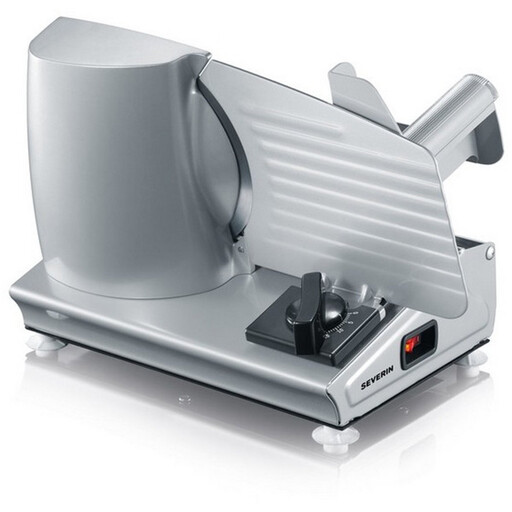
Why it suits this profile: This model combines an adjustable slice thickness of 0 to 15 mm with 180 watts of power and two blades. It’s a good fit for households that want to alternate between slicing bread, cheese, cold meats and vegetables.
The product specifications list two blades and a stainless steel sliding plate with a finger guard. That means you don’t need a separate appliance for every task.
Continuously adjustable from 0 to 15 mm, 180 watts, smooth and serrated blades, rubber feet and a 131 cm cable.

Why it suits this profile: The listed specifications are a good match for keen home cooks who want plenty of control when slicing bread, meat and cheese.
The description lists a smooth and a serrated blade, slice thickness of up to 23 mm, a removable carriage and electronic speed control. Check exactly which parts are included before buying.
All-metal construction according to the product description, 0–23 mm slice thickness, variable speed control and a 24 cm cutting path.
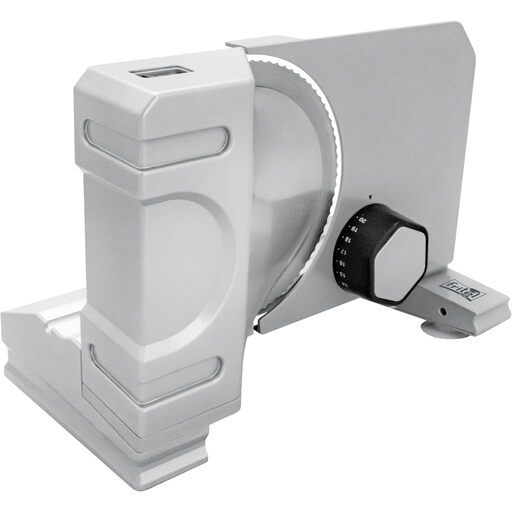
Why it suits this profile: This kitchen slicer is designed for people who want to slice bread, charcuterie, cheese, vegetables and meat to different thicknesses.
The 15° angled carriage, non-slip feet and end-piece holder are designed to help you slice with control. The stated maximum operating time also prevents you from running the motor continuously for too long.
0–20 mm slice thickness, 190 mm blade diameter, metal housing, removable carriage and a gear-driven motor.
We’ve put together a complete, up-to-date list of products that meet these strict selection criteria and current European safety requirements.
Place the machine on a flat, dry surface before plugging it in. Ideally, set the slice thickness first and always use the supplied pusher. For small pieces, cutting by hand is often safer than trying to feed the last bit through the machine.
Follow this routine too:
Electrical appliances sold in the EU are covered by a statutory guarantee of conformity. The product information for the models mentioned generally states a warranty period of at least two years; check the current terms with the retailer.
That depends on the blade and the product specifications. A serrated blade is generally designed for bread, while a smooth blade may be better suited to cold meats and cheese. Check whether both blades are included and whether the manufacturer lists the foods you want to slice.
Many domestic models offer a range of 0 to 15 mm. Other models go up to 20 or 23 mm. The practical maximum thickness also depends on the blade diameter, the carriage and the size of the food.
Energy use depends on the power and how long the appliance is running. A 100-watt appliance running for a few minutes uses relatively little energy per slicing session. A higher wattage can use more electricity during prolonged use. So, check both the power and the recommended operating time rather than looking at either figure on its own.
