
Preparing lunch eggs ahead
You cook hard-boiled eggs in one go for several lunches and care most about having enough capacity and keeping them chilled. The Voedingscentrum advises storing hard-boiled eggs in their shells in the fridge.


If you usually cook one or two eggs at a time for lunch, a compact model is an obvious choice. If you prepare eggs ahead for several lunches, compare the capacity of models that hold one to seven eggs too. Hard-boiled eggs are practical to store according to the Voedingscentrum (Netherlands Nutrition Centre); also choose controls that suit how you want to set the doneness. Before buying, check that the specific unit for sale carries the required CE marking, as this has not been verified for the models on this page.
You cook hard-boiled eggs in one go for several lunches and care most about having enough capacity and keeping them chilled. The Voedingscentrum advises storing hard-boiled eggs in their shells in the fridge.
You usually make eggs just for today’s lunch and don’t want a larger egg holder than you need. A model with a smaller capacity suits these modest portions.
You want to tailor the cooking to your preferred doneness, so you’re comparing a measuring cup for the water with an adjustable cooking time.
For lunch eggs in a small household, portion size, controls and ease of cleaning are the main things to consider. First, decide how many eggs you generally want to cook at once.
| What to consider | What to look for | Who is this most important to? |
|---|---|---|
| Capacity for batch cooking | Compare the number of eggs you can cook at once with the minimum and maximum capacity. For storage, follow the guidance appropriate to how well the eggs are cooked and whether they are still in their shells. | If I prepare several lunch portions ahead, I want to cook enough eggs in one go and then keep them chilled. Around 36% of consumers prioritise capacity. |
| Size for small portions | Check the capacity and stated dimensions of the model you’re considering; don’t rely on the word ‘compact’ alone. | If I usually cook just for today, I don’t want a larger holder than I need. Around 29% of consumers are mainly looking for a suitable size. |
| Controls for doneness | Check whether the instructions specify measuring the water or setting a cooking time, and how to use the relevant setting. | If I want to control how well the eggs are cooked, I want controls that are easy to follow. Around 21% of consumers give this need priority. |
| Cleaning after use | Compare the cleaning instructions for the holder, lid and base; check which parts the manual says are washable. | If I use the egg cooker regularly, I want to know which parts need cleaning afterwards. Around 14% of consumers put ease of maintenance first. |
A larger capacity can let you prepare several portions in one go, but it offers little benefit if you usually cook just one or two eggs.
Choose based on how many eggs you usually cook at once and how often you want to prepare them ahead.
Storage advice varies depending on how well the egg is cooked and whether it is still in its shell.
Follow the Voedingscentrum’s advice for the type of egg and keep it chilled.
The setting you need may depend on how the model works and on the eggs you use. Philips notes that factors such as egg size and starting temperature affect the amount of water required.
Start by following your model’s instructions, then adjust the cooking if the results differ with the eggs you usually use.
According to WMF, the KITCHENminis 415020011 is designed for one or two eggs.
Severin states that the EK 3163 holds up to three eggs and has electronic cooking-time control.
According to Rommelsbacher, the ER 300 is suitable for one to three eggs and has a dial to select the desired level of doneness.
Tristar states that the EK-3076 has a capacity of one to seven eggs.
Inventum states that the EK701B holds one to seven eggs and comes with a measuring cup for the water.
These Joybuy products are options to compare if you’re cooking small portions or preparing several eggs for lunch. The NVWA lists kitchen appliances as an example of electrical equipment that must carry CE marking. Before buying, check that the specific unit for sale has the marking.
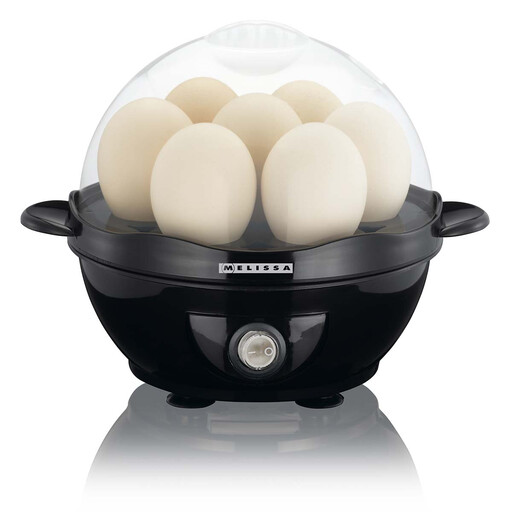 No image available
An option to compare if you sometimes want to cook several eggs for lunch at once.
Listed features: capacity for 7 eggs, measuring cup and audible signal.
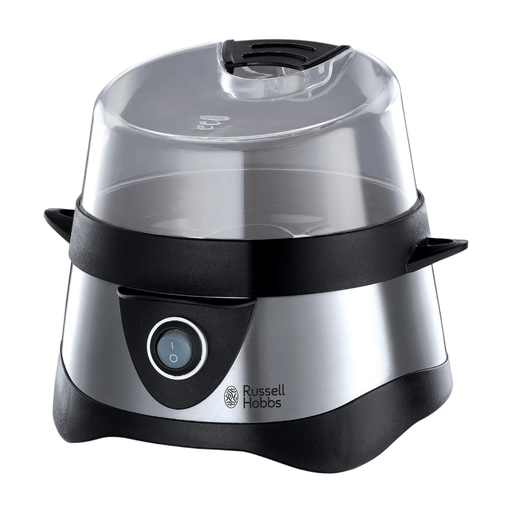 No image available
An option to compare if you’re looking for enough capacity to cook several eggs in one go.
Listed features: capacity for 7 eggs, 365 W, stainless steel finish and automatic shut-off.
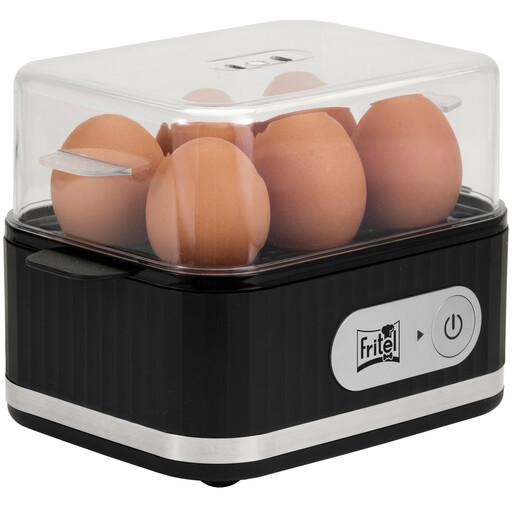 No image available
An option to compare if you want capacity to suit smaller or larger lunch portions.
Listed features: 1–6 eggs, 400 W, soft, medium or hard settings, measuring cup and egg piercer.
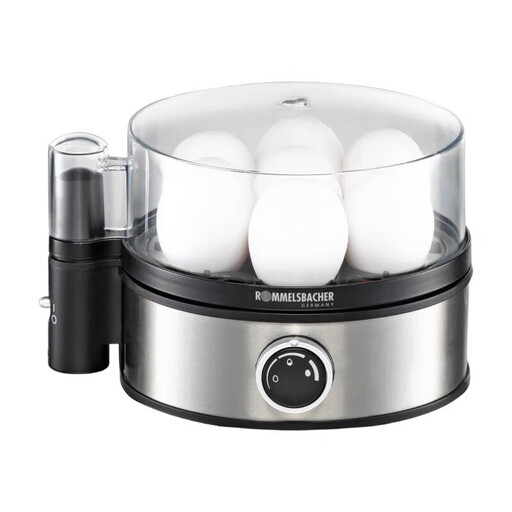 No image available
An option to consider if you’re looking for an egg cooker for small portions.
Check the capacity and controls of this version before buying.
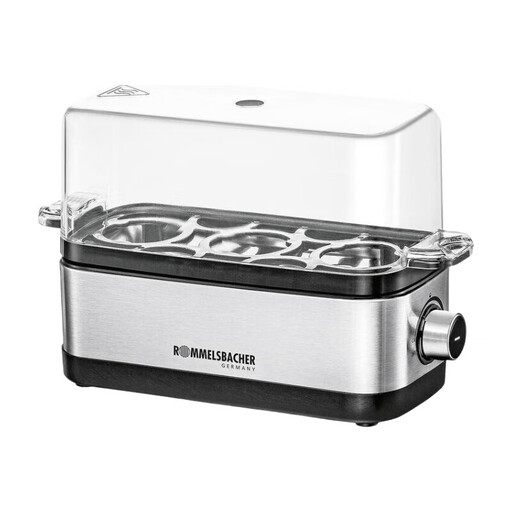 No image available
Suitable for small portions; according to Rommelsbacher, this model cooks one to three eggs.
The manufacturer says the ER 300 has a dial with electronic time control to set the desired level of doneness.
According to the Voedingscentrum, you can keep a hard-boiled egg in its shell in the fridge for up to a week. For a soft-boiled egg, the recommendation is no more than two days. A peeled egg will keep for two days in the fridge in a sealed container.
Plan to keep a lunch containing a cooked egg chilled, either in storage or during transport. The Voedingscentrum recommends a fridge temperature of 4 °C and advises not leaving perishable food out of the fridge for more than two hours. This general advice is not a separate shelf-life assessment for every type of cooked egg in a lunchbox.
Follow the instructions for the measuring cup or cooking-time control on your particular model, and stick to its cleaning guidance. Philips says factors such as the size and starting temperature of the eggs can affect the amount of water required; Inventum provides separate cleaning instructions for the EK701B.
No. According to the Dutch government, the Netherlands has no fixed statutory warranty period: you are entitled to a product that meets what you could reasonably expect from it. If a product is faulty, the retailer is your point of contact; any manufacturer’s warranty is in addition to this.
Yes. According to the NVWA, CE marking is required for electrical products, and kitchen appliances are classed as electrical equipment. Check the marking and the identity of the specific appliance being offered; CE is not a comparative quality rating.