
Cooking for several people
You’d ideally like to cook eggs for lunchboxes and a shared meal in one batch. So first check how many eggs the model can cook at a time.


Choose the capacity based on how many eggs you need to cook at a time: a model for up to three eggs may mean extra batches, while models for six or seven can cook more at once. Then compare how you set the doneness and whether it’s practical to cater for different preferences at the table. For lunchboxes, chilled storage and the CE marking on the specific appliance also matter.
You’d ideally like to cook eggs for lunchboxes and a shared meal in one batch. So first check how many eggs the model can cook at a time.
You cook eggs ahead of time to take with you later and want to know which level of doneness and storage method will suit your plans.
Some people like a soft-boiled egg, while others prefer a hard-boiled one. Check how the appliance’s controls let you manage these different preferences.
Choose this if: you usually cook one to three eggs at a time and want to save space.
Bear in mind: you may need extra batches for more lunchboxes or people.
Choose this if: you want to cook several eggs in one batch and can adjust the doneness using a measuring cup.
Bear in mind: follow the measuring cup and instruction manual for the number of eggs and the doneness you want.
Consider this if: you want to remove soft-boiled eggs part-way through cooking and leave the others to cook for longer, as WMF describes for the Stelio 415070011.
Bear in mind: you’ll need to remove the soft-boiled eggs part-way through; the appliance won’t automatically cook every egg to a different level of doneness at the same time.
| What to consider | What should you look for? | Who is this important to? |
|---|---|---|
| Capacity per batch | Compare the number of eggs you need with the capacity of the exact model; decide whether extra batches would be manageable. | If I’m preparing lunchboxes as well as dinner, I want to know how many eggs fit at once and whether I’ll need to cook another batch. This matters to around 35% of consumers who mainly want to cook one batch for several people. |
| Doneness and storage | Check how to set the doneness you want, and plan chilling and storage separately from the cooking setting. | If I cook eggs in advance, I want to tailor the preparation to taking them with me and storing them. Around 29% of consumers make this their top priority. |
| Different levels of doneness | Check whether the manual explains how to remove eggs part-way through cooking or whether it’s better to plan separate batches. | If people at the table have different preferences, I want to know what I’ll need to do. Around 22% of consumers prioritise catering for different levels of doneness. |
| Cleaning and storage | Check which parts are removable, which are dishwasher-safe and how much space the appliance takes up. | If I use the egg cooker often or have limited storage space, I want to know how to clean and store its parts. Around 14% of consumers make this their top priority. |
An egg cooker determines how many eggs you cook in each batch, not how you chill, store or transport them afterwards. The Netherlands Nutrition Centre’s storage times for eggs in the fridge don’t apply to transporting them unrefrigerated for hours.
As well as planning how many batches to cook, think about how you’ll keep the eggs chilled during storage and transport. Don’t apply fridge storage advice to transport without refrigeration.
For models with a measuring cup, you choose the doneness for a batch by adjusting the amount of water. WMF describes a different method for the Stelio: remove soft-boiled eggs while the others continue cooking.
Compare the cooking steps in the manual if people at the table want eggs cooked to different levels. Otherwise, plan separate batches.
Cleaning instructions vary by model. Removable parts and the electrical base may each need to be cleaned differently.
Check the manual to see which parts are dishwasher-safe, and let the appliance cool down before cleaning it.
The Stelio 415070011 is designed for up to seven eggs and may suit a table where people prefer different levels of doneness.
According to Tristar, the EK-3074 is suitable for one to seven eggs; you adjust the doneness using a measuring cup.
According to Princess, the 262046 is suitable for one to six eggs and comes with a measuring cup.
According to Severin, the EK 3163 is a compact egg cooker for up to three eggs, with electronic cooking-time control.
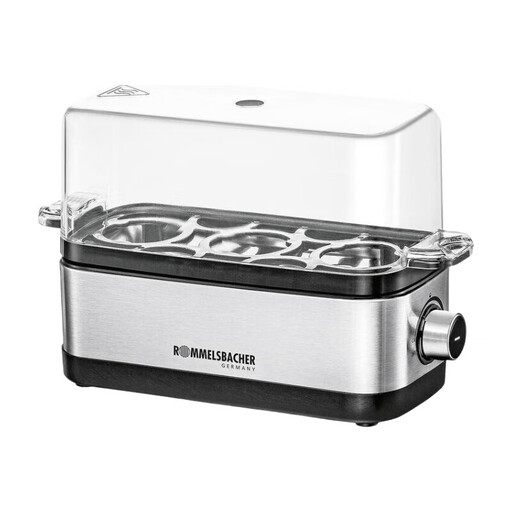
According to Rommelsbacher, the ER 300 is a compact model for one to three eggs, with a dial to adjust the doneness.
These models are suited to cooking eggs for several people or preparing lunches in advance. Before buying, check the CE marking on the specific appliance; the NVWA states that CE marking is compulsory for electrical products placed on the market in the Netherlands.
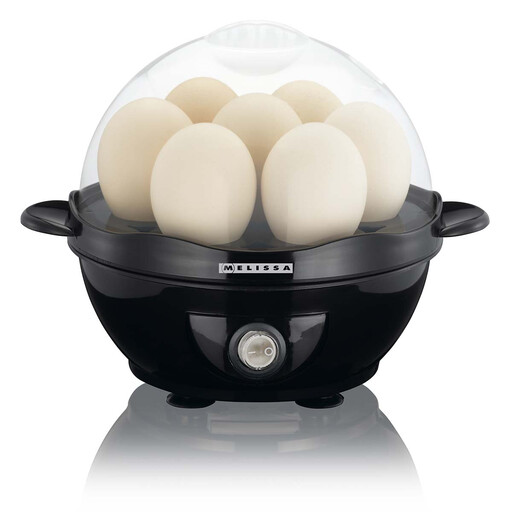 No image available
Suitable if you want to cook up to seven eggs per batch; the product description states that it can steam up to three eggs.
The product name mentions an audible signal, measuring cup and black finish.
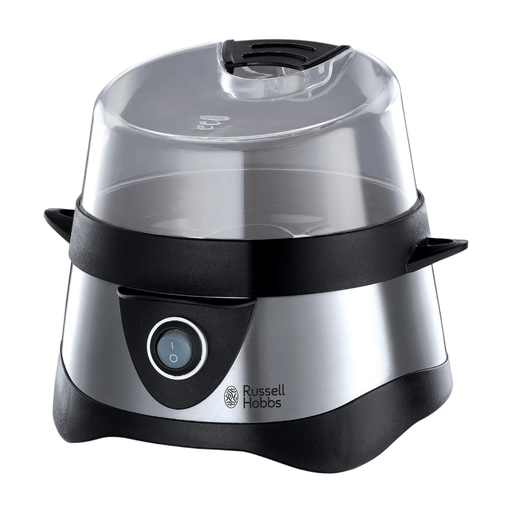 No image available
An option for several people if a capacity of seven eggs per batch suits your preparations.
The product name lists 365 W, automatic shut-off and a stainless-steel finish. The instructions warn of hot steam and specify that an earthed socket must be used; do not immerse the appliance, cord or plug in water.
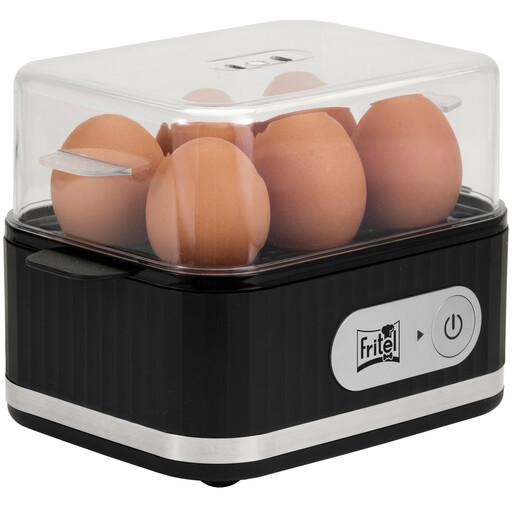 No image available
Suitable if you want to cook one to six eggs per batch and adjust the doneness using the amount of water.
The product name lists 400 W, soft, medium or hard cooking, an egg pricker, a measuring cup and a black finish.
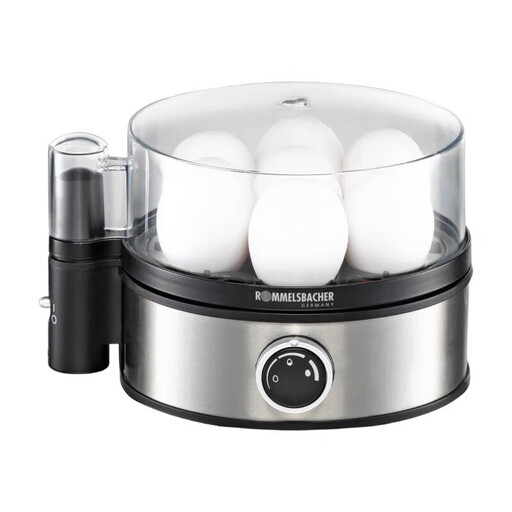 No image available
An option if you want to cook up to seven size M eggs per batch and use a dial to set the doneness.
The product information lists a measuring cup for measuring the water; the stated capacity applies to size M eggs.
 No image available
Best suited to smaller batches: the holder fits one to three eggs, so you’ll need extra batches for larger quantities.
The product information lists an electronic timer with a dial for soft, medium or hard cooking.
According to the Netherlands Nutrition Centre, a hard-boiled egg in its shell can be kept in the fridge for up to a week. For a soft-boiled egg, the Centre recommends a maximum of two days; according to the same source, a peeled egg will keep for another two days in a sealed container in the fridge. These fridge storage times don’t apply to transport without refrigeration.
The Netherlands Nutrition Centre recommends thoroughly cooked eggs for, among others, pregnant people, young children up to and including the age of four, older people and those with a weakened immune system. It warns against eating partially raw egg. Adjust the preparation to suit those eating; a ‘soft’ setting doesn’t guarantee that an egg is thoroughly cooked.
Follow the manual for the exact model; parts and the electrical base may have different cleaning instructions. Princess states that the egg rack and lid of the 262046 are dishwasher-safe, but recommends cleaning the base with a damp cloth. For the EK 3163, Severin advises unplugging the appliance, letting it cool down and not immersing the electrical base in liquid.
Yes. The Netherlands Food and Consumer Product Safety Authority (NVWA) states that CE marking is compulsory for electrical products placed on the market in the Netherlands; kitchen appliances fall within the category of electrical appliances described. Check the marking on the specific appliance. CE marking is not an independent comparison of cooking results.
It depends on how the model works. For the Stelio 415070011, WMF explains that you can remove soft-boiled eggs part-way through and leave the others to cook for longer; with models that use a measuring cup, you generally adjust the doneness for a batch by changing the amount of water. Check the manual if you want to cater for different levels of doneness at the table.