
Vandaag of morgen in huis

Kwaliteit gegarandeerd

Welkomstaanbiedingen ontgrendelen: GRATIS bezorging | Tot 80% korting | Gratis 30 dagen JoyPlus-proefperiode
Download de app
A toy box can quickly fill up with products that are barely used after a few weeks. When choosing educational toys for toddlers, it’s not just about lots of features or colourful packaging. The right choice suits your child’s age, play space and preferred ways of exploring.
A play table with a piano, lights, phone sounds and spinning parts might seem appealing. But a child may lose interest when everything is competing for their attention at once. Look at each activity separately and consider whether your toddler can use it independently.
An activity cube for babies, a musical table or other sensory toy is most practical when it offers several ways to play without complicated controls. A volume control is also useful in a living room or flat.
A product for ages 3 and up isn’t automatically suitable for a younger toddler. Small parts can pose a choking hazard. On the other hand, a simple baby toy may not offer enough of a challenge for a child aged 3 or 4.
Always check:
Words such as “Montessori”, “development-focused” or “safe for every child” don’t tell you much on their own. Look instead at specific features such as the material, dimensions, rounded edges, fastenings, volume control and care instructions.
Some sellers state in their product descriptions that certain items meet CE and EN71 standards. When buying, check the current product information, warnings and conformity details. A reference to a standard is no substitute for supervision or checking the product before use.
For babies aged around 6 to 18 months, simple cause-and-effect activities are a good fit, such as pressing, turning, tapping and listening. Musical toys for babies or a soft play mat may be suitable.
From 1 to 2 years, movement, stacking, pushing and sorting become more interesting. Consider a wooden walker, a toddler musical instrument or large foam climbing blocks. For walkers, check the stability, wheel resistance and available space at home.
From 2 to 4 years, children become more interested in pretend play, simple construction and playing together. A LEGO DUPLO set for toddlers, a pretend-play toy, a toy doctor’s kit or a play kitchen could be suitable. Check the age guidance, though, as some building and role-play sets contain smaller parts.
ABS plastic, wood and foam each have their own advantages. Plastic is often easy to clean. Wood feels sturdy but needs to be kept dry. Foam climbing blocks are soft and suitable for active indoor play, but check whether the covers are removable and washable.
Look for:
For a battery-powered product, check the battery type, how the battery compartment is secured and whether batteries are included. Keep loose batteries out of reach of young children.
Measure the space where the toy will go beforehand. A large play set may look appealing, but it can be awkward in a smaller home. Think about storage space, too. A construction toy for children with a storage case or a vehicle with built-in storage can make tidying up each day easier.
Ride-on toys and walkers need a flat indoor surface. Don’t use them near stairs, on slopes or on public roads. Follow the manufacturer’s specific safety instructions.
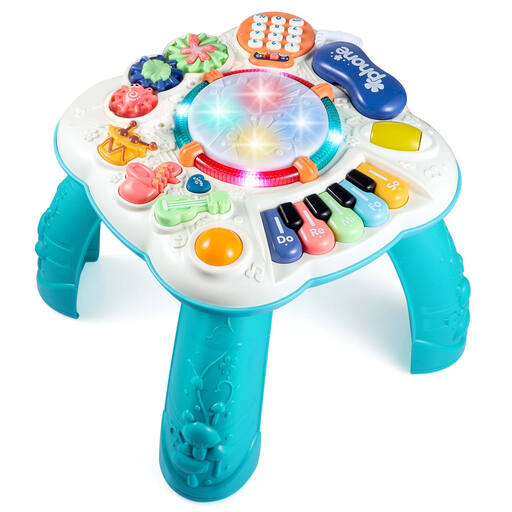
Why it suits this profile: A compact choice for families looking to combine different activities in one product, such as piano keys, spinning parts and a toy phone.
The product description mentions a volume control and a design that can be used as a floor panel or a table. Check the latest warnings and battery information before use.
Six activity zones, measuring approximately 30 × 30 × 31 cm, and stated suitability for ages 6–36 months.
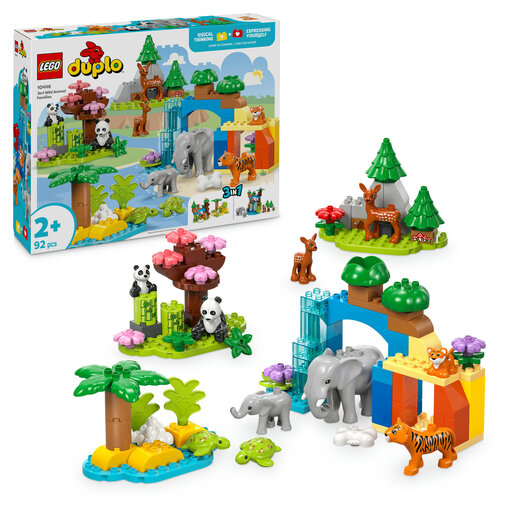
Why it suits this profile: A great choice for families looking for a reusable building and pretend-play set to enjoy together from age 2.
The set has a clear age recommendation of 2+ and is made up of large DUPLO pieces. Still, always check the packaging and remove any damaged pieces.
92 pieces, animal families and a 3-in-1 play concept featuring sorting, comparing and role play.
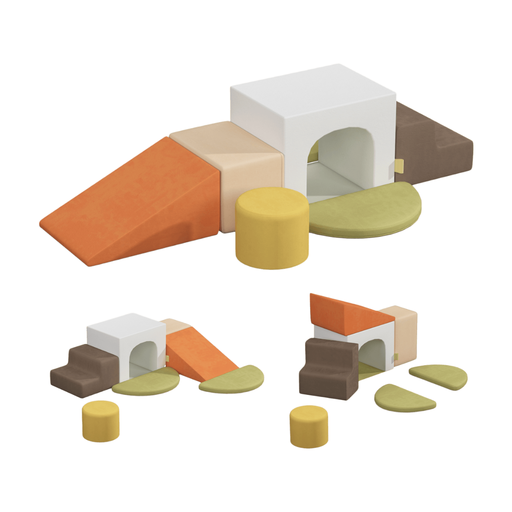
Why it suits this profile: A practical option for lots of active indoor play in a playroom, nursery or spacious living room.
The description mentions non-slip bases, hook-and-loop fastenings and removable, washable covers. Allow vacuum-packed pieces to expand fully before use and check the seams.
Seven foam pieces, washable covers and a design for climbing, crawling and building.
We’ve put together a complete, up-to-date list of products that meet these strict selection criteria and the applicable European safety requirements.
Choose large pieces that are easy to grasp, and activities such as stacking, sorting, pushing, turning and making music. A wooden walker, a simple activity cube or a toddler musical instrument could be a good fit. Always check the minimum age and supervise children when they’re using toys that move.
Lifespan depends on the material, how the toy is used and how well it’s cared for. Toys with different levels of difficulty, such as building sets or pretend-play toys, may hold a child’s interest for longer. Check regularly for loose parts, cracks, sharp edges and damaged battery covers.
As well as the purchase price, remember to factor in the cost of batteries and replacement parts. Check whether the product has a volume control, which type of batteries it needs and whether they’re included. A battery-free toy, such as a wooden sorting or building set, generally has fewer ongoing costs.
