
Vandaag of morgen in huis

Kwaliteit gegarandeerd

Welkomstaanbiedingen ontgrendelen: GRATIS bezorging | Tot 80% korting | Gratis 30 dagen JoyPlus-proefperiode
Download de app
A good piece of educational toys for toddlers does not need to have lots of functions, sounds or parts. Above all, it should be suitable for the child’s age, safe and suited to the way they play. For babies and toddlers aged around 1 to 3, parents often look for toys that support motor skills, language, counting or imagination without quickly ending up unused in the cupboard.
The choice is not always straightforward, however. Products use terms such as Montessori, sensory, interactive and developmental, but these words mean little on their own. Start by looking at the specific features instead.
A toy table with a piano, drum, cogs and lights may seem versatile. However, a young child can become overwhelmed when everything makes a sound at once. Check whether the volume can be adjusted, whether the components can be used separately and whether the toy is easy to understand without assistance.
With educational toys for babies, the age recommendation is also important. A product for 6 to 36 months may be suitable for several developmental stages, but the way a child plays changes considerably between a baby lying on their tummy and a toddler who can stand independently.
Construction toys for children can be appealing, but they sometimes contain small blocks, loose figures or magnets. This does not automatically make them unsafe, but they may be unsuitable for children under 3. Look out for warnings such as a choking hazard and regularly check whether any parts are damaged.
Magnetic toys require extra care. Tokky’s product information warns that swallowed magnets can cause serious injury. Only use this type of toy in accordance with the age recommendation, and immediately set aside any loose or damaged parts.
A brand may claim, based on its own research or product communications, that a toy helps develop certain skills. This does not mean that the result is guaranteed for every child. Instead, focus on verifiable features: the number of parts, materials, controls, age recommendation, maintenance and batteries required.
A simple sorting game, a train with numbers or a toy for developing fine motor skills may be more useful in everyday play than a product with lots of electronic effects.
Choose toddler toys for ages 1 to 3 based on what the child can do now. For a child of around 1 year, large buttons, sturdy components and simple movements are practical. From around 1.5 or 2 years, sorting, building, role play and counting become more prominent.
Also check whether adult supervision is required. With toys containing small parts, magnets, batteries or assembly, supervision is not a minor detail but part of safe use.
Look for ABS plastic, rounded edges and components without sharp burrs. Product pages may provide information about BPA-free materials or safety markings. For example, the musical activity table is described as being made from ABS plastic and BPA-free materials, with a design featuring rounded edges. The product information also mentions CE and EN71 compliance; always check the product’s current packaging and documentation.
A CE marking is not a quality ranking. It indicates that the responsible party declares that the product meets the relevant European requirements. Also check that the toy feels sturdy, has no loose parts and does not crack easily after being dropped.
Battery-free toys are easy to get ready and do not involve the cost of replacing batteries. Examples include wooden or plastic sorting games, construction sets and vehicles that move by hand. Electronic interactive toys for toddlers can provide additional stimulation, but check whether batteries are included, how the volume is adjusted and whether the toy switches off automatically.
For toys used every day, cleaning and storage are also important. Many plastic toys can be wiped clean with a damp cloth. Card games and other cardboard toys, on the other hand, need to be stored somewhere dry and handled with care.
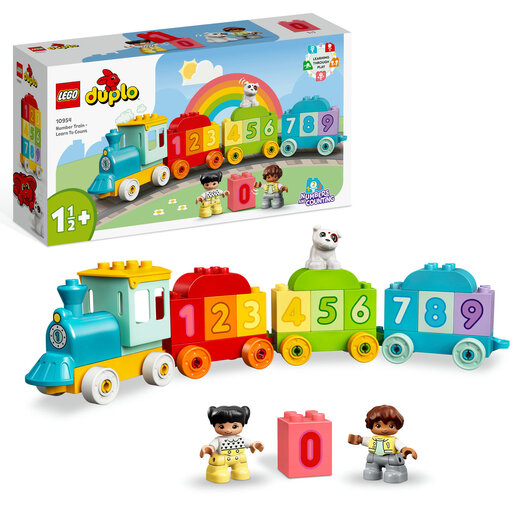
Why it suits this profile: This set combines a familiar vehicle with numbers, figures and an animal. This makes it easy for parents and children to play, sort and count together, without batteries or complicated assembly.
The product information lists 10 number blocks, 2 figures and a dog, with no batteries required. The play objectives are therefore clear and easy to check.
Suitable from 1.5 years; numbers 0 to 9; moving train wheels; no battery required.
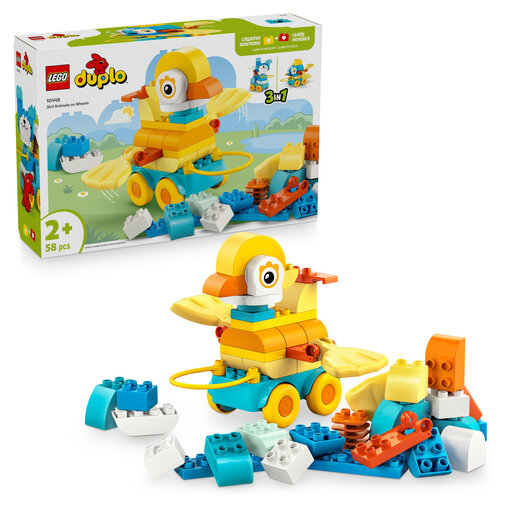
Why it suits this profile: The set offers building, transforming and role play in one product. It is ideal for families looking for reusable developmental toys with large, toddler-friendly parts.
With 58 parts and three possible animals, it offers variety without electronic components. The product page recommends it for children aged 2 and over.
Moving parts; three animal models; suitable for creative building and sorting; no batteries.
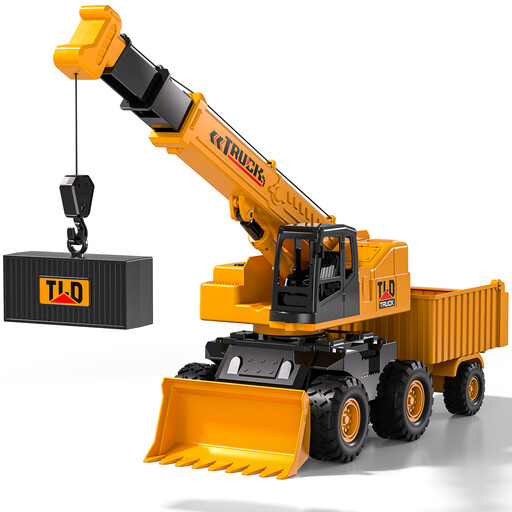
Why it suits this profile: For toddlers who enjoy playing with vehicles and sand, this hand-operated construction truck offers multiple functions for indoor and outdoor play.
The arm, hook, tipping trailer and bulldozer scoop are operated by hand. According to the product description, no batteries are required and the tyres are designed for use on sand, grass and floors.
Thick ABS plastic according to the product information; five play functions; hand-operated; suitable from 3 years.
We have put together a complete, up-to-date list of products that fully meet these strict selection criteria and the applicable European safety regulations.
Choose large, sturdy parts that are easy to grip. An activity roller, musical table with detachable legs or a vehicle with large buttons may be suitable. Always check the age limit and only use toys with small parts when permitted by the manufacturer.
Yes. Building blocks, number sets, sorting games and vehicles encourage play through movement, combining and talking. Adults can ask questions about colours, shapes, quantities and stories. This creates enriching play without the need for lights or sounds.
Their lifespan depends on the materials, how they are used and how they are stored. Regularly check plastic parts for cracks, sharp edges and loose components. Store magnetic toys complete in the box supplied and keep cardboard games dry. Toys that grow with the child through multiple ways of playing may remain interesting for longer.
They can be, provided the gift suits the child’s age and interests. For a birthday, a number set, construction toy, simple sorting game or vehicle for role play can be a practical choice. Before buying, check the warnings, dimensions and batteries required.
