
Vandaag of morgen in huis

Kwaliteit gegarandeerd

Welkomstaanbiedingen ontgrendelen: GRATIS bezorging | Tot 80% korting | Gratis 30 dagen JoyPlus-proefperiode
Download de app
Educational toys for children should offer more than lights, sounds or eye-catching packaging. They should be suitable for the child’s age, match the way they play and be safe to use at home. For parents, grandparents and carers, it is not always easy to distinguish marketing claims from practical product information.
Pay particular attention to these three common pitfalls:
For babies aged 6 to 12 months, large, easy-to-reach parts and stable floor toys are important. A musical activity table for babies can be a good option when the play surface can also be used without the legs. This means a child does not need to be able to stand independently before they can play with it.
For toddlers, educational toys for toddlers with simple cause-and-effect features are often suitable. Think of a button that activates a sound, a cog that turns or a shape that fits into the corresponding opening. Also check the size: toys that are easy to knock over or take up too much space are less practical in a small Dutch home.
From the age of 3, magnetic building blocks and other STEM toys for ages 3+ become an option. The number of pieces, their dimensions and the recommended age are important here. Small magnets must not come loose. Always let children play in line with the age warning and check the toy regularly for damage.
Look at the stated material, rounded edges and any loose parts. The product information for several of the toys mentioned lists ABS plastic and BPA-free materials. This is verifiable information about the composition, but it does not replace supervision during play.
Also look for safety markings. A product description may refer to CE and EN71. CE is a declaration by the manufacturer that the product has been assessed in accordance with the applicable European requirements; it is not automatically an independent quality ranking. EN71 refers to European standards for toy safety. When buying, also check the warnings, importer details and instructions on the product page.
Products with magnets, batteries or a remote control require additional checks:
For interactive musical instruments for children, a volume control is useful. According to the product information for the musical activity table, children’s drum kit and little piano, these models have volume control. This helps you adjust the sound to suit the room, but you should still avoid using the toy close to children’s ears for extended periods.
Electronic toys often run on AA or AAA batteries. The activity table and several musical toys state that batteries are not included. A toy robot, on the other hand, may have a built-in rechargeable battery. Take charging time, play time and the safe storage of cables into account.
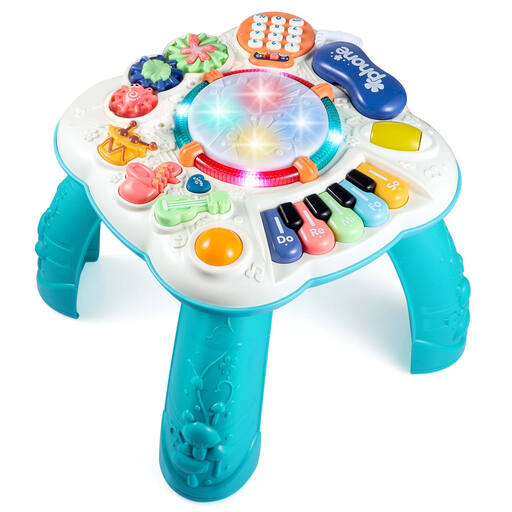
Why it suits this profile: A versatile starting option for families looking for one product that supports both floor play and standing play from 6 to 36 months.
According to the product information, the legs can be removed so it can be used as a floor panel. The stated volume control prevents the sound from being limited to simply on or off.
Six play zones, ABS material according to the listing, rounded edges and batteries not included.
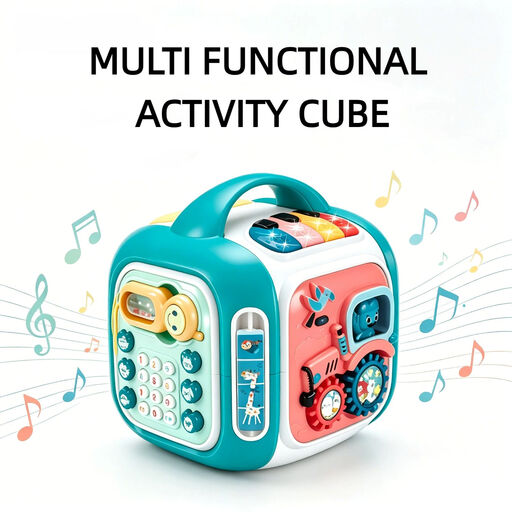
Why it suits this profile: Suitable for anyone wanting several types of play in a compact format, whether for a playroom, a visit to grandparents or play on the go.
The eight play modes are clearly arranged across one cube: turning, pressing, playing the piano and role play. According to the listing, the model has a handle and measures 23 × 23 × 24 cm.
Compact design, several fine-motor activities and rounded ABS parts according to the product description.
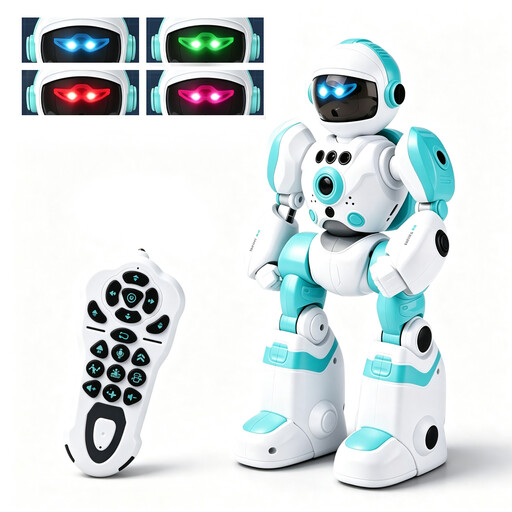
Why it suits this profile: For children aged 3 and over who enjoy giving instructions, programming movements and playing with an electronic toy character.
The product information lists several control methods, including remote control, voice commands and gestures. The listing also states that children under 3 should be supervised.
Built-in rechargeable battery according to the listing, programmable actions and several interactive features.
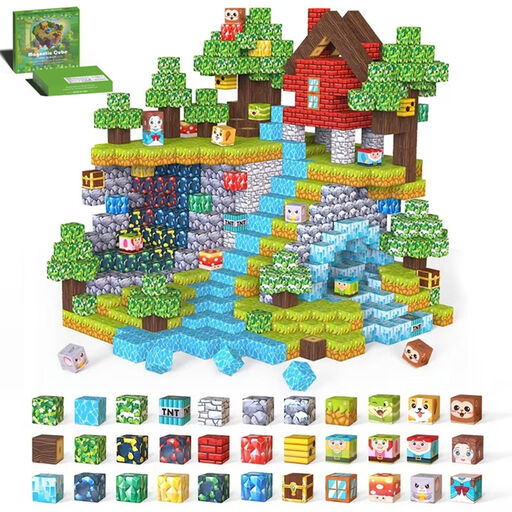
Why it suits this profile: A natural choice for children who enjoy building creations and for families looking for a construction set for open-ended play or as a birthday present for children.
The product title states that there are 150 pieces and recommends it for ages 3 and over. Before buying, however, check the exact contents and magnet warnings on the current product page.
Plenty of pieces for a variety of builds and a clear positioning as educational construction toy.
We have put together a complete, up-to-date list of products that fully meet these strict selection criteria and the applicable European safety regulations.
For babies from around 6 months, simple products with large push buttons, sounds, colours and safe rotating parts are suitable. A sensory toy for babies should be stable and contain no small parts that could come loose. Always check the age guidance and stay nearby during play.
The lifespan depends on the material, how intensively the toy is used and how well it is maintained. Electronic toys may last longer when batteries are removed promptly before long-term storage. Check musical toys, magnetic building sets and toys with remote controls regularly for cracks, loose parts and damaged battery compartments.
No. The educational value mainly comes from the activities a child can carry out independently. A simple shape sorter or a set of magnetic building blocks can remain engaging for a long time as children discover new combinations. Compare features, safety, size and age suitability rather than looking at the price alone.
