
Vandaag of morgen in huis

Kwaliteit gegarandeerd

Welkomstaanbiedingen ontgrendelen: GRATIS bezorging | Tot 80% korting | Gratis 30 dagen JoyPlus-proefperiode
Download de app
Finding a gift that is both fun and educational sounds simple. Yet online shops are full of products that use terms such as Montessori, STEM and sensory learning without making it clear what a child can actually do with them. As a result, parents sometimes pay for features that are barely used, or choose toys that are unsuitable for the child’s age and available play space.
The most common pitfalls:
The age on the packaging is a starting point, not a substitute for supervision. For babies from 6 months, it is best to choose toys without loose small parts. Toys for children aged 3 and over may contain parts such as magnetic tiles, figures or kitchen accessories that, according to the product information, are unsuitable for younger children because of the risk of choking.
Pay attention to:
A product with an age range up to 10 or 12 years may be interesting for younger children, but this does not mean that all its functions are equally suitable at every age.
Check whether the product page lists material details, such as ABS, wood, foam or textile. The supplied product information for baby and toddler toys may, for example, mention BPA-free ABS, rounded edges and a construction without loose parts.
You may also see references to CE and EN71. CE indicates that the manufacturer declares that the product meets the relevant European requirements; it is not an independent quality mark. EN71 refers to European requirements for toy safety. Always check that the marking and warnings are actually listed for the product you have selected.
For magnetic building blocks, it is sensible to check the construction, age limit and whether there are loose magnets. Do not allow children who still put parts in their mouths to use magnetic toys.
A toy with lots of functions is not automatically more interesting. Consider how the child will play with it:
Batteries are often not included with electronic toys. Also check whether parts can be removed, how the product should be cleaned and how much space it takes up.
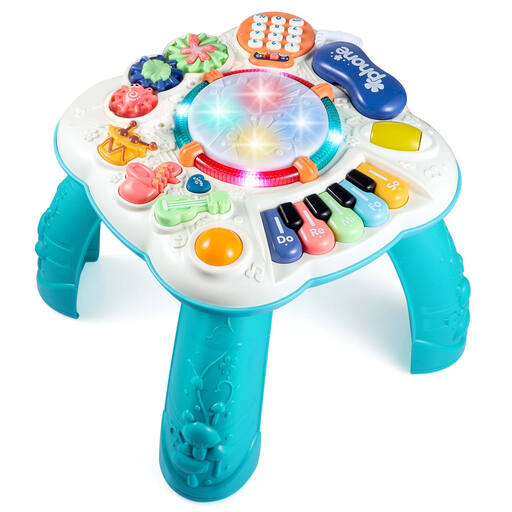
Why it suits this profile: This compact table combines several activities for children aged 6 to 36 months. The removable legs allow it to be used as a floor panel; put the legs back on when the child starts standing.
The product description mentions six play zones, volume control and a silent mode. This makes the functions clearer than with a product that only uses general educational claims.
Measures approximately 30 × 30 × 31 cm and includes a piano, drum, telephone and cogs; batteries are not included.
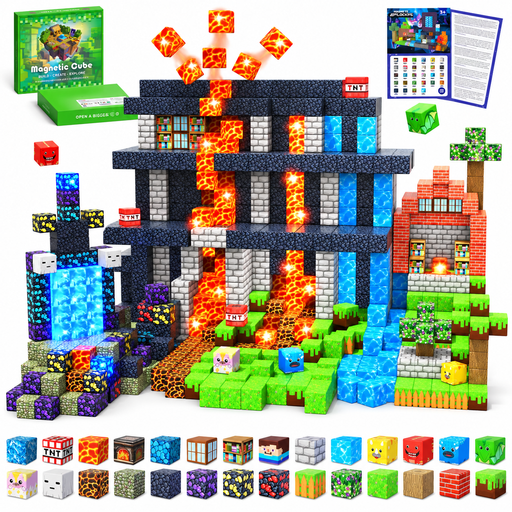
Why it suits this profile: For children aged 3 and over who enjoy building, a set of 150 pieces offers plenty of scope for repeated, open-ended play. Its natural appearance suits a calm play environment.
The title states the number of pieces, ABS material, rounded edges and minimum age. This provides concrete information for comparison, although you should check the current safety details on the product page.
150-piece set, magnetic construction toy, rounded edges and suitable from age 3.

Why it suits this profile: This portable product focuses on maths and logical thinking. The product name states 5 to 12 years; check the current age information before buying, as the description also mentions a different minimum age.
The functions are clearly described: five modes, 19 games and maths exercises covering addition, subtraction, multiplication and division. The differing age information in the listing makes checking especially important.
Rechargeable battery via usb-c, lcd screen, portable size and several maths modes; charging should take place under adult supervision.

Why it suits this profile: This soft play set is designed for climbing, crawling and building. It is particularly suitable for families with plenty of floor space and children who enjoy active play.
The description mentions non-slip bases, hook-and-loop fastenings, removable covers and machine-washable material. Before use, check that all parts have fully expanded after being vacuum-packed.
Soft foam blocks, playpen supplied without balls, removable washable covers and references to EN71-1, EN71-2 and EN71-3 in the product information.
We have put together a complete, up-to-date list of products that fully meet these strict selection criteria and the applicable European safety regulations.
Choose a toy that encourages grasping, pressing, turning or listening without small loose parts. A musical activity centre or baby drum may be suitable, provided the age recommendation is correct, the volume can be adjusted and an adult supervises play.
That depends on the specific set and the warnings on the product page. Magnetic building blocks can encourage construction skills and spatial awareness, but loose magnets pose a risk if swallowed. Only use them according to the stated minimum age and check regularly for damaged parts.
As well as the purchase price, batteries or charging may also be a consideration. Some products do not include batteries, while other models have a rechargeable battery via USB. Also check whether the volume can be adjusted and whether the toy can be used without sound. This helps you avoid unexpected running costs and reduce noise levels at home.
