
Vandaag of morgen in huis

Kwaliteit gegarandeerd

Welkomstaanbiedingen ontgrendelen: GRATIS bezorging | Tot 80% korting | Gratis 30 dagen JoyPlus-proefperiode
Download de app
Educational toys for children should do more than simply look educational on the packaging. They should suit the child’s age, play style and interests. A toddler will get little out of a complicated STEM toy with small parts, while an eight-year-old may quickly lose interest in a simple sorting game.
As a Joybuy Product Recommendation Officer, I therefore focus mainly on verifiable details: recommended age, material, dimensions, number of parts, batteries and how the toy is used. This helps you avoid buying something that ends up in the cupboard after only a short time.
The age shown on the packaging is an important starting point, but it is not the only consideration. Also check whether the product contains small parts, batteries or loose accessories. These may pose a risk to young children. A toy recommended for ages 3 and up is not automatically suitable for a child who still puts everything in their mouth.
When choosing toys for ages 2 and up and toys for toddlers, look out for:
Lights, sounds, songs and interactive buttons quickly attract attention. However, the number of features does not determine how much play value a product offers. Good educational toys give children room to make their own choices, repeat activities and invent new situations.
So do not compare only the “number of games” or “number of sounds”. Also ask:
Electronic toys sometimes run on batteries that are not included. Also check the size. A large play set may be appealing, but you need somewhere to store it after use.
Also consider:
First choose the appropriate developmental level, then consider the theme. For young children, shapes, colours, counting, stacking and simple cause-and-effect activities are suitable. Preschoolers may enjoy imaginative toys, construction toys and simple educational games that offer more challenge. Older children may be interested in STEM toys, maths, technology or experiments.
A product recommended for ages 6 and up, such as Operation, is not intended for toddlers. A geode set for ages 8 and up also requires supervision when using tools.
Check that the material specification is clearly stated, for example plastic, cardboard or wood. Also pay attention to the number of parts and the dimensions. A large number of parts can offer more ways to play, but it also means more tidying up and a greater chance of pieces going missing.
The CE marking indicates that the manufacturer declares the product meets applicable European requirements. It is not a quality ranking and does not replace checking age warnings, materials, instructions for use and supervision.
For everyday use, easy maintenance is practical. Products containing electronics can generally only be wiped on the outside. Parts described as dishwasher-safe should still be cleaned according to the instructions.
When buying, also check whether the toy is intended for one player, shared play or parent-and-child interaction. This makes a difference when choosing a birthday present, an activity for a rainy afternoon or a toy for a family with several children.

Why it suits this profile: A straightforward battery-free game for children aged 2 to 5 who are practising shapes and colours.
The way to play is clear: 16 cardboard shapes are placed on four coloured cards. There are no electronic features or battery costs.
16 shapes, four coloured cards, a Dutch-language game and a playing time of approximately 15 minutes.
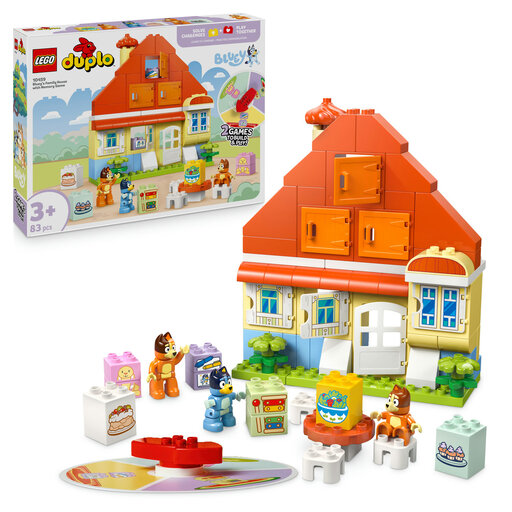
Why it suits this profile: A gift for toddlers and preschoolers who enjoy combining building, familiar characters and shared play.
The set combines building with a memory game and role play. This means play does not depend solely on lights or sound effects.
83 pieces, three figures, a memory game and a playhouse measuring approximately 30 cm high, 51 cm wide and 37 cm deep, according to the listed dimensions.

Why it suits this profile: Suitable for children who want to practise maths independently through short game-based activities.
The product description lists five learning modes and 19 maths games. Before buying, check that the level and controls are suitable for the child.
Exercises covering addition, subtraction, multiplication and division; rechargeable via USB-C with a portable design.

Why it suits this profile: For children aged 8 and over who enjoy experimenting and are interested in geology and STEM toys.
The set encourages active investigation rather than simply pressing buttons. Use the tools only as described in the instructions and under adult supervision.
Includes mineral and geode samples, an illustrated guide and experiments for children aged 8 and over.
We have put together a complete, up-to-date list of products that fully meet these strict selection criteria and the applicable European safety regulations.
A product for boys and girls does not have to feature a neutral colour or universal theme. Focus mainly on the child’s interests: animals, building, maths, vehicles, music or imaginative play.
Choose toys with large parts and simple activities involving colours, shapes, counting and sorting. Always check the age warning. Even with toys for ages 2 and up, supervision is advisable if the product contains loose parts.
That depends on the power supply. Some products use AA or AAA batteries, while others can be recharged via USB. Check the number of batteries required, whether they are included and whether the device switches off automatically. For long-term storage, it is advisable to remove the batteries according to the instructions.
How long a toy remains engaging depends on the variety it offers and whether it can be used in different ways. Construction sets, role play and games with different levels can remain appealing for longer than products with one fixed activity. If you are unsure, choose a product that supports both shared and independent play.
