
Vandaag of morgen in huis

Kwaliteit gegarandeerd

Welkomstaanbiedingen ontgrendelen: GRATIS bezorging | Tot 80% korting | Gratis 30 dagen JoyPlus-proefperiode
Download de app
A colourful toy with lights and sounds can easily seem educational. Yet not every product marketed as educational toys for children is a good match for a child’s age, play space or interests. Some sets contain lots of small parts, while others require more supervision than the product photo suggests. Battery costs, noise levels and storage convenience can also make a purchase less practical than it first appears.
With these checkpoints, you can make a more informed choice from interactive toys, Montessori toys, sensory toys, building sets and imaginative play toys.
A product might be labelled as suitable for children aged 1 to 5, yet the way it’s played with varies hugely by age. A baby benefits most from simple grasping, pressing and listening. A toddler, on the other hand, may want to build, sort or engage in role play.
So, check:
With baby toys and toddler toys, supervision is important, even when the product description mentions rounded edges or BPA-free ABS.
A play table with a piano, telephone, gears, lights and melodies offers plenty to do. But a long list of features doesn’t automatically mean the toy will hold a child’s interest for long. Look instead at whether the features match what the child enjoys doing: making music, sorting, moving, building or inventing stories.
With electronic toys, a volume control is very practical. Also check whether batteries are included. For several products in this selection, batteries are not supplied.
Building toys, till sets and imaginative play sets often consist of many loose pieces. This encourages combining and role play, but makes tidying up more important. Look for a storage bag, storage compartment or carry case. Also check whether the toy can be cleaned with a dry cloth and whether parts are securely attached.
Look for clear information about materials, age suitability and warnings. CE marking and references to EN71 may be part of the product information, but always check the details on the product page and packaging. According to the seller, some selected products include CE and EN71 information; this is a claim by the seller and not an independent guarantee for every use situation.
For children under 3, warnings about choking hazards from small parts are especially relevant. A toy set with mini cars, coins or building pieces is therefore not suitable for younger children when the product information states this.
Measure the space where the toy will be used beforehand. An activity table around 30 cm wide takes up little room, whereas a race track 4.5 metres long is only suitable if you can roll it up after play. For standing toys, look for a wide base, and for track pieces, check for suction cups, connectors or non-slip details.
Electronic toys often run on AA or AAA batteries. The costs are usually modest, but do check:
A volume control is especially handy in a flat, during quiet times or when several children are playing at once.
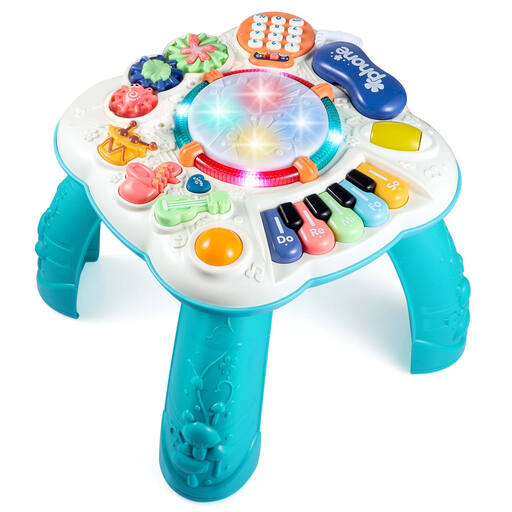
Why this fits the profile: The table combines several activities in one product and, according to the product description, can be used with or without legs. That’s practical when you’re looking for one versatile piece of baby toys.
The product information mentions six play zones and a volume control. This means you can adjust features and sound levels rather than just focusing on lights and sound effects.
Suitable according to the seller for 6–36 months; piano, drum, gears and telephone function; batteries not included.
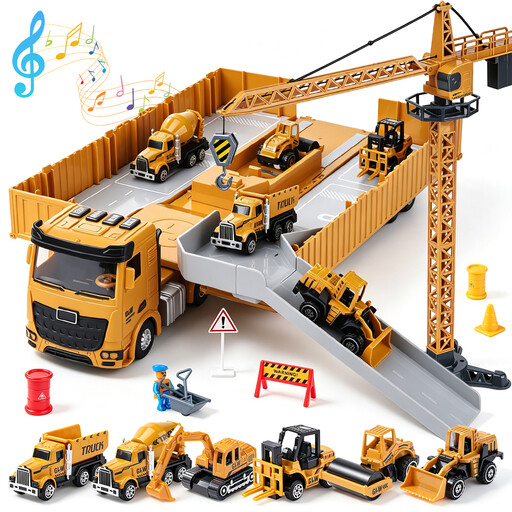
Why this fits the profile: For children who play for a long time with one theme, this set offers vehicles, traffic accessories and a truck that can serve as storage.
According to the product description, the set has an integrated storage function. This helps keep vehicles from being scattered around, although small parts still require supervision and tidying up.
Eight vehicles and accessories; movable parts such as a crane and tipper; intended for children aged 3 and over; requires three AA batteries.

Why this fits the profile: For children who love to build and start again, the bendable track allows for different straight sections, curves and loops.
The track is rollable and works without batteries. This avoids both complicated storage and recurring battery costs.
Track length of 4.5 metres; two lanes; four friction-powered cars; according to the warning, not suitable for children under 3 years.
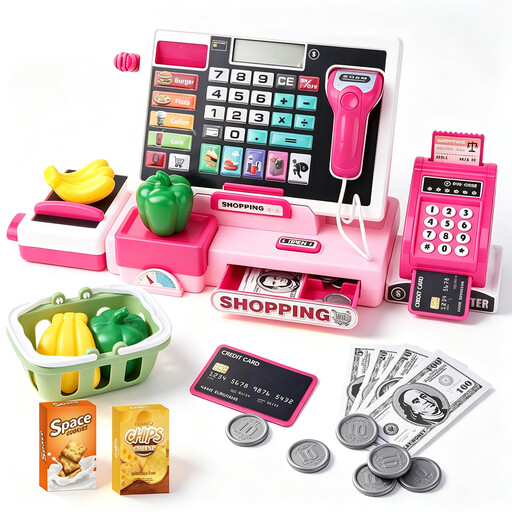
Why this fits the profile: This set suits children who love playing shops, sorting items and building a story together with a parent or friend.
In addition to sound and light, the set includes a calculator, play money and a weighing scale. The learning activities are therefore linked to concrete role play.
Suitable from 3 years; working calculator according to the product description; scanner, play money and shopping basket included; requires two AA batteries.
We’ve put together a full, up-to-date list of products that fully meet these strict selection criteria and current European safety regulations.
Choose activities where the child can press, turn, listen and discover simple cause-and-effect relationships. A sensory toy such as an activity table, musical toy or compact activity cube often suits this stage. Always check the age rating, stability and warnings.
Not always. Sets with small cars, coins, food items or building pieces can pose a choking hazard. Use toys for ages 3 and over according to the warning on the product page and supervise young children, especially during the first play sessions.
That varies by product. Music tables, cash registers, dinosaur toys and some building sets use AA or AAA batteries. Race track toys with friction cars sometimes need no power at all. Check the battery type, quantity and whether batteries are included before you buy.
