
Vandaag of morgen in huis

Kwaliteit gegarandeerd

Welkomstaanbiedingen ontgrendelen: GRATIS bezorging | Tot 80% korting | Gratis 30 dagen JoyPlus-proefperiode
Download de app
Educational toys for children can encourage creative play and help develop motor skills, language, musical ability and numeracy. Even so, finding the right one isn’t always easy. A product with lots of buttons, bright colours or terms such as “Montessori” isn’t automatically right for every child.
Look out for these three common pitfalls:
An overly broad age range
A toy table advertised as suitable from 6 to 36 months may, in practice, be best suited to just one stage of development. Check how the toy is used: lying down, sitting or standing.
Lots of features, but little room to play
Music, lights, sounds and buttons can grab a child’s attention, but may also become boring quickly. Construction toys and magnetic building toys often leave more room for children to come up with their own ideas, provided the number of pieces and level of difficulty are right for them.
Safety claims without checks
A CE marking is required for many toys sold in the European Union, but it isn’t an independent quality mark. Also check the age warning, small parts, battery information, material details and whether there’s a responsible party based in the EU.
Don’t choose based on the age in the product title alone. Think about the actions involved, too:
Product descriptions sometimes mention ABS plastic, BPA-free materials or rounded edges. Treat these as the seller’s product specifications and check that the information is clearly stated on the product page. According to the descriptions of some baby products in this selection, they’re made from ABS and are BPA-free. This is a claim in the product information, not a general guarantee for all toys.
For babies and toddlers, loose small parts are an important consideration. Also check whether a product is easy to wipe down and clean. Electronic toys generally shouldn’t be submerged in water. A slightly damp cloth is often the recommended way to clean them, but always follow the instructions provided.
Musical toys for babies and interactive toys often use batteries or a rechargeable battery. Check:
A volume control is useful in a flat or during quiet moments. Don’t treat claims that a volume setting protects hearing as medically proven. Always keep the volume moderate and limit prolonged exposure to loud sounds.
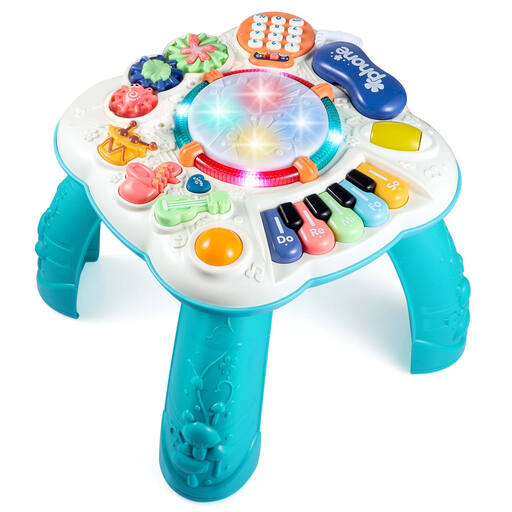
Why it suits this profile: This compact activity table combines several types of play in one product. According to the product description, the legs can be removed so the table can also be used as a flat play board.
The six play zones make its features clear. Still, check whether your child is most interested in music, spinning or pretend play.
The product information says it’s suitable for ages 6 to 36 months, with volume control and dimensions of approximately 30 x 30 x 31 cm. Batteries aren’t included.
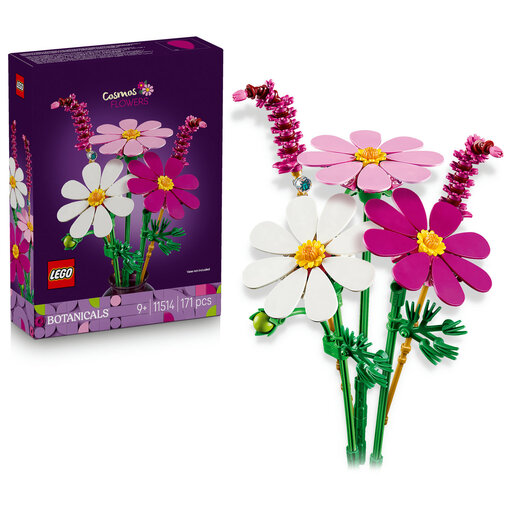
Why it suits this profile: A good choice for children who enjoy building at their own pace and want to make something they can display afterwards.
This isn’t a toy that relies only on lights or sound effects: the building steps call for active attention. The small parts mean supervision and the stated minimum age are important.
The set contains 171 pieces, is listed as suitable for ages 9 and over and builds into a floral display measuring over 23 cm tall.

Why it suits this profile: A good fit for families looking for targeted practice in addition, subtraction, multiplication and division.
The learning features are clearly focused. Do check the warning about small parts, and supervise younger children when they use it.
According to the product description, it offers five learning modes, 19 games and more than 50,000 questions. The battery recharges via USB-C, with a stated running time of up to 6 hours.
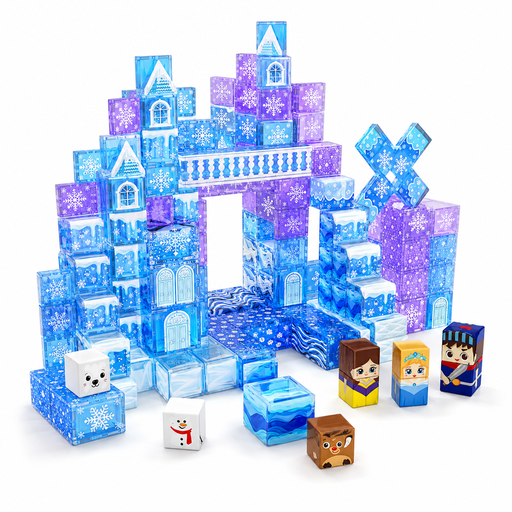
Why it suits this profile: A good starter option for children aged 3 and over who enjoy creating their own shapes, towers and patterns.
Magnetic building toys stay interesting for longer when children can build freely rather than simply copying a single model.
Transparent blocks with a snow or ice effect and a stated minimum age of 3 years. Before buying, check the number of pieces and safety information on the product page.
We’ve put together a complete, up-to-date list of products that meet these strict selection criteria and current European safety requirements.
An adjustable-volume drum kit could be a good option for active toddlers. According to the product description, this model has three illuminated drum pads, a microphone and a removable stand. Check whether batteries are included and whether the sound level is suitable for the room.
For children who love vehicles and dinosaurs, a dinosaur toy set with vehicles is a natural choice. Check for small figures, batteries and the minimum age. A remote-controlled robot with programmable movements is better suited to older children who can follow instructions.
Choose toys with large parts that are easy to grip and simple actions such as pressing, turning, sorting or rolling. Toddler toys with volume control and a sturdy base are practical for everyday use. Avoid products with small parts if your child still puts things in their mouth.
It depends on the design. Magnetic building sets may be suitable from age 3 if the pieces are large enough and the warnings confirm this. More complex programming or maths products are generally better for older children. Focus on the actions involved, not just the STEM label.
How long a toy stays interesting depends on how much variety it offers and whether children can come up with new ways to play. A toy robot with a fixed set of songs may become predictable sooner, while construction toys or LEGO Botanicals can be rebuilt. If you’re unsure, choose a product that offers several ways to play and check whether add-ons are available.
