
Vandaag of morgen in huis

Kwaliteit gegarandeerd

Welkomstaanbiedingen ontgrendelen: GRATIS bezorging | Tot 80% korting | Gratis 30 dagen JoyPlus-proefperiode
Download de app
A product with the words “educational”, “sensory” or “Montessori” on the packaging isn’t automatically a good purchase. For parents, grandparents and carers, what really matters is whether the toy suits the child’s age, can be used safely, and stays interesting beyond the first few days of play.
With educational toys for children, a few common pitfalls keep cropping up:
So the right choice doesn’t start with the colour or the number of accessories, but with verifiable product specifications.
Always look at the recommended age and the safety warnings. Toys for age 3+ may contain small parts that aren’t suitable for children under 36 months. A building set, till toy or DIY model should only be used with supervision for younger children if the product information says so.
For baby toys from around 6 months, large, securely fixed parts are important. An activity table or sensory toy with removable legs can be practical, because it can be used on the floor and later when standing. Do check that the child can’t get to batteries or loose parts.
Plastic toys often mention ABS. That’s a common material, but the mention of “ABS” alone doesn’t tell you everything about safety. Check whether the product page gives information about rounded edges, small parts, batteries and supervision requirements.
If a seller mentions CE or EN71, also check that this information applies to the specific product. In the product information of several toys mentioned, compliance with European CE and EN71 regulations is stated. That’s a claim from the seller; use the warnings, instructions and information about the responsible seller as an additional check.
For musical toys for toddlers, a volume control and possibly a silent mode are practical features for a flat, a car journey or a quiet moment. They make it easier to adjust the sound level to the situation. That’s different from a medical or hearing-protection function.
Also check:
For magnetic building blocks, pay extra attention to damaged parts. Stop using them if a magnet comes loose or a part breaks.
For babies aged 6 to 18 months, simple cause-and-effect activities often work well: pressing, turning, tapping, listening and watching. A moving toy can encourage reaching or crawling, while an activity table combines several actions.
Toddlers aged 1 to 3 can benefit from sensory toys with light, sound, shapes and colours. Musical instruments like a children’s keyboard or drum set support free play. The product information may indicate that tapping and pressing keys engage hand-eye coordination and fine motor skills. These are possible play opportunities, not guaranteed developmental outcomes.
From age 3, magnetic building blocks, construction toys and simple STEM activities become interesting. Children can combine shapes, copy models or invent their own structures. With magnetic sets, check the number of parts, the dimensions and the recommended age.
Role-play toys, such as a toy till, offer a different type of play. With a scanner, play money and shop accessories, children can act out everyday situations. A calculator function can be a playful introduction to counting, without the product needing to be seen as teaching material.
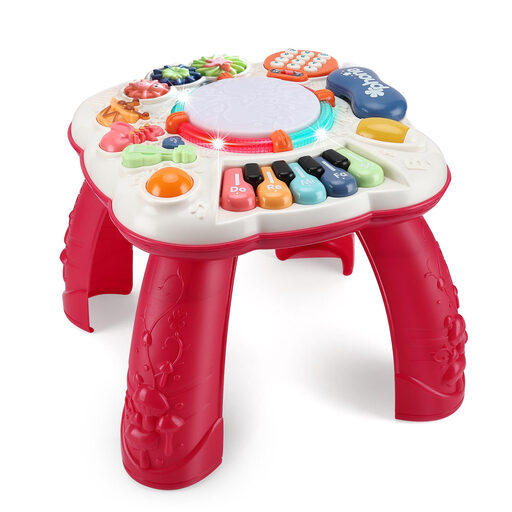
Why this fits the profile: A compact choice for families looking for one baby activity with multiple play zones. According to the product information, the table is suitable for 6 to 36 months and has removable legs.
The age indication, size and six mentioned play zones are clearly described. Check the battery information yourself and use the product according to the warnings.
Piano, drum, telephone and spinning elements in one product; volume control and floor-level play thanks to removable legs.
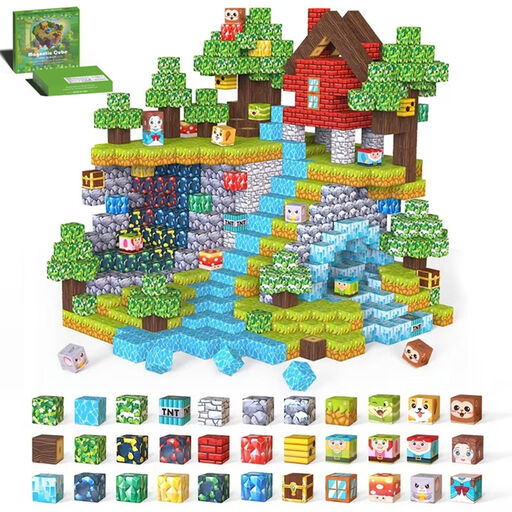
Why this fits the profile: A set with 150 pieces offers room for free building and joint projects. This suits children from the stated age who enjoy construction toys.
The number of parts is clearly stated. Check the full contents, the age limit and the condition of magnets and plastic before purchase.
150-piece set; suitable for building, combining and creative tasks; can be used with other children.
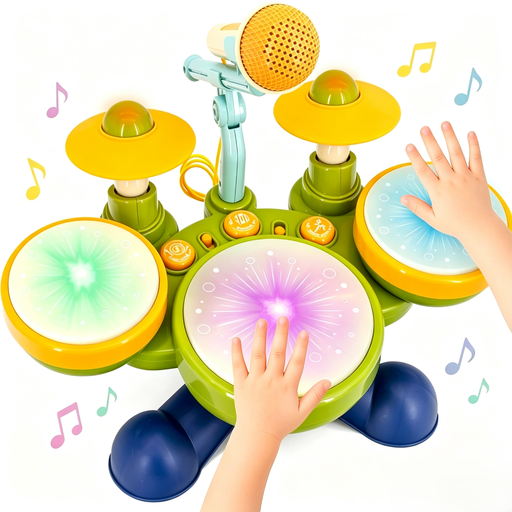
Why this fits the profile: This musical toy for toddlers is designed for active tapping, singing and making rhythms. The adjustable stand and detachable design are practical when multiple playing positions are wanted.
The product information mentions a volume control, age range of 1 to 3 years and a four-point base. Check the stability before use and don’t let young children play without supervision.
Illuminated drum pads, two movable cymbals, working microphone, adjustable drumstick height and detachable stand.
We’ve put together a full, up-to-date list of products that fully meet these strict selection criteria and the applicable European safety regulations.
Look for toys with large parts and clear actions, such as magnetic building blocks, a simple construction set, a toy till or role-play toys. Always check the age indication and warning about small parts. The child’s interest is at least as important as the STEM or Montessori label.
That depends on the play possibilities. A product with one fixed action can quickly become predictable. Sets that let a child sort, build, combine or invent stories usually offer more variety. Don’t keep all the toys out at once; rotating them can help make existing products interesting again.
Besides the purchase price, batteries and replacement parts can add up. So check whether batteries are included and what type is needed. For many products mentioned, batteries are not included. A volume control, silent mode and simple operation can make using them at home more practical, but check the exact product information for each model.
