
Vandaag of morgen in huis

Kwaliteit gegarandeerd

Welkomstaanbiedingen ontgrendelen: GRATIS bezorging | Tot 80% korting | Gratis 30 dagen JoyPlus-proefperiode
Download de app
Educational toys for children should offer more than lights, sounds or eye-catching packaging. They should be suitable for the child’s age, safe to use and match what they enjoy. However, it can be difficult to distinguish marketing claims from practical product information.
Many parents, grandparents and gift buyers face the same challenges:
The checks and profile-based recommendations below will help you make a more informed choice.
Don’t just look at the age stated on the front of the packaging. Also check how the toy is used. An activity table with removable legs may be suitable for floor-based play when children are younger and can later be used as a standing toy. This makes the product more flexible, but only if its size suits the available play space.
For toys from 1 year upwards, stable parts and easy-to-reach buttons are important. For toys from 3 years upwards, remote controls, simple instructions and imaginative play may play a bigger role. For children over 6, more complex features such as programming, steering or building are often more appealing.
Also consider:
Product descriptions sometimes mention ABS, BPA-free, rounded edges and CE or EN71 markings. These are relevant details, but a CE mark is not an independent mark of quality. It indicates that the manufacturer declares that the product meets the applicable European requirements.
According to the product descriptions of several of the toys mentioned, they are made from BPA-free ABS and have rounded edges. Always check the current product page, warnings and age limit before ordering. For example, the RC dump truck model explicitly states that it is unsuitable for children under 3 because it contains small parts.
Use developmental claims with care. A piano, drum or sensory toy can encourage children to press, tap, listen and move. This may help them practise fine motor skills and understand cause and effect through play, but it does not replace guidance or other forms of play.
For musical toys and other interactive toys, volume and power supply are important. A volume control or silent mode is useful in a flat, during quiet play or when several children are playing in the same room. Also check whether batteries are included.
The product information for the items below states, among other things:
A rechargeable battery may be more convenient in the long term, while loose batteries can be appealing for a gift that can be used straight out of the box. Always check the charging time, play time and battery type.
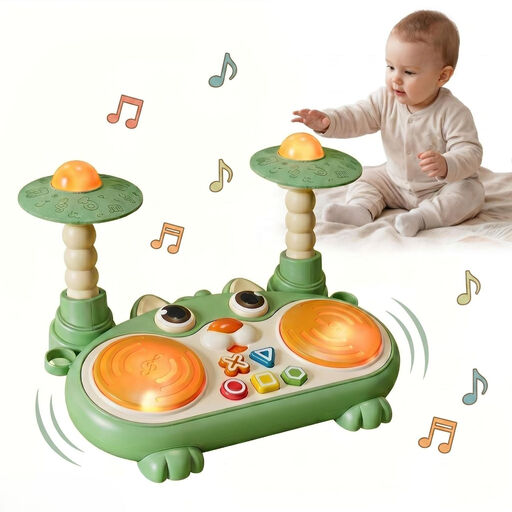
Why it suits this profile: This compact sensory toy combines drumming, lights, shape sorting and animal sounds in one product for young children.
The features are clearly described and the recommended age is stated. The volume control helps you adjust the sound level. You will need to provide the batteries yourself.
Five shape buttons, two drum surfaces, light and sound effects; according to the product description, BPA-free ABS with rounded edges.
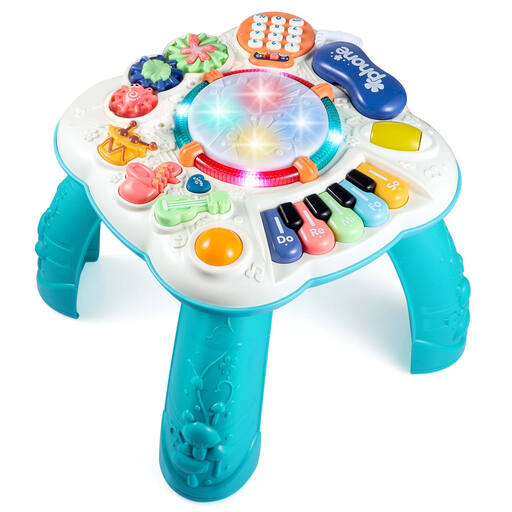
Why it suits this profile: This activity table offers different play zones for children who enjoy switching between music, spinning, pressing and imaginative play.
According to the product description, the legs can be removed so that the panel can also be used on the floor. It has a volume control and silent mode.
Six play zones, dimensions of approximately 30 × 30 × 31 cm and a stated usage age of 6-36 months.
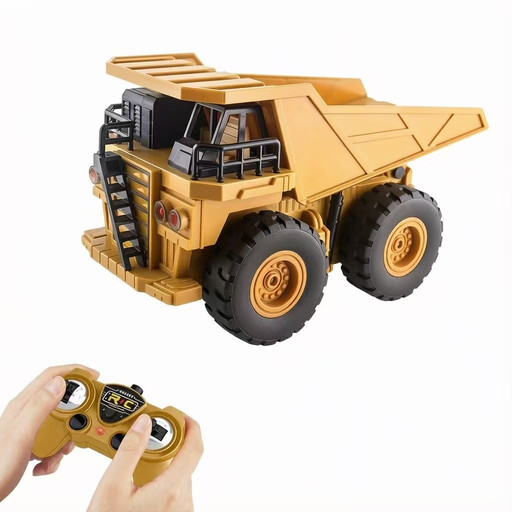
Why it suits this profile: For children aged 3 and over who enjoy controlling vehicles, role play and recreating a building site with a parent.
The product information includes a warning about small parts and use under supervision. The age limit helps prevent you from buying this toy as a baby toy.
Six control functions, tipping body with remote control, 2.4GHz connection and an included rechargeable 3.7V 500mAh battery.
Toys with lights and sounds can be suitable for children who respond to music, colours and immediate feedback. For example, a children’s piano with volume control is a good fit for a toddler who enjoys repeatedly pressing keys. A robot dinosaur or programmable robot may be more appealing to children who like movement and imaginative play.
Note the difference between:
These terms alone say nothing about quality. Look at the specific features, age limit, power supply and safety warnings.
We have put together a complete, up-to-date list of products that fully meet these strict selection criteria and the applicable European safety regulations.
For babies from around 3 months, lightweight objects that are easy to hold and have no loose small parts are practical. Examples include simple rattles, cloth books or activity toys with clear light and sound effects. Always check the minimum age and use baby toys under supervision.
Their lifespan depends on the material, usage, storage conditions and battery type. A toy with a rechargeable battery can be convenient for regular use, while battery-powered toys may be easier to store. Remove the batteries from toys that will not be used for an extended period and regularly check cables, battery compartments and moving parts.
No. The price does not always indicate how much play value a product offers. Above all, compare the stated age range, features, dimensions, material information, power costs and warnings. A simple product that matches the child’s interests may be used more often than an expensive model with features that are not suitable for their age.
