
Hosts planning an Easter lunch with generous toppings
If you’d like to serve rusks with toppings such as egg, fish, cheese or a spread, look for an explicitly larger size. That doesn’t necessarily mean the rusks are thicker.


For an Easter lunch with generous toppings, look for rusks described on the packaging as extra large, large or robust. These terms can help you find a roomier base, but they don’t tell you how thick the rusks are. Also compare the nutritional information and ingredients for the exact product, especially if fibre or allergens are important for your guests.
If you’d like to serve rusks with toppings such as egg, fish, cheese or a spread, look for an explicitly larger size. That doesn’t necessarily mean the rusks are thicker.
For them, the ingredients and fibre content per 100 g are more useful than the colour of the rusks. Compare the nutritional information for the varieties you’re actually considering.
When choosing rusks with grains, seeds or kernels, check the allergen information on the exact product packaging. The varieties reviewed list ingredients including wheat, egg or sesame; which ingredients matter will vary by product.
First decide what matters most to you for your Easter lunch: room for toppings, nutritional information, ingredients suitable for your guests or keeping the rusks crisp when serving.
| What to consider | What to check before buying | Who it matters to |
|---|---|---|
| Room for generous toppings | Look for a description such as extra large, large or robust; also compare the number of rusks and the serving information. Don’t assume these terms indicate thickness. | If I’m serving generous toppings, I want a roomier base without assuming it’s also thicker. This is the top priority for around 40% of consumers. |
| Wholegrains and fibre | Check the ingredients and compare the fibre content per 100 g on the packaging of the exact variety. | If wholegrains or fibre are my main reason for choosing, I want to compare the label rather than judge by colour. This is the top priority for around 30% of consumers. |
| Allergens | Read the allergen information on the packaging, including for varieties made with spelt or seeds. | If guests need to avoid certain ingredients, I want to know whether the rusks I’ve chosen are suitable for them. This is the main deciding factor for around 20% of consumers. |
| Keeping crisp when serving | Read the storage instructions and reseal the rusks in a dry place after opening. | If I’m setting the table in advance, I want to open the rusks shortly before eating and store any leftovers properly. Keeping them crisp is the top priority for around 10% of consumers. |
Extra large, large and robust are product descriptions, not standardised, comparable measures of rusk thickness.
Use these descriptions to look for a larger base for toppings. If the actual thickness is crucial, ask about the dimensions of the specific product.
The varieties reviewed list different grains, egg or sesame. So a wholegrain or seed variety isn’t automatically suitable for someone who needs to avoid one of these ingredients.
Check the allergen information on the packaging you buy and, if needed, choose a separate suitable alternative for a guest.
Baker’s salt contains added iodine, but according to the Voedingscentrum, bakers aren’t required to use it. So a label that only says ‘salt’ doesn’t confirm that baker’s salt was used.
If the type of salt used matters to your choice, check the label or ask the producer.
For several of the products reviewed, the storage advice is to keep the rusks dry and sealed after opening.
Ideally, open the pack shortly before serving and seal any leftovers as instructed on the packaging.
Among the product ranges reviewed, Bolletje offers extra-large rusks and a multiseed variety.
Jumbo Robuust Beschuit Meergranen is a multigrain own-brand variety with kernels and seeds.
AH Beschuit Volkoren is a standard wholegrain variety to compare with rusks explicitly described as larger.
PLUS describes PLUS Beschuit luxe naturel met zaden as large, crisp rusks.
These Bolletje varieties are worth considering if you’re looking for a larger rusk base for your Easter lunch. Choose from this range according to your preference for seeds, wholegrains or original rusks, and check the packaging for ingredients and allergens.
 Image unavailable
An option if you’re looking for rusks with a mix of seeds to serve with your Easter toppings.
The pack contains 10 pieces. Check the size and allergen information for this variety before choosing it for the whole table.
 Image unavailable
An option if you’d like to pair a larger rusk with a wholegrain variety.
This variety is listed as containing 10 pieces and 10 g of fibre per 100 g. Check the ingredients and allergens on the packaging; the information for this variety lists ingredients including wheat, oats, barley and sesame.
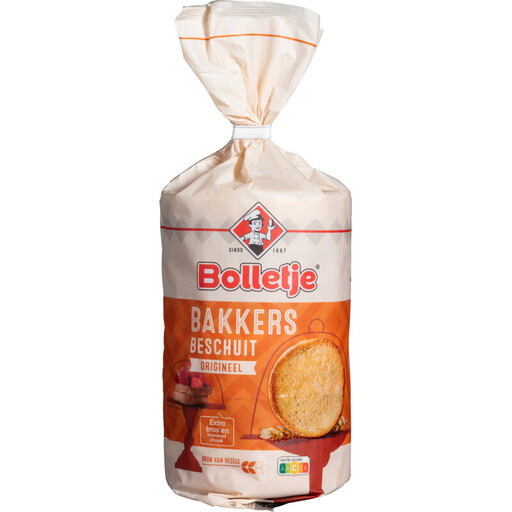 Image unavailable
An option if you’re looking for original rusks in an explicitly larger size to serve with your Easter toppings.
The pack contains 10 pieces. When planning for guests, check the latest allergen information, including for wheat and egg.
No. Don’t treat ‘thick cut’ as a standard measure of rusk thickness. Descriptions such as extra large and robust can help you find a larger base for toppings, but they don’t prove a specific thickness in millimetres. Compare the number of pieces and serving information if you want to assess the size.
Check the packaging of the product you’re serving for any allergens that matter to your guests. The robust and wholegrain varieties reviewed list ingredients including wheat, egg or sesame; other grains or possible traces may also be listed, depending on the variety.
No. Don’t assume that all rusks are made with baker’s salt. According to the Voedingscentrum, bakers aren’t required to use it. If the type of salt used matters to your choice, check the ingredients or ask the producer.
Follow the storage advice on the packaging and reseal the rusks in a dry place after opening. Several of the products reviewed recommend storing them in a dry place; opening the roll shortly before serving means the rusks won’t be left exposed for as long.