
Brunch host whose guests prefer different types of bread
If not everyone wants wholemeal rolls, you can serve white and wholemeal rolls separately and label them clearly. That way, neither type has to be the only option.


For an Easter brunch with guests who have different preferences, serve both white rolls and rolls labelled wholemeal, so everyone can choose for themselves. According to the Netherlands Nutrition Centre, wholegrain products generally contain more fibre than white grain products; ‘multigrain’ on its own does not mean a roll is wholemeal. Check the allergens, salt used and preparation instructions for each product. If a guest needs to eat gluten-free, provide a separate roll specifically sold as gluten-free.
If not everyone wants wholemeal rolls, you can serve white and wholemeal rolls separately and label them clearly. That way, neither type has to be the only option.
If you mainly want to serve wholemeal rolls, you can offer white rolls as an extra option. The Netherlands Nutrition Centre explains that wholegrain products are made from the entire grain; when comparing specific products, also check the fibre per 100 g.
An ordinary wheat roll is not a substitute for a product specifically labelled gluten-free. Check the latest allergen information and keep the gluten-free option separate from the regular rolls during preparation and serving.
Decide which types of bread you need, including whether you need a separate gluten-free option. Then check each product’s label, the number of rolls and the preparation instructions.
| What to consider | What to check before buying | Who it matters to |
|---|---|---|
| Choosing between white and wholemeal | Buy both types and keep them clearly separate when serving. | If my guests don’t all want the same type of bread, I want them to choose for themselves; around 36% of consumers prioritise having a choice between white and wholemeal. |
| Wholemeal and fibre | Look for the word ‘wholemeal’ and compare fibre per 100 g, rather than relying on names such as ‘brown’ or ‘multigrain’. | When I’m mainly looking for wholemeal rolls, I want to know what they actually contain; around 29% of consumers prioritise choosing wholemeal. |
| Allergens and separate options | Read the latest allergen information; if needed, choose a product specifically labelled gluten-free and keep it separate. | If I have a guest who needs to eat gluten-free, I want to know which roll is suitable before buying and be able to serve it separately; around 14% of consumers prioritise this need. |
| Baking and quantities | Count the rolls in each pack and follow the preparation instructions for each bake-at-home variety. | If I need to plan the brunch timings, I want to have enough rolls without assuming they all take the same time to bake; around 21% of consumers prioritise this kind of planning. |
A mix of grains doesn’t tell you on its own whether a roll is made with wholemeal flour. The Netherlands Nutrition Centre advises looking for the word ‘wholemeal’ to check.
Read the product description and compare the nutritional information per 100 g if fibre is important to your choice.
According to the Netherlands Nutrition Centre, using iodised baker’s salt in bread is not compulsory. So you can’t tell whether it’s been used just from the type of bread.
For packaged rolls, check the ingredients list for iodised salt or baker’s salt. For loose rolls, ask which ingredients have been used if the information isn’t displayed.
Even a separately purchased gluten-free product can come into contact with regular rolls when you serve it.
Read the packaging and use a separate breadboard, pair of tongs and knife for the gluten-free option.
Compare individual products within each range: a white, wholemeal or multigrain roll from the same brand may have a different recipe and preparation method.
Worth considering if you want to choose separate white and wholemeal rolls, or need a separate gluten-free product.
Worth considering if you want to browse different types of rolls and bake-at-home bread within one range.
Worth considering if you want to pair white bake-at-home rolls with a separate wholemeal multigrain variety.
Worth considering if you want to compare loose white rolls with packaged bake-at-home varieties.
Worth considering if you want an individual white roll, or to look at other bread you can bake at home.
These g'woon white rolls work well as a white option alongside separately chosen wholemeal rolls. On their own, they don’t make up a complete mix of white and wholemeal.
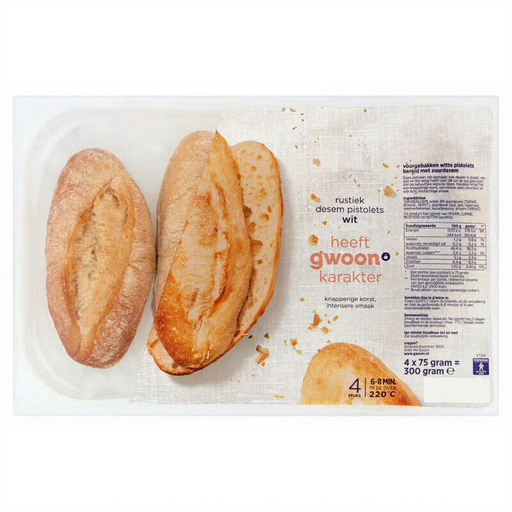 Image unavailable
A white option for guests who prefer white rolls at Easter brunch. The pack contains four rolls; choose a variety labelled wholemeal separately if you’d like to serve wholemeal too.
Not necessarily: ‘multigrain’ means that more than one grain has been used, not that all the flour is wholemeal. The Netherlands Nutrition Centre advises looking for the word ‘wholemeal’ and checking the ingredients list for the specific product.
No. The Netherlands Nutrition Centre says that using baker’s salt in bread isn’t compulsory. For packaged rolls, read the ingredients list; for loose rolls, ask which salt has been used.
If the allergen information isn’t displayed with the rolls, ask for it before buying. According to the Netherlands Food and Consumer Product Safety Authority, this information must also be available for unpackaged food. Ask specifically about the ingredients that are relevant to your guest.
No. A regular wholemeal wheat roll isn’t gluten-free. If a guest needs to eat gluten-free, choose a roll specifically labelled gluten-free, check the latest packaging and prevent contact with regular rolls when serving.
No, preparation instructions vary by product. PLUS gives different air-fryer settings for its white and wholemeal multigrain rolls than Albert Heijn does for its gluten-free white rolls. Always follow the instructions on the packaging of the product you’re using.