
Reader of PDFs packed with maps and tables
You want to view small text, figures and captions on report pages, and are willing to consider a larger device for more screen space.


If you mainly read continuous text and want a device that’s easy to hold, a compact e-reader could suit you. For fixed-layout PDFs with small text, maps and tables, a larger screen gives you more room to view the original page. Try one of your own reports to see how often you need to zoom and pan, whether the lighting is comfortable and whether the specific model’s import and annotation features work with your files.
You want to view small text, figures and captions on report pages, and are willing to consider a larger device for more screen space.
You mainly read text and value a device that’s easy to handle. Before you buy, check how much zooming and panning your PDFs require on a smaller screen.
You use colour, maps or handwritten notes as you read. Check how the features work with your model, file and preferred import method.
Best for: mainly reading continuous text and keeping your device easy to handle in bed.
The trade-off: fixed-layout PDF pages may require more zooming and panning.
Best for: viewing maps, tables and small text on fixed-layout report pages.
The trade-off: a larger device can take up more space when you’re reading in bed, so weigh the extra screen space against your reading position.
| What to consider | What should you check? | Who will find this important? |
|---|---|---|
| Readability of report pages | Open one of your own reports and view a full page, its captions and the landscape view. Note how much zooming and panning you need. | If I want to read small map labels and tables, I need to know how much of the page stays visible; around 28% of consumers put page readability first. |
| Comfort when holding it in bed | Compare the device’s dimensions and stated weight, and allow for any case or stylus. | If I’m holding the device for a long time, ease of handling matters more to me than seeing a full page at once; around 22% of consumers prioritise comfort when holding a device. |
| Reading in low light | Check whether the model has a front light and whether you can adjust the brightness and, where available, the light colour. | When I read in bed without much ambient light, I want to be able to adjust the screen lighting to suit me; around 22% of consumers choose lighting as their main consideration. |
| Colour and annotations | View one of your own colour maps and check that the legend remains clear and that you can save annotations with your PDF and preferred workflow. | If colour is meaningful in my figures or I want to keep notes with a report, I check these features first; around 17% of consumers prioritise colour or annotation. |
| Your own report files | Check file security, the supported transfer method and where imported files and notes will remain available. | If I mainly want to transfer and find my own reports, the import method needs to work with my files; around 11% of consumers make file import their first consideration. |
Kobo’s PDF reader doesn’t let you adjust text size and style in the same way as it does for regular e-book text. This can make a report page with small labels look different from what you expect.
Before choosing, test one of your own reports with small map labels and tables on the screen size you’re considering.
You may need to zoom and pan more than you expect.
Writing and highlighting features can vary by model and PDF import method. A general claim of PDF support doesn’t tell you which annotation features work with your files.
Use a test file to check whether you can highlight, write, save and export in the way you need.
A larger device offers more screen space, but its size and stated weight don’t necessarily tell you whether it will be comfortable to hold in bed.
Compare the device with the case you plan to use, and think about whether you’ll hold it while reading or prop it up.
You may need a case or stand to support the device in your preferred reading position.
Kobo offers compact models for reading on the go, as well as larger models for documents and notes.
The InkPad X Pro is designed for reading on a larger screen and making handwritten notes.
The Note Air6 C is worth considering if you’re looking for a larger colour screen, PDF features and Android.
The Paper Pro is designed for reading and writing on a large colour screen.
The Kindle Scribe is designed for reading documents and taking notes on a large, illuminated screen.
This selection includes compact colour e-ink readers for anyone weighing up a handy size, colour display or adjustable lighting when reading their own report files.
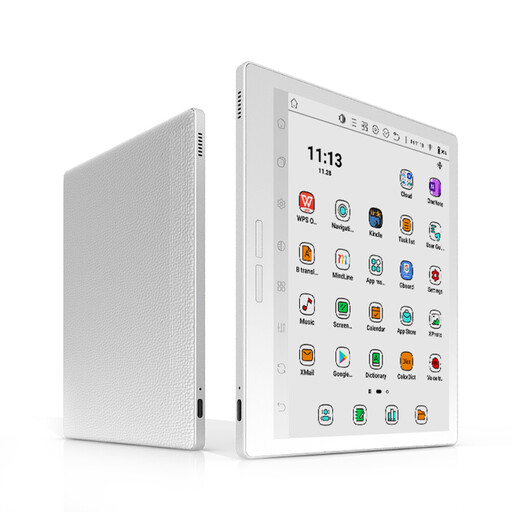 No image available
A good fit if you’re looking for a more compact colour e-ink reader with a front light; the screen size alone doesn’t tell you how much of your report page will be readable at once.
The product name lists 4+64GB, 300 ppi and a front light with 36 levels.
According to the product description, a power adapter isn’t included.
 No image available
A good fit if you’re looking for a small colour screen; test whether report pages and map details are easy for you to view at this size.
The product name lists Android 14 and 8GB+256GB.
Not with Kobo’s standard PDF reader: Rakuten Kobo says you can zoom in and rotate PDFs, but you can’t change the text size or style as you would in a regular e-book. Try one of your own reports to see how its layout works on the screen you’re considering.
According to Rakuten Kobo, you can copy unprotected PDF files from a computer to an e-reader. Check whether your file is protected, and consider which device you want to read the imported report on; imported content won’t automatically appear on other devices.
Don’t assume so: according to the product information for Kindle documents, you can’t write directly on the page of PDFs loaded via USB-C. Check the transfer method and the options available for your specific file before relying on annotations.
The Dutch Government explains that when you buy as a consumer, you’re entitled to a product that meets reasonable expectations, and that the seller must provide a solution if your claim under the legal guarantee is valid. According to its guidance, there’s no fixed statutory guarantee period for every product in the Netherlands.
For online purchases from a business, the Dutch Government says you’ll often have a 14-day cooling-off period, and the seller must tell you about it. Check the terms for your specific purchase, and don’t assume the same rules apply when buying from a private seller.