
Novel reader with a packed train bag
You mainly read science fiction in continuous prose and want a handy device with a light that you can adjust to changing conditions while travelling.


If you mainly read science fiction novels on the train, a compact, front-lit, black-and-white e-reader of around 6 inches is a sensible place to start. If maps, illustrations, more reading space or physical page-turn buttons matter to you, you could consider a larger colour screen. Bear in mind, though, that colour displays are not the same as conventional black-and-white screens. Before you buy, check where your books come from too: according to the Online Library, Kindle does not support the Adobe DRM protection used for its e-books.
You mainly read science fiction in continuous prose and want a handy device with a light that you can adjust to changing conditions while travelling.
You want to put science fiction from the Online Library on your e-reader. Check whether the title is available for e-readers and whether the device supports Adobe DRM; the Online Library explains how to transfer books using a computer.
You also read books with maps, images or comics, and weigh up colour and extra screen space against portability and text contrast.
Start by thinking about where your books come from, then compare screen size, lighting and controls with what you read on the go.
| What to consider | What should you look for? | Who is this important to? |
|---|---|---|
| Comfortable reading and lighting | Compare screen size and adjustable lighting; a larger screen takes up more space. | If I mainly read novels on my journey and want my e-reader to be easy to carry, I prioritise a compact screen and reading light. Around 40% of consumers prioritise portability. |
| Access to books | Check the format and DRM protection for each title. To borrow books from the Online Library, you need titles that are suitable for e-readers and Adobe DRM; the Online Library explains how to transfer books using Adobe Digital Editions on a computer. | If I want to read my existing books or eligible library loans, I first check that my book source is compatible. Around 30% of consumers prioritise access to books. |
| Reading area, colour and buttons | Look at a sample of the type of book you read. An independent review by eReaders.nl notes that the Kobo Libra Colour has less contrast than a conventional black-and-white screen. | If I read maps, illustrations or comics, I weigh up colour and page-turn buttons against size and reading comfort. Around 20% of consumers prioritise images or controls. |
| Only the features you use | Compare the stated screen resolution and storage of the models you are considering. PocketBook lists 212 ppi and 8 GB of nominal storage for the Verse Lite, and 300 ppi and 16 GB for the Verse Pro. | Do you mainly read text-based novels and have no need for extra features? Then I can compare models based on the features I actually need. Around 10% of consumers prioritise simplicity. |
Send to Kindle accepts EPUB files, but the Online Library uses Adobe DRM to protect its e-books. So the mention of EPUB does not mean that a library loan will work on a Kindle.
Before you buy, check both the book’s protection and the DRM support of the exact device.
An independent review of the Kobo Libra Colour notes that it has less contrast than a conventional black-and-white screen. This may be worth considering if you mainly read novels with continuous prose.
Think about whether your books are mainly text or images, and compare screens using sample pages if possible.
The Online Library does not offer every e-book in a version for e-readers.
Check the reading format for each title and use the ‘For e-reader’ filter before choosing a book.
The Clara BW is a compact black-and-white option, while the Libra Colour has a larger colour screen and physical page-turn buttons.
The Verse Lite is a compact entry-level option; according to the manufacturer, the Verse Pro has a higher stated screen resolution and SMARTlight.
The Paperwhite 16 GB (2024 model) is an option for readers who use the Kindle ecosystem and want a 7-inch screen.
The Go 6 (Gen II) is a compact option for anyone who specifically wants to use Android apps on an e-paper device.
These Joybuy models are e-readers with colour displays for readers of illustrated science fiction; one model lists Android 14 in its product name.
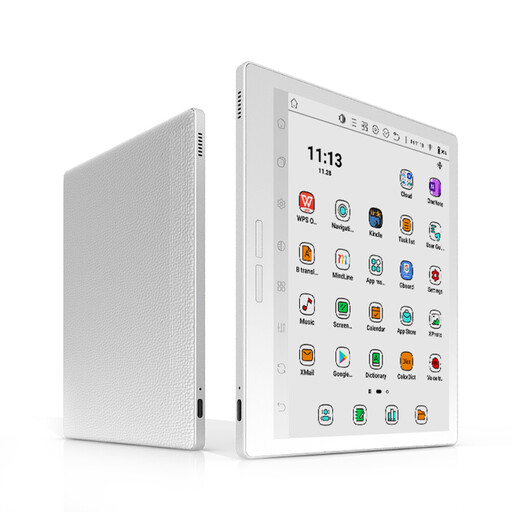 No image available
An option to compare if you read science fiction with colour illustrations as well as novels.
7-inch colour E Ink screen, 4+64GB, 300 ppi and front light with 36 levels.
 No image available
A compact colour-screen option to compare if you read images and consider Android 14 an important listed specification.
6.13-inch colour E Ink screen, Android 14 and 8GB+256GB.
No. Choose a title listed as ‘for e-reader’ and check that your device supports EPUB or PDF with Adobe DRM. The Online Library says Kindle is not suitable for its protected e-books.
Follow the Online Library’s steps: authorise your computer and e-reader in Adobe Digital Editions, borrow an eligible e-reader title, download the book and transfer it using your computer. Do this before your journey.
Not necessarily for a novel that is mainly continuous prose. Colour can be useful for maps, illustrations or comics, but an independent review of the Kobo Libra Colour notes that it has less contrast than a conventional black-and-white screen, and that small text in comics can still be hard to read.
Stow your e-reader and bag so they do not take up an available seat or block the aisle or doors. NS’s luggage rules mention luggage racks and the space under seats; different rules may apply on international trains.
No. According to ACM ConsuWijzer, the remedy depends in part on whether the product breaks sooner under normal use than you could reasonably expect. The seller must resolve the problem in line with the applicable terms; the manufacturer’s warranty is separate.