
Evening reader sharing a room
You read long texts in bed and want to do so without a bedside lamp. Kobo and PocketBook describe adjustable lighting on the models mentioned; see for yourself how much light your roommate notices in your own room.


For reading long philosophical texts in bed, a compact e-reader with adjustable lighting could be a good fit, but check for yourself whether its lowest brightness setting disturbs your roommate. Also check where your books come from: according to Consumentenbond, Kindles don’t support library books with Adobe DRM, and fixed-layout PDFs can be difficult to read on e-readers. If you plan to write extensively on PDFs, compare the note-taking features and any included stylus across models.
You read long texts in bed and want to do so without a bedside lamp. Kobo and PocketBook describe adjustable lighting on the models mentioned; see for yourself how much light your roommate notices in your own room.
You want to read philosophy books from different shops or the online library. Consumentenbond points out that you should factor in file format and copy protection when choosing.
You work with PDFs, footnotes or extensive annotations. Consumentenbond describes potential problems with PDFs on e-readers, so compare a compact model with a larger note-taking device or tablet.
Start with the type of text you read and where your books come from. Then compare the lighting and the space you need for highlighting or making notes.
| What to consider | What to look for | Who is this most important for? |
|---|---|---|
| Reading in low light | Compare brightness, warm light settings and any dark mode in a dark room. | If I read in bed while my roommate is asleep, I want to be able to adjust the lighting myself. Around 36% of consumers prioritise a peaceful evening read. |
| Access to books | Check the file format, Adobe DRM and transfer method for the books you rely on most. | I want to know whether I can open the books I’ve bought or borrowed, including those with copy protection. Around 29% of consumers prioritise access to books. |
| PDFs and footnotes | Open a representative PDF and check the text size, zoom and page turns. | When reading articles with footnotes, I want to be able to read without constantly zooming in. Around 21% of consumers put PDF readability first. |
| Making annotations | Check whether you can write on your file format, whether a stylus is included and how notes are saved. | If I want to make notes directly on philosophical texts, the writing feature needs to work with my files. Around 14% of consumers prioritise extensive annotation. |
According to Consumentenbond, library books with Adobe DRM don’t work on Kindle. A book you can’t open isn’t much use on your e-reader.
Before choosing, check where the books you want to read come from, their file format and any copy protection.
If you want to keep reading these borrowed books, you may need a different compatible reading device.
Consumentenbond explains that zooming can be awkward on an e-reader and that reflowing text can disrupt the layout. So, the fact that a device can open a PDF doesn’t by itself tell you how easy your document will be to read.
Try one of your own articles with footnotes and a representative scan on the screen size you’re considering.
If you read a lot of fixed-layout pages, you may also want to compare a tablet or a larger device.
According to BOOX, the Go 10.3 Gen II doesn’t have a front light, while the Gen II Lumi does. This matters if you want to read without a room light on.
Check the full model name and lighting specifications of the version you’re considering.
The Clara BW is a compact model for reading continuous text, while the larger Elipsa 2E is designed for reading and note-taking.
The Verse Pro is a compact model, while the InkPad 4 has a larger screen and, according to PocketBook, supports formats including EPUB and PDF, even with DRM.
An option to compare if you mainly read philosophical e-books from your existing Kindle collection. The 2024 Paperwhite reviewed has a 7-inch screen.
A brand to compare if you’re looking for a larger e-ink device for documents and note-taking.
These Joybuy product picks are e-ink e-readers for digital reading. Check the lighting and features you need for your books for each version.
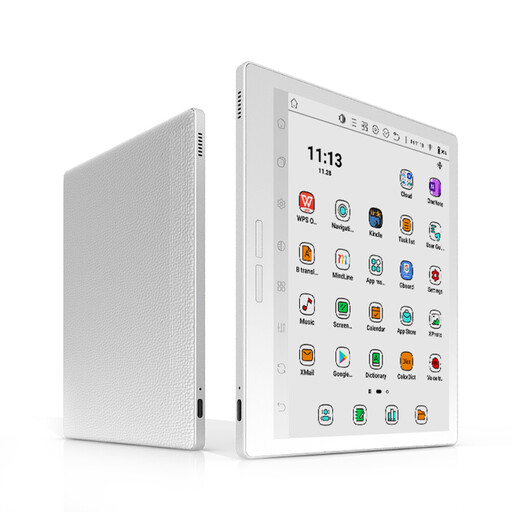 Image unavailable
The product name describes an e-ink e-reader with a 36-level front light.
Specifications according to the product name: 7-inch colour screen, 4+64GB and 300 ppi.
According to the product information, a power adapter is not included.
 Image unavailable
The product name describes this model as an e-book reader with an E-Ink screen.
Specifications according to the product name: 6.13-inch screen, Android 14 and 8GB+256GB.
There’s no guarantee. Adjustable brightness is worth considering, but see which setting works for both of you in your own bedroom; dark mode doesn’t necessarily mean the screen emits no light.
According to Consumentenbond, no: these borrowed books use Adobe DRM, which Kindle doesn’t support. For another e-reader, check the file format and the steps needed to transfer books as well.
Consumentenbond describes transferring books from a computer via USB. A file with Adobe DRM requires special software and an account; check that your model and file support this method.
Not necessarily. Consumentenbond warns that many A4 PDFs remain difficult to read on e-readers because of zooming and fixed layouts. Try a representative scan and compare a tablet if you mainly read this type of document.
When you buy remotely from a business, you’re often entitled to a 14-day cooling-off period, according to the Dutch government. You’re also entitled to a product that meets the terms of the agreement. The Netherlands has no fixed statutory guarantee period, and if something is wrong, the seller is your point of contact. Check the terms and conditions of the specific seller.