
Readers of continuous philosophical texts
If you mainly read ePub books and want a device that’s easy to take with you, a compact design may be your priority; having plenty of screen space for full article pages may matter less.


If you mainly read continuous ePub text, a compact e-reader could suit your needs. For fixed-layout PDFs and extensive note-taking, it’s worth considering a larger screen or a model with a stylus. If you want to borrow e-books from the Dutch Online Library, check before buying that the device supports Adobe DRM and that your chosen title is suitable for e-readers.
If you mainly read ePub books and want a device that’s easy to take with you, a compact design may be your priority; having plenty of screen space for full article pages may matter less.
If you regularly refer to fixed-layout PDFs, consider how much screen space you need and weigh that against the size and weight of a larger device.
If you want to highlight passages or jot down your thoughts, check that the device supports a stylus and that note-taking works with your file format and its security settings.
| What to consider | What should you check? | Who is this important for? |
|---|---|---|
| Access to the books you want | Check each title to see whether it’s available for e-readers, which file format is offered and whether Adobe DRM is required. | If I want to read a particular borrowed or purchased edition, access to that specific title is crucial. Around 31% of consumers give access to the books they want top priority. |
| PDFs with footnotes | View a representative article on the screen size you’re considering, and check how you can zoom in and read the page. | If I want to see a full page of an article, including its footnotes, PDF display matters more than a compact design. Around 25% of consumers prioritise the readability of fixed-layout PDFs. |
| Highlights and notes | Check whether the model supports a stylus, whether one is included and whether note-taking works with your file format and its security settings. | If I want to record my thoughts alongside a passage, I need to know whether I can do that in my own files. Around 25% of consumers give annotating top priority. |
| Portability for long reading sessions | Compare the models’ dimensions and stated weights. Also consider whether lighting or physical page-turn buttons matter for where you read. | If I often take my e-reader with me and read for long stretches, a manageable device is an important factor in my choice. Around 19% of consumers prioritise portability and reading for extended periods. |
A device that works with standard e-books won’t necessarily support the security and transfer requirements of a borrowed book. Availability can also vary by title.
Check where you’ll get the edition you want, whether the title is available for e-readers and which file format and DRM support it requires.
If a device isn’t compatible with your preferred way of borrowing, you may need to find another way to read that title.
Kobo says the Stylus 2 can be used to take notes in ePub, Kobo ePub and unprotected PDF files; protected PDFs aren’t included in that list.
Check the stylus function with the same file format and security settings as the text you’re studying.
A stylus or larger device adds little if your files don’t support the stylus functions you want.
With a PDF, the page layout and footnotes stay in fixed positions. The Consumers’ Association notes that zooming in on PDF files is generally easier on a tablet than on an e-reader.
Try a representative article on the screen size you’re considering. If you expect to zoom in frequently, compare it with a tablet too.
The Clara BW is a compact option for reading. The Libra Colour and Elipsa 2E are worth considering if you’re looking for a compatible Kobo with a stylus.
The InkPad 4 is a 7.8-inch reader for ePub and PDF users; the InkPad One is a larger 10.3-inch model with an active stylus.
The Go 10.3 (Gen II) range is designed for readers who want a larger e-paper screen for both reading and note-taking.
These Joybuy products range from e-readers with smaller screens to larger E-Ink devices for reading and note-taking. If you’re borrowing books, check separately whether your chosen model works with your title’s security settings and files.
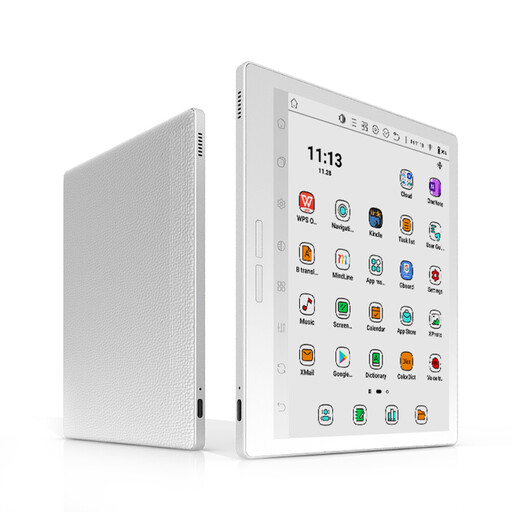 No image available
An e-reader with a colour E-Ink screen for anyone looking for a device with a smaller screen for reading.
7-inch colour E-Ink screen; 4+64 GB; 300 ppi; front light with 36 levels.
 No image available
An E-Ink e-reader with a 6.13-inch screen for anyone considering a device with a smaller screen.
6.13-inch E-Ink screen; Android 14; 8 GB + 256 GB.
 No image available
A larger E-Ink device for anyone who wants to combine reading with handwritten notes.
10.65-inch E-Ink screen; stylus and handwriting features listed in the product description.
No, not every e-reader supports this borrowing service. The Online Library says the device must support Adobe DRM and ePub or PDF, and the chosen title must be available for e-readers. Check these requirements for each title.
The Online Library explains how to transfer books using Adobe Digital Editions on a computer: authorise the computer and e-reader, download a compatible title and transfer it via USB. Since 23 June 2026, the library has specified that new users and anyone reauthorising should use a ByteBooks account.
Don’t assume so without checking first. Kobo says the Stylus 2 can be used to take notes in ePub, Kobo ePub and unprotected PDF files; protected PDFs aren’t among the listed file formats.
Check the current service status before relying on a download. On 21 October 2026, the Online Library reported that e-reader downloads were temporarily unavailable due to an outage; the notice didn’t give a date for when the service would be restored.