
Reader of continuous philosophical texts
You want to read chapters on a long flight using a portable device, with the option to adjust the font size. PDFs with complex, fixed layouts aren’t your main use case.


If you mainly read reflowable e-books, look for a compact e-reader with adjustable text settings. For fixed-layout PDFs and handwritten notes, a larger screen or stylus support may matter more than a compact design. The Consumers’ Association warns that PDF support alone doesn’t guarantee that an A4 page will be comfortable to read. Also check that your edition, DRM protection and preferred note-taking features work on the device you choose.
You want to read chapters on a long flight using a portable device, with the option to adjust the font size. PDFs with complex, fixed layouts aren’t your main use case.
Your texts have fixed pages, footnotes or diagrams. You mainly want to know whether your specific file will be easy to read on the screen.
You highlight arguments or add your own thoughts. The note-taking features available for each model and file format are therefore important when choosing.
Start with the type of file you’ll read most during the flight: reflowable text has different requirements from a PDF with fixed pages. Then decide how important annotating, access to your book source and reading offline are to you.
The Consumers’ Association warns that many PDFs are laid out for A4 and can therefore be difficult to read on an e-reader. Kobo documents adjustable text settings and an aeroplane mode for the Clara BW; check the features of the specific model you’re considering.
| What to consider | What should you check? | Who is this most relevant to? |
|---|---|---|
| Comfortable reading on the go | Check whether your edition contains reflowable text and whether you can adjust the font size and margins. | If you mainly read chapters and want to hold your device for a long time, comfortable text display matters most. Around 26% of consumers say that comfortable reading of continuous text is their main need. |
| PDFs and footnotes | Open a representative page on a similar-sized screen; check the fixed layout, footnotes and diagrams. | If most of your philosophy texts are PDFs with fixed pages, you’ll want to follow the footnotes without constantly adjusting the page. Around 21% of consumers prioritise the readability of PDFs and footnotes. |
| Saving notes | Check stylus compatibility, annotation support for each file format and whether you can export your notes. | If you want to mark up arguments by hand and find them again later, the features available for your files are decisive. Around 21% of consumers make taking and saving notes their top priority. |
| Access to books | Check the exact title, file format and DRM method, and whether your book source works on the device you’ve chosen. | If you want to read a specific edition you’ve bought or borrowed, make sure it opens on your device before you leave. Around 16% of consumers prioritise access to the books they want. |
| Lighting and offline reading | Check the lighting on the exact model; charge the device and open downloaded books before you leave. | If you want to keep reading when the cabin lights are dimmed or there’s no connection, lighting and books saved in advance matter most. Around 16% of consumers prioritise reading in low light and offline. |
An e-reader may open a PDF, but the text, footnotes and fixed page layout can still be difficult to follow on screen. The Consumers’ Association points out that many PDFs are formatted for A4.
Try a representative page with footnotes on the screen you’re considering. If you mainly read PDFs, compare a tablet too.
If you have lots of files with a fixed A4 layout, you may need a second reading device.
The online library uses Adobe DRM for its e-books; check that this borrowing method works on the device you choose.
Before buying, look up the exact title and check its file format and the protection it uses.
According to Kobo, note-taking and export features vary by file format. You can’t write on a PDF protected with DRM using the Kobo Stylus.
Check support for your model and files, and test exporting with a compatible edition before relying on this workflow.
If you can’t export notes in the way you want, it may take extra time to record passages again later.
The range includes compact models for continuous text, as well as models you can use with a compatible stylus.
The Verse Pro Azure is a more compact model, while the InkPad 4 has a larger screen for readers who want more room for text and footnotes.
According to BOOX, the Go 10.3 (Gen II) series is designed for reading and annotating on a larger screen; the Lumi version has front lighting.
This selection of Joybuy e-readers includes models for reading philosophy on the go, including options with a colour E Ink screen or a compact E Ink screen.
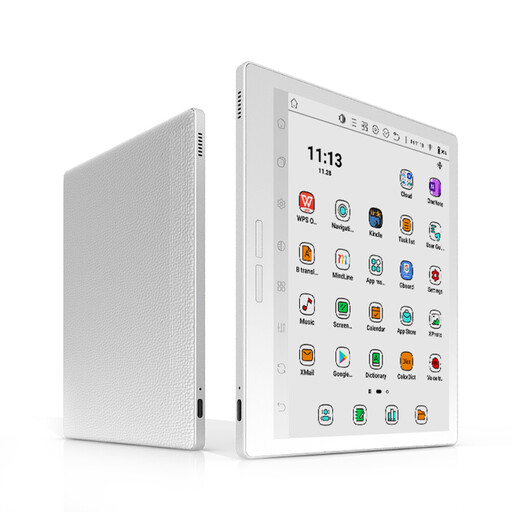 Image unavailable
The listed front light makes this model worth comparing if you read during a flight with changing light conditions.
7-inch colour E Ink screen; 4+64GB; 300 ppi; front light with 36 levels.
According to the product description, a power adapter isn’t included.
 Image unavailable
The product name describes an E Ink e-book reader for reading on the go; check that your reading files and required features work on this model.
6.13-inch E Ink screen; Android 14; 8GB+256GB.
According to EASA, you can use e-readers on board under normal circumstances. It’s best to carry portable electronic devices in your hand luggage, follow instructions for wireless features and check your airline’s rules before you leave. KLM specifically lists e-readers as permitted in hand luggage; these rules don’t automatically apply to every airline.
First, check whether the title is available as an e-book for e-readers from the online library and whether the borrowing method works on your device. The library explains how to authorise and transfer books using Adobe Digital Editions; since 23 June 2026, new authorisations have used a ByteBooks account. Download the book and check that it opens before setting off without an internet connection.
That depends on the model and file format. According to Kobo, handwritten notes in EPUB stay on the e-reader; an unprotected PDF with handwritten notes can be exported. Back up important notes before signing out of or resetting your device.
According to ACM ConsuWijzer, online purchases generally come with a statutory 14-day cooling-off period from delivery, with some exceptions. In addition, under the rules on statutory guarantees, the seller must resolve issues if a product doesn’t meet what you could reasonably expect when used normally. This guarantee isn’t automatically a fixed two-year period.