
Essay reader outdoors
You mainly read continuous text in bright daylight and want a handy screen with as little distracting glare as possible.


If you mainly read reflowable ePub text outdoors, a compact e-reader with a non-reflective E Ink screen is a good fit; the Dutch Consumers’ Association notes that these screens reflect less sunlight. For articles with fixed-layout PDF pages, a larger screen matters more. A model with a stylus is worth considering if you want to write on your texts. Before choosing, also check file support, DRM, and how you can save or export notes.
You mainly read continuous text in bright daylight and want a handy screen with as little distracting glare as possible.
You read literary criticism as PDFs and want to follow footnotes and the original page layout.
You highlight arguments and make your own notes; being able to save or export them is also an important factor in your choice.
Start with the files you actually read: choose a screen size to suit your PDFs, then check screen glare, annotation features and access to your books.
| What to consider | What should you look for? | Which readers is this for? |
|---|---|---|
| Reading in bright daylight | Compare a non-reflective E Ink screen with the screen size and how comfortable the device is to hold. | When I read outdoors, I want to follow continuous text without distracting glare. Around 33% of consumers prioritise compact reading in daylight. |
| Fixed-layout PDFs | Open a representative article on the screen you’re considering and check whether the text and footnotes are readable without constant zooming. | For articles with fixed pages, I want to follow the layout and footnotes, even if that means choosing a larger device. Around 27% of consumers prioritise PDF readability. |
| Highlighting and saving notes | Check that the stylus is compatible with the model and that the file allows writing and the export you need; DRM may impose restrictions. | If I annotate passages by hand, I want to know whether I can use those notes later. Around 20% of consumers prioritise annotating and saving notes. |
| Books and library loans | Check the file formats, any Adobe DRM requirements and the current borrowing process for the source you use. | If my reading list depends on my own e-books or library loans, the device needs to work with that source. Around 20% of consumers prioritise access to their books. |
A device may open a PDF, but that doesn’t mean small text and footnotes are comfortable to read on its screen.
Try a representative article on the screen size you’re considering. Choose a larger screen if the original page layout matters to you.
Kobo distinguishes between ePub notes, unprotected PDFs and PDFs that don’t allow writing. This means you can’t save or transfer notes in the same way for every file.
Check how it works with the file type you actually use, and decide in advance whether you need to export your notes.
The Dutch Online Library says that Kindle doesn’t support the Adobe DRM used for its e-books.
Before buying, check that the device works with the library or other lending service you want to use.
Rakuten Kobo offers compact models for continuous text, as well as larger models for reading and annotating.
The PocketBook InkPad 4 is aimed at readers who want a black-and-white screen with more page space.
The Paperwhite is an option for readers who get their books through Kindle.
BOOX positions the Note Air4 C as a device with a colour screen and note-taking tools for documents.
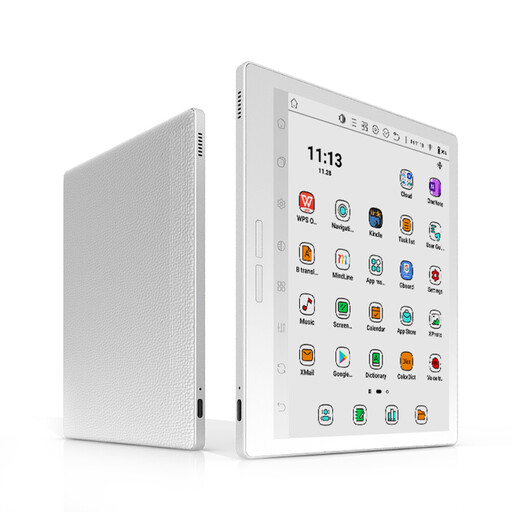
This selection features e-readers with E Ink screens for reading digital texts; check that the screen size and features suit your files for each model.
 No image available
An e-reader for digital texts; check that the screen size and colour display suit the files you read.
7-inch colour E Ink screen; 4+64GB; 300 ppi; 36-level Frontlight.
 No image available
An E Ink e-reader for digital texts; check that the size and listed features suit the way you read.
6.13-inch E Ink screen; Android 14; 8GB+256GB; 5MP/20MP Camera.
For long reading sessions in sunlight, the Dutch Consumers’ Association points to an e-reader’s non-reflective screen. For PDFs that require a lot of zooming, it says a tablet is more convenient. So consider the layout of the texts you usually read.
First, check that the book is suitable for e-readers and that your device supports Adobe DRM and the ePub or PDF format used. According to the Online Library, you borrow and download the book, open it with Adobe Digital Editions, then transfer it using a computer and USB. Since 23 June 2026, new users and those who need to sign in or authorise their device again have needed a ByteBooks account.
According to Kobo, you can export handwritten notes from an unprotected PDF. With ePub, these notes stay on the e-reader; the Stylus can’t write on PDFs that are DRM-protected or have annotation disabled. Check how to save your notes before resetting the device, too.
ACM ConsuWijzer says that online purchases come with a 14-day cooling-off period from the date the product is delivered; check which terms and exceptions apply to your purchase. Separately, under the legal guarantee, the seller must put right, free of charge, any product that doesn’t do what you can reasonably expect when used normally. This doesn’t mean there’s one fixed guarantee period that applies to every e-reader.
No. The Dutch government says that downloading from an illegal source is prohibited and that you must not circumvent copy protection. Use a legitimate source and check the terms that apply to the work.