
Reader of scanned letters
You want to see the handwriting and the original page layout. So consider how much screen space you need, and check whether the smaller lines on your scans are legible. The KB describes a scan as an image of the text.


If you’re reading transcripts with adjustable text, a compact, glare-free e-reader is a sensible choice. For scans with handwriting and a fixed page layout, a larger screen is more practical for viewing. Try one of your own letters on the screen you’re considering and see if you can read the smallest lines without constantly zooming in. Then check how you can transfer your files and save any notes.
You want to see the handwriting and the original page layout. So consider how much screen space you need, and check whether the smaller lines on your scans are legible. The KB describes a scan as an image of the text.
You mainly read converted text outdoors and want a compact screen with adjustable text. Kobo describes the Clara BW, among others, as a glare-free e-reader. Try reading your own text on the screen where you plan to use it.
You switch between letters and your own notes. Check whether you can write on your file and how to save or export your notes; these features vary by device and file format.
First decide whether you’ll mainly read transcripts or scans. Then compare screen size, how easy it is to read outdoors, and how files and notes are handled.
| What to consider | What should you check? | Who is it most important for? |
|---|---|---|
| Scans and handwriting | Open a full scan and check whether you can read the smallest lines without constantly zooming in. | If I want to view the letter page and its handwriting, screen space is my main concern. Consumers who prioritise scan readability are expected to account for around 36% of those considering an e-reader for this type of reading. |
| Reading outdoors | Compare one of your own scans and transcripts outdoors. Check glare, contrast and the amount of zoom needed separately. | If I mainly read transcripts outdoors, I want a compact screen that’s comfortable to view in bright daylight. Consumers who prioritise compact reading outdoors are expected to account for around 29% of those considering an e-reader for this type of reading. |
| Transferring files | Check the file format, any protection and the transfer method for the exact device. | If my letters arrive in different file formats, I want to open them without unnecessary conversion. Consumers who prioritise access to a mix of source files are expected to account for around 21% of those considering an e-reader for this type of reading. |
| Notes and export | Check whether writing on your file works and how you can save or export your notes. | If I want to add comments to letters and find them again later, I want to know how notes are saved for each file type. Consumers who prioritise document annotation are expected to account for around 14% of those considering an e-reader for this type of reading. |
A scan may preserve the original page as an image. Kobo says you can enlarge and rotate PDFs, but you can’t change the text size. This can mean extra zooming and scrolling while you read.
Before choosing a screen size, try a full page from your source with the smallest handwritten lines.
Frequent zooming and scrolling can interrupt your reading.
The import method and file format can determine whether you can write directly on a PDF and how notes can be exported. For example, Amazon notes a limitation for PDFs loaded onto the Kindle Scribe via USB-C, while Kobo describes different export options for PDF and EPUB notes.
Try one of your own letters and check the import method, file protection and export options.
You may need to take extra steps to transfer files or save notes.
The KB describes a scan as an image of text. The National Archives treats handwriting recognition as a separate step for converting handwritten text. So a readable file isn’t automatically searchable.
Ask the archive whether a transcript is available alongside the scan.
Without a transcript, you may need to read the letter manually or find or create a transcript first.
Worth considering if you’re comparing a compact e-reader for text with a larger model for documents and notes.
Compare the black-and-white InkPad 4 with the InkPad Color 3 if you use files in different formats or colour is important in the source material.
The Go 10.3 Gen II Lumi we reviewed is worth considering if you want to combine a large screen for documents with annotation and additional apps.
Worth considering if you’re comparing a large-screen Kindle with a stylus and want to send your documents using a compatible Kindle method.
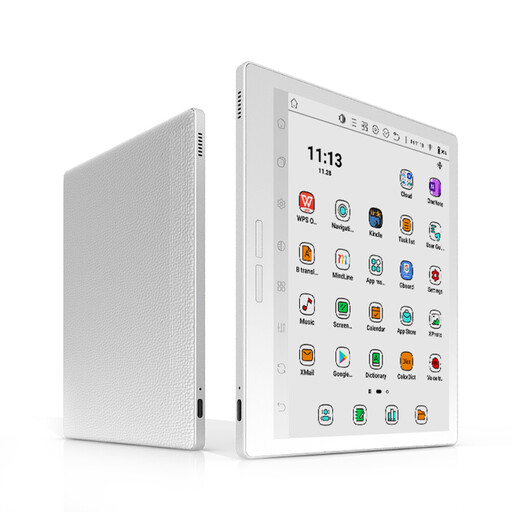
These product picks focus on colour screens for letters where the colour of ink, stamps or markings matters. Screen sizes vary, so try one of your own scans on the model you’re considering.
 No image available
A good fit if you’re comparing colour screens and colour information in the letter matters.
The product title lists a colour E-Ink screen, 300 ppi, 36-level Frontlight and 4+64GB.
The 7-inch screen offers less physical space for a full scan page than a larger screen designed for documents.
 No image available
A good fit if you’re comparing colour screens and colour information in the letter matters, but you’re considering a smaller screen.
The product title lists an E-Ink e-reader with Android 14 and 8GB+256GB.
The 6.13-inch screen offers less physical space for a full scan page than a larger screen designed for documents.
On a Kobo, you can enlarge and rotate a PDF, but according to Kobo you can’t change its text size or font. Try a scan of one of your own letters. For adjustable text, you’ll need a suitable text version.
It depends on your device and files. Kobo explains how to add unprotected PDF and EPUB files using a computer. Amazon says Send to Kindle supports formats including PDF and EPUB, with a maximum file size of 200 MB. Check the transfer method for your file and model.
No. A scan is initially an image of the text. The KB describes OCR as a way to convert scans into computer-readable text; the National Archives treats handwriting recognition as a separate transcription step. Check whether a transcript is already available for your source.
According to ACM ConsuWijzer, the seller must put things right if the product doesn’t perform as you could reasonably expect under normal use. This statutory right is separate from any manufacturer’s warranty and isn’t automatically limited to a fixed two-year period.
ACM ConsuWijzer says that for products bought online, you’ll generally have a statutory 14-day cooling-off period from delivery, with some exceptions. Check the terms that apply and handle the device as you would be allowed to in a shop while trying it out.