
Reader of letter scans
You study handwriting, margins or the original page layout and want to assess a sample scan at the screen size and with the zoom options available.


For full-page scans of historical letters, it’s worth comparing larger screens. A more compact e-reader may be enough for transcriptions, while making notes calls for suitable annotation features. First, check whether the letters are available as files and which formats you can use. An e-reader won’t automatically give you access to physical collections or material that can only be consulted in a reading room.
You study handwriting, margins or the original page layout and want to assess a sample scan at the screen size and with the zoom options available.
You want to make notes on digital letters and check whether annotations work with the file you actually use.
You mainly read reflowable text and want to check that the e-reader is compatible with the file formats and security requirements of the Online Library.
Start by asking whether you’ll be reading a scan, transcription or library loan. The source determines whether screen space, annotations or file access should come first. If you need to zoom in on PDF scans frequently, a tablet is also worth comparing: according to the Consumers’ Association, zooming in on PDFs is smoother on a tablet than on an e-reader.
| What to consider | What should you check? | Who is this important for? |
|---|---|---|
| Scan readability | Open a representative scan and assess the handwriting, margins, navigation and how much you need to zoom in. | If I want to study the original page and small handwriting, I want to see how a real scan looks on the screen first. Around 36% of consumers say scan readability is their top priority. |
| Making notes | Check annotations on your PDF or EPUB, and whether a stylus is included with that exact version. | For my research, I want to be able to save and find notes alongside the digital letter. Around 29% of consumers say annotation is their top priority. |
| File access | Check whether the letter is available as a file and, for library loans, what DRM and transfer requirements apply. | Before choosing a device, I want to know whether my letters or library loans can actually be loaded onto it. Around 21% of consumers put access to the files they want first. |
| Size and weight | Compare the dimensions and weight of the exact version, and view the same sample page on that screen. | If I plan to take my e-reader with me often, I weigh up portability against the screen space a scan page needs. Around 14% of consumers prioritise portability. |
The KB states that the letter collection described can be consulted in its reading room and is not available for loan. So an e-reader won’t automatically make a collection like this available at home.
For the specific letter, first check how to access it, its file format and the terms of use.
The fact that a device opens PDF files doesn’t tell you how much you’ll need to zoom in on a particular scan. The Consumers’ Association notes that zooming in on PDFs is smoother on a tablet than on an e-reader.
Test a representative scan on the screen you’re considering, and think about a tablet too if you’ll need to zoom in frequently.
E-books from the Online Library have separate DRM and file-transfer requirements. Support for your own files doesn’t answer this question.
Before buying, check that the exact model meets the library’s requirements, including the necessary transfer using Adobe Digital Editions.
A brand to consider if you want to compare a larger screen and note-taking features with smaller e-readers.
The InkPad 4 is an option to compare if you want to read a range of text and image files.
The Go 10.3 is designed for reading and annotating documents on a large E Ink screen.
These Joybuy products are designed for digital reading and note-taking on E Ink screens. Check which features and included accessories are relevant to your files for each version.
 No image available
The product description mentions handwriting features and an included stylus, which may be useful if you want to make notes on digital letters.
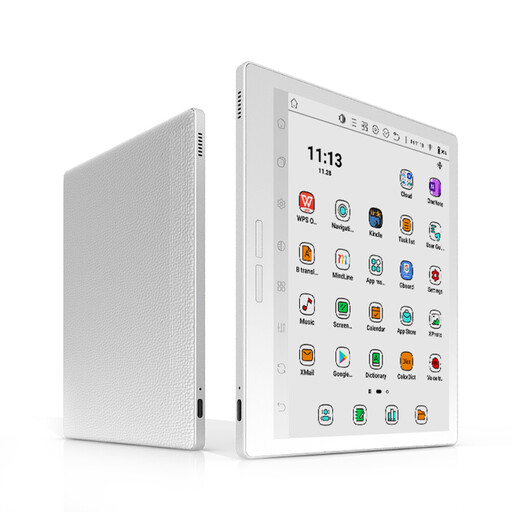
The product is described as an E Ink tablet with a 10.65-inch screen.
 No image available
If you mainly read digital text and are considering a smaller screen, this model may be an option. With fixed scans, however, you’ll need to weigh up the available screen space.
The product name lists 300 ppi and a front light with 36 levels.
 No image available
This model has a 6.13-inch E Ink screen. Compare the screen space with your sample scan if you want to read historical pages.
The product name lists a colour screen, Android 14 and 8GB+256GB.
Don’t assume you can: the KB states that the letter collection described can be consulted in its reading room and is not available for loan. For the specific letter, check whether a digital file is available and what terms of use apply.
No. Check the requirements for the exact model. The Online Library specifies support for Adobe DRM, EPUB and PDF, as well as Adobe Digital Editions on a computer for transferring files. Since 23 June 2026, new users have needed a ByteBooks account for authorisation. On 21 October 2026, the library reported a temporary issue with e-reader downloads; check the latest service status before relying on them.
No. Test a representative scan to see whether the handwriting and margins are legible and how much you need to zoom in. According to the Consumers’ Association, zooming in on PDFs is smoother on a tablet than on an e-reader.
For a distance purchase from a business, the Dutch government says that a 14-day cooling-off period applies in many cases, with some exceptions. Before ordering, check the seller’s information on the cooling-off period and returns. This has no bearing on whether the letters themselves are available.
Not without first checking the rights and terms that apply to the specific material. For material on its website, the KB describes, among other things, an exception for a copy intended solely for your own use, and notes that specific terms of use may take precedence. Check the terms for the relevant source before sharing or publishing images.