
Speaker in a noticeably echoey booth
You record solo and can hear reflections or background noise. You can position the microphone close to you and keep it steady; Shure stresses that a microphone cannot improve a room’s acoustics.


If you can hear reflections or ventilation in a test recording, start with a directional microphone that you can position comfortably close to your mouth. A dynamic model is a practical option. If the booth is quiet and acoustically controlled, compare condenser models too, to find the sound you want for your voice. With either option, check the connection, headphone monitoring and space for a stable mount. As Shure explains, a microphone cannot fix poor room acoustics on its own.
You record solo and can hear reflections or background noise. You can position the microphone close to you and keep it steady; Shure stresses that a microphone cannot improve a room’s acoustics.
You want to hear how a soft voice sounds and can first check that the space is quiet enough. RØDE and Audio-Technica offer condenser models you can compare in this type of setup.
You want to get started without a separate audio interface and monitor the incoming audio through headphones during long recordings. Check the connection and monitoring features of the exact model.
Choose this when: your booth still has audible reflections or background noise, and you can speak at a consistent, close distance.
Bear in mind: position the microphone comfortably out of your breath stream. For XLR, you’ll need compatible recording equipment.
Choose this when: a test recording confirms that the booth is quiet and acoustically controlled enough, and you want to compare the sound of a condenser microphone.
Bear in mind: your setup still makes all the difference; a more sensitive recording will not remove audible reflections. According to RØDE, 32-bit float on the RØDE NT1 5th Generation works via USB only, not XLR.
| Concern | What to check before buying | Who this matters to |
|---|---|---|
| Clarity when there’s room noise | Make a test recording from your planned speaking position and listen for reflections, ventilation and plosives. Shure points out that a microphone cannot effectively separate direct speech from reflections. | If I record softly spoken audio and can hear echo or background noise, I first want to know whether my positioning works. Around 36% of consumers put room noise first among their concerns. |
| How a soft voice sounds | Compare short test recordings using your normal speaking voice at the same playback volume. Assess them in the booth where you plan to use the microphone. | When my voice is soft, I want to listen to the recording in a relaxed setting before choosing a model. Around 29% of consumers prioritise how their voice sounds. |
| Recording and monitoring | Check the connection, computer compatibility and headphone output of the exact model. Make a short test recording before a full session. | When I record longer meditations, I want to connect easily and check what the microphone is picking up. Around 21% of consumers prioritise simple recording and monitoring. |
| Mounting and accessories | Check what’s included with the exact package and whether a stand or arm, cable and pop filter will fit in your booth. | When space is tight in my booth, I want to position the microphone securely without affecting how I speak. Around 14% of consumers prioritise the setup and accessories they need. |
A microphone cannot improve the acoustics of your booth. Audible reflections may therefore still be present in your recording even after you change models.
First, make a test recording from the distance you plan to speak at and assess the room before comparing microphones.
Features can vary between outputs. Shure says that the MV7+’s digital processing is not available via XLR; RØDE states that 32-bit float on the NT1 5th Generation works via USB only.
Check the features of the exact microphone and the connection you plan to use. With XLR, you may need compatible recording equipment.
What comes in the box varies by model. For example, Audio-Technica lists a desk stand with the AT2020USB-X and sells the shock mount mentioned separately as an optional accessory.
Compare the box contents with the space you have available, and test whether the microphone sits securely where you want it.
Compare the dynamic PodMic USB for close-up speech with condenser models such as the NT1 5th Generation and NT-USB+ if your recording space is quiet enough.
The dynamic MV7+ is an option to compare for a fixed, close-up speaking setup with USB-C and XLR.
The AT2020USB-X is a condenser option if you want to record via USB in a quiet booth.
The dynamic Q2U is a USB/XLR option for a compact speech recording setup.
This selection includes compact USB microphones and wireless microphone systems for spoken recordings. Check that the connection and how the microphone is worn suit your recording device and fixed booth setup.
 No image available
This set is designed for a wireless recording setup with two transmitters and one receiver.
The product name mentions a charging case. Check that the connections are compatible with your recording device.
 No image available
According to the product name, this wireless set has one transmitter and one receiver. Compare this configuration with your recording needs.
The product name lists iPhone, camera and Android devices as compatible. Before buying, check that your device and preferred connection are suitable.
 No image available
The product name lists two transmitters and one receiver for a wireless recording setup.
This version is listed as coming with a charging case. Check that the connection is compatible with your recording device.
 No image available
This compact USB microphone could suit you if you’re looking for a small desktop microphone for speech recordings.
The product name mentions a tap-to-mute function. Check that the USB connection is compatible with your recording device.
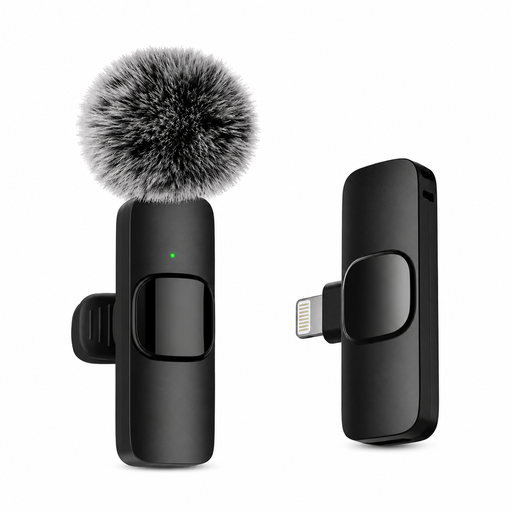 No image available
According to the product name, this is a wireless clip-on microphone with an iOS interface, for anyone looking for a microphone worn on clothing.
The product name mentions noise cancellation. Check that the iOS interface is compatible with your device.
No. A microphone cannot improve the acoustics of your booth. Shure explains that direct speech cannot be effectively separated from unwanted reflections, so make a test recording from your actual speaking position.
For the RØDE PodMic USB, follow the model-specific positioning guidance: RØDE recommends placing it around 5–10 cm from your mouth and speaking towards the grille. Also make a short test recording with headphones, and adjust the position if breath noise or plosives are distracting.
For a consumer purchase in the Netherlands, ACM ConsuWijzer says the seller must offer an appropriate free solution if the product does not meet what you could reasonably expect under normal use. For distance purchases, you will often also have a 14-day cooling-off period; check the applicable terms and conditions.
Check the information provided about the applicable CE marking for the specific product version; the Dutch government explains CE marking for electronic products sold in the EU. If you record identifiable voices belonging to other people and process them as personal data, the Dutch Data Protection Authority says you need a lawful basis under the GDPR. Consent is one possible basis, but it is not automatically the only one.