
People who portion it up at home
If you regularly take Dutch breakfast cake with you, you can buy a larger pack, cut it into portions at home and wrap them up. Check how much you actually use each time and how to store the cake once opened.


Choose a larger pack if you portion it up at home, or a ready-to-go portion if convenience is your priority after exercise. Dutch breakfast cake isn’t automatically a complete meal: the Netherlands Nutrition Centre recommends having a regular main meal after exercise. To choose between standard, wholegrain and no-added-sugar varieties, compare the nutrition information and ingredients on the exact pack.
If you regularly take Dutch breakfast cake with you, you can buy a larger pack, cut it into portions at home and wrap them up. Check how much you actually use each time and how to store the cake once opened.
You want something simple to eat after your workout, but you’re also thinking about what you’ll eat later or alongside it. The Netherlands Nutrition Centre recommends having a regular main meal after exercise.
You want to know what a standard, wholegrain or no-added-sugar variety contains per 100 g and per portion. The ingredients, sweeteners and allergens in the pack you choose also matter.
First decide whether you’ll portion it up at home or want something ready to take with you. Then consider how the cake fits in with your next meal and which nutrition information matters to you.
| What to consider | What to check when buying | Who it matters to |
|---|---|---|
| Pack size | Compare the weight and decide whether you want to cut and wrap the cake yourself. | If I portion it up at home, I want a pack that suits how I use it. Around 38% of consumers prioritise pack size. |
| Meal after exercise | Consider whether you’ll have a regular meal afterwards and, if needed, check the protein per portion. | If I’m not having a meal straight after exercise, I want to know what else I need alongside the cake. For around 31% of consumers, how the snack fits in with a meal is the main consideration. |
| Nutrition information | Compare fibre and sugars per 100 g and per portion; for other varieties, check the ingredients too. | I choose between standard, wholegrain and no-added-sugar varieties based on the label. Around 23% of consumers prioritise this comparison. |
| Convenient portions | Check whether the cake is pre-sliced or individually wrapped. | If I’m travelling straight from the gym, I want something I can take with me without having to cut it first. Around 8% of consumers consider this convenience the most important factor. |
According to the Netherlands Nutrition Centre, an average 30 g slice of Dutch breakfast cake contains around 0.9 g of protein. A slice on its own is therefore not the same as a regular main meal after exercise.
Think about when your next meal will be and consider the cake as part of what you eat then.
The Peijnenburg variety reviewed still lists sugars and contains polyols. According to the Netherlands Nutrition Centre, consuming too many polyols can have a laxative effect.
Check the nutrition information, ingredients and warnings for the exact variety, rather than relying on the front of the pack.
The wholegrain and standard Dutch breakfast cakes reviewed contain rye, a cereal that contains gluten. Other cereals may also be listed in the ingredients or allergen information.
If you need a gluten-free option, check for an explicit gluten-free statement and read the current label on the product.
Within these product ranges, the main differences are pack size, whether the cake is sliced and the nutrition information for each variety. Always compare the exact product, not just the brand name.
Jumbo sells plain Dutch breakfast cake in 550 g and 280 g packs.
PLUS sells plain Dutch breakfast cake in an unsliced 550 g pack and a sliced 485 g pack.
Albert Heijn sells its own Dutch breakfast cake in a 600 g pack.
Koek & Bakker is an ALDI brand with products including sliced wholegrain Dutch breakfast cake and a 485 g Zero variety.
Peijnenburg sells sliced plain Dutch breakfast cake and a no-added-sugar variety, both made with rye.
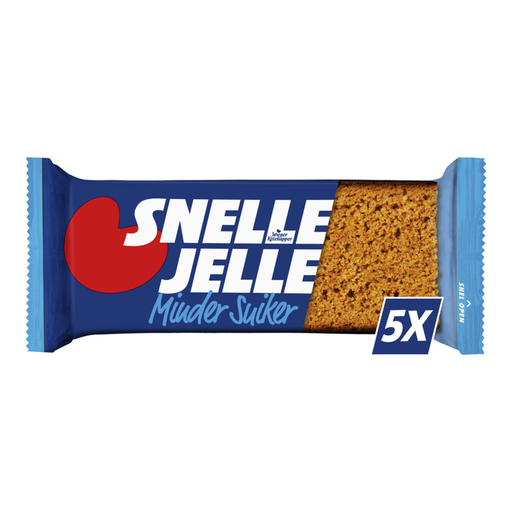
This Snelle Jelle pack is a good option if you want to take Dutch breakfast cake with you after exercise. Consider the wording on the front alongside the nutrition information on the pack.
 No image available
A 250 g pack for anyone who wants to take Dutch breakfast cake with them after exercise.
Don’t take ‘Less Sugar-Free’ as confirmation that the cake is sugar-free: check the sugars per 100 g on the pack. Also compare the nutrition per portion on the label and check the ingredients if you need to avoid gluten.
No, a slice of Dutch breakfast cake does not automatically replace a regular main meal. The Netherlands Nutrition Centre recommends having a regular main meal after exercise; its nutrition figures show that an average 30 g slice of Dutch breakfast cake contains around 0.9 g of protein.
No, that claim does not mean a product is sugar-free. The Peijnenburg variety reviewed lists 4.9 g of sugars and 23 g of polyols per 100 g; also read the warning on the pack about excessive consumption.
No, ‘wholegrain’ does not mean ‘gluten-free’. The wholegrain Dutch breakfast cake reviewed contains rye, a cereal that contains gluten. If you need a gluten-free option, check for an explicit gluten-free statement and read the current label for the exact variety.
Follow the storage instructions on the pack you choose. The product information for the Jumbo, PLUS and Peijnenburg products reviewed says to store them in a dry place; Peijnenburg recommends keeping the cake in a sealed container or tin after opening.