
For those who like to cut their own thick slices
If you want a thicker slice to top with a spread or cut into a shape, an unsliced Dutch spiced cake lets you choose the thickness. PLUS, for example, lists an unsliced plain version.


Choose an unsliced Dutch spiced cake if you want to cut a thick slice yourself for a Valentine’s Day treat, perhaps to top with a spread or cut into a shape. Pre-sliced pieces are ready to share, but the pack weight and number of slices won’t tell you how thick they are. Whichever you choose, check the ingredients and allergen information on the label.
If you want a thicker slice to top with a spread or cut into a shape, an unsliced Dutch spiced cake lets you choose the thickness. PLUS, for example, lists an unsliced plain version.
If you’re weighing up wholegrain ingredients, fibre, sugars or allergens, the information for the exact variety matters more than the name on the front of the pack. For its wholegrain version with no added sugars, Peijnenburg lists separate nutritional values per 100 g.
Pre-sliced Dutch spiced cake is ready to share for a little Valentine’s Day treat. If you’re comparing varieties, check the stated portion size. Albert Heijn, for example, lists one for its plain sliced Dutch spiced cake.
First decide whether you want to choose the slice thickness yourself or serve pre-cut slices straight away. Then check the nutritional information and packaging for the variety that suits you.
| What to consider | What to check when buying | Who it matters to |
|---|---|---|
| Cutting your own thick slices | Check that the pack explicitly says unsliced; don’t use the pack weight to judge slice thickness. | If I’m topping a slice or cutting out a shape, I want to choose how thick it is myself. Around 33% of consumers prioritise this freedom to cut their own slices. |
| Ingredients and nutritional information | Compare sugars and fibre per 100 g, and read the ingredients and allergen information for the exact variety. | If the ingredients determine my choice, I want to know more than whether the cake is called plain or wholegrain. Around 27% of consumers prioritise this. |
| Ready to share | Check whether the cake is pre-sliced and look at the number of slices or the stated portion size. | For a snack platter, I want to be able to lay out slices without having to cut them first. Convenience matters most to around 20% of consumers. |
| Finding the type you want | Check shortly before buying whether the sliced or unsliced version you want is available. | If I want to cut thick slices myself, a sliced pack from the same brand won’t be much use. Around 20% of consumers prioritise finding the product in the form they want. |
The weight and number of slices don’t tell you how thick each pre-sliced piece is. So a pack like this may not be the right choice if you need a specific thickness for a topping or a shape.
Choose an unsliced Dutch spiced cake if you want to decide the thickness yourself; choose a sliced one if having ready-cut portions matters more.
Peijnenburg states that its sliced wholegrain version with no added sugars still contains 4.9 g of sugars per 100 g. The description also tells you nothing about slice thickness.
Read the nutritional table and ingredients list for the exact variety, even if the front of the pack carries a claim that matters to you.
The plain varieties described by Peijnenburg, AH and PLUS contain rye or cereals containing gluten. So the variety name is no substitute for checking the allergen information.
If you have a food allergy or coeliac disease, always check the current label on the pack you’re buying.
Peijnenburg lists sliced plain and wholegrain varieties, as well as an unsliced plain variety.
Albert Heijn lists, among other products, 485 g packs of its own-brand plain sliced Dutch spiced cake.
Jumbo’s range of Dutch spiced cakes includes both sliced and unsliced products.
PLUS lists its own-brand plain sliced version at 485 g and plain unsliced version at 550 g.
ALDI lists sliced Koek & Bakker Dutch spiced cake in wholegrain and Zero varieties.
Lidl lists 485 g packs of wholegrain sliced Dutch spiced cake as a store product.
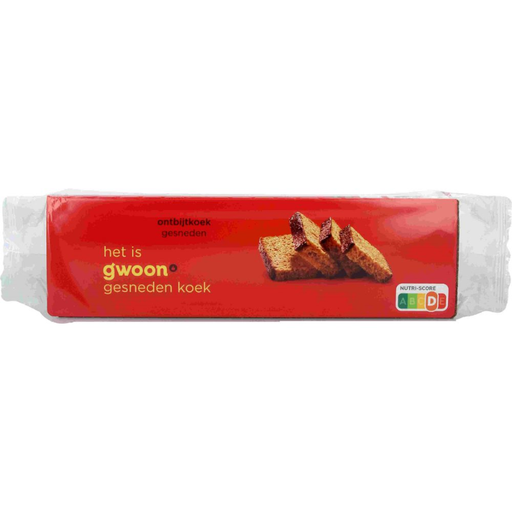
This sliced Dutch spiced cake is a good choice if you want to serve slices straight away. If you’d rather choose the thickness yourself for your Valentine’s Day treat, go for an unsliced product.
 No image available
Ideal if you want to serve slices without cutting them; as the cake is pre-sliced, you can’t choose the slice thickness yourself.
If you have allergies, check the ingredients and allergen information on the current packaging.
Don’t use the weight or number of slices to judge thickness: neither gives you the actual thickness. If you want to choose the thickness yourself for a topping or a shape, make sure you buy unsliced Dutch spiced cake.
No. Peijnenburg states that its sliced wholegrain version with no added sugars contains 4.9 g of sugars per 100 g. Compare the nutritional values for the exact variety rather than relying on the claim on the front of the pack.
No. The plain varieties described by Peijnenburg, AH and PLUS list rye or cereals containing gluten. Check the ingredients and allergen information on the current pack.
You can’t tell from the term alone. In the 2008 agreement published by the Ministry of Health, Welfare and Sport, baker’s salt is described as iodised table salt. However, this doesn’t tell you whether, or how much, is used in a particular pack of Dutch spiced cake. Check the product information for that.
Seal the packaging or storage tin properly and keep the cake somewhere dry and dark. Also follow the storage and use-by information on the specific pack.