What should you look for when buying?
First, decide whether you need a baking ingredient, a chocolate finish or something ready to eat. Then check exactly what the Fairtrade claim applies to on the product you’ve chosen.
| What to consider |
What to check when buying |
Who it matters to |
| Fairtrade claim |
Look for the FAIRTRADE mark or the Fairtrade Cacao statement on the specific product. If there’s an arrow, read the explanation on the back. |
If I’m baking from scratch, I want to check what the Fairtrade claim on my cocoa or chocolate applies to. Around 50% of consumers put this check first. |
| Format for the recipe |
Compare what the recipe calls for with the product format: cocoa powder for the dough, or a bar for pieces or a finish. |
If my recipe calls for cocoa powder, I don’t want to use a chocolate bar without adapting the recipe. Around 30% of consumers prioritise the right product format. |
| Ready to eat or a separate product |
Check whether you’re buying chocolate-covered kruidnoten, a baking ingredient or ontbijtkoek. Also check the ingredients and allergens on the packaging you choose. |
If I’m not baking, I’m looking for something ready to eat; when buying ontbijtkoek, I want to know that I’m not buying a chocolate ingredient. This distinction matters most to around 20% of consumers. |
Brands and product ranges to help you choose
These examples will help you distinguish between product formats and claims. Check the packaging of the product you choose; a mention here doesn’t mean it’s available on Joybuy.
Albert Heijn Delicata
A chocolate range to consider if you’re looking for a bar with a Fairtrade claim.
- On 4 May 2026, Fairtrade Netherlands reported that the entire Delicata chocolate range carries the Fairtrade mark.
- A mark for the range doesn’t tell you which bar is right for your Dutch spiced biscuit recipe. Check the format, cocoa percentage, ingredients and label.
PLUS
The product pages mentioned offer several options with a Fairtrade Cacao claim: cocoa powder, a dark chocolate bar and chocolate-covered kruidnoten.
- The different product formats let you choose between an ingredient for your recipe and a ready-to-eat snack.
- The products aren’t interchangeable. The bar mentioned contains soya; the chocolate-covered kruidnoten contain wheat, milk and soya.
Lidl / Favorina
A seasonal chocolate range to consider if you’re looking for chocolate around the Sinterklaas period.
- Lidl says that its Favorina seasonal chocolate, including products for Sinterklaas, is Fairtrade certified.
- This claim about the range doesn’t confirm that a particular Dutch spiced biscuit product is available at the time or suitable for your recipe. Check the current product and its label.
Peijnenburg
Worth considering if you’re looking for ontbijtkoek alongside your baking ingredients, but not an obvious choice for Fairtrade chocolate.
- The ingredients list for Peijnenburg Ontbijtkoek Naturel at Jumbo includes rye flour and spices.
- That ingredients list doesn’t include cocoa. Don’t treat this ontbijtkoek as a substitute for cocoa or chocolate in a Dutch spiced biscuit recipe.
Cocoa powder for home baking on Joybuy
This cocoa powder is right for recipes that call for powder. To check whether it’s the Fairtrade option you’re looking for, read the claim and any accompanying explanation on the packaging.
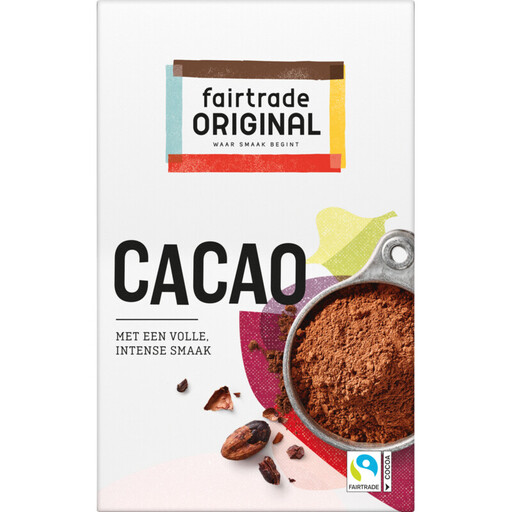 Image unavailable
Fairtrade cocoa powder, 125 g
For recipes that call for cocoa powder; don’t use it instead of a chocolate bar without adapting the recipe.
Size: 125 g. Check the packaging to see which Fairtrade claim and explanation apply to this product.
View on Joybuy
Frequently asked questions
Does the FAIRTRADE mark mean that every ingredient is Fairtrade?
No, you can’t necessarily assume that for a product made from several ingredients. Fairtrade International advises you to read the back of the packaging if there’s an arrow next to the mark. It will explain which ingredients and sourcing method the claim refers to.
When should I choose cocoa powder for homemade Dutch spiced biscuits?
Choose cocoa powder when your recipe calls for it in the dough. The PLUS product page states that Fairtrade Original Cocoa Powder contains Fairtrade Cacao under the mass balance principle; don’t replace a specified quantity of chocolate bar with powder without adapting the recipe.
Can ontbijtkoek replace the chocolate in a Dutch spiced biscuit recipe?
No, not as a direct substitute. The ingredients list for Peijnenburg Ontbijtkoek Naturel at Jumbo includes rye flour and spices, but no cocoa. Choose ontbijtkoek as a separate product and follow the ingredients in your recipe for the Dutch spiced biscuits.
What should I check if I have an allergy and want to buy chocolate-covered kruidnoten?
Always check the packaging of the kruidnoten you’re buying. The PLUS milk chocolate-covered kruidnoten described contain wheat, milk and soya; also check the current list of ingredients that the product may contain.
Is iodised baker’s salt compulsory for Dutch spiced biscuits?
No, don’t assume you have to use iodised baker’s salt for Dutch spiced biscuits. According to the Netherlands Nutrition Centre, bakers aren’t required to use baker’s salt. Check the ingredients information to find out what salt is used in a specific product.


