
Shoppers with a strict sugar target
You want to know exactly how much sugar the rusks contain. Check the nutrition information per 100 g; ‘light’ doesn’t necessarily mean the product has less sugar.


When comparing Dutch rusks with aniseed sprinkles, start by checking the sugars per 100 g in similar rusks, rather than relying on the brand, a wholemeal label or the word ‘light’. Under EU rules, a solid food can only be described as low in sugars if it contains no more than 5 g of sugars per 100 g. Assess the aniseed sprinkles separately as a topping, too. If you’re mainly looking for fibre or the traditional rusk shape, that’s a different choice from needing a rusk that demonstrably qualifies as low in sugars.
You want to know exactly how much sugar the rusks contain. Check the nutrition information per 100 g; ‘light’ doesn’t necessarily mean the product has less sugar.
You want to keep a familiar combination while making a considered choice. Compare the rusks and the sprinkles separately, as the nutrition information for the base alone doesn’t tell you everything about the treat.
You might be considering wholemeal or multiseed rusks, for example. Compare fibre and sugars separately per 100 g: a fibre-focused option isn’t automatically low in sugars.
First decide whether the sugar content of the rusks, the fibre or the familiar way of serving them matters most to you. Then check the nutrition information for both the rusks and the topping before assessing them as a combination.
| What to consider | What to check when buying | Who it matters to |
|---|---|---|
| Sugars in the rusks | Check ‘of which sugars’ per 100 g. If the product is labelled ‘light’ or ‘less sugar’, check what the comparison refers to. | If I’m specifically looking for a rusk that’s low in sugars, I want to be able to check its sugar content rather than rely on the packaging. For around 42% of consumers, a demonstrably low sugar level is the most important factor. |
| Fibre as well as sugars | Compare both values per 100 g in similar rusks, rather than looking only at the values per portion. | I might choose a wholemeal or multiseed option for its fibre, but that doesn’t tell me anything about its sugar content. For around 33% of consumers, fibre comes first when choosing. |
| Rusks and topping together | Check the nutrition information for the aniseed sprinkles, too, and decide how much topping you want to use. If you choose a different base, check whether its shape works for serving. | When serving them, I mainly want to keep the familiar combination of rusks and aniseed sprinkles, without overlooking the sweet topping. For around 25% of consumers, the serving experience is the main priority. |
Fibre and sugars are separate nutrients. So you can’t judge whether a wholemeal or seeded option is low in sugars based on its name alone.
Compare both fibre and sugars per 100 g in similar rusks. Under EU rules, a solid food can only carry the claim ‘low in sugars’ if it contains no more than 5 g of sugars per 100 g.
According to the Voedingscentrum, ‘light’ can refer to a reduction in energy, fat or sugar compared with a similar product.
Check what the reduction refers to on the packaging, and look at the sugar value separately.
A portion of rusks with aniseed sprinkles consists of a base and a topping. The sugar content of the rusks alone doesn’t tell you about the whole combination.
Check the nutrition information on both packs and take into account how many sprinkles you use.
Albert Heijn notes in its product information that ingredients and nutritional values, among other details, may change.
If you’re following a strict sugar target or have an allergy, check the packaging of the product you’re actually using, too.
Bolletje has several rusk ranges, including Echte Beschuit and Bakkers Beschuit Origineel.
Albert Heijn’s rusk range includes its own-brand wholemeal and multiseed options.
Jumbo’s range includes plain and multigrain rusks.
Albert Heijn’s range includes TastyBasics rusks with mixed seeds, as well as sunflower and pumpkin seeds.
These TastyBasics rusks are options for anyone considering a seeded base with a topping. If you’re serving them with aniseed sprinkles, check that their shape and texture are suitable, and assess the sprinkles separately.
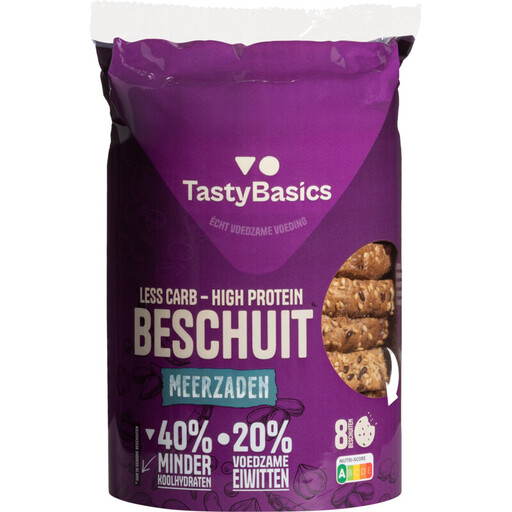 Image unavailable
For anyone considering a multiseed base with a topping; check whether the shape is suitable for aniseed sprinkles.
Pack size: 184 g. To help you choose based on sugar content, compare the nutrition information on the pack and consider the topping separately.
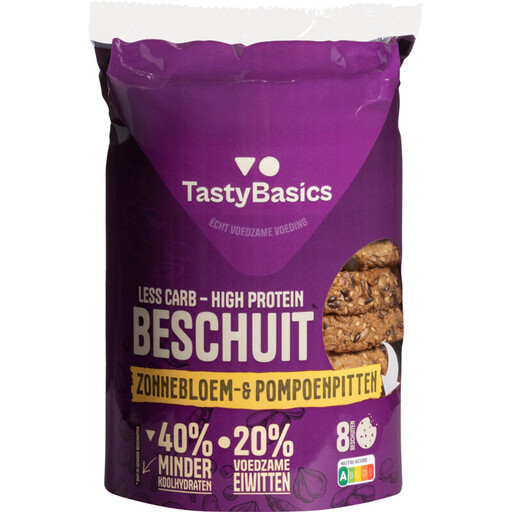 Image unavailable
For anyone considering a sunflower seed option as a base with a topping; check that it suits the way you want to serve it.
Pack size: 8 pieces. Check the latest nutrition information for sugars per 100 g, and assess the aniseed sprinkles separately.
Under EU rules, a solid food can carry the claim ‘low in sugars’ if it contains no more than 5 g of sugars per 100 g. A wholemeal label or seed mix alone doesn’t prove that rusks meet this limit.
Not necessarily. According to the Voedingscentrum, ‘light’ can refer to at least 30% less energy, fat or sugar than a similar product. Check what the reduction refers to, and also look at ‘of which sugars’ in the nutrition information.
Compare similar rusks per 100 g, looking at the values that matter for your choice, such as sugars and fibre. The Voedingscentrum recommends comparing labels per 100 g, as portion sizes can vary.
Yes. If you’re choosing based on the sugar content of the whole treat, assess the rusks and the aniseed sprinkles separately. Check the nutrition information on both packs and take into account how much topping you use.