For seated practice at a computer, a wired USB headset is usually the simplest place to start, as long as its connection is compatible with your computer. Consider Bluetooth only after checking that your computer and headset support microphone recording and your preferred playback at the same time. A recording headset with an XLR microphone requires a suitable audio interface. A claim about noise cancellation for calls does not prove that Dutch pronunciation details will be captured accurately, so make a test recording of the sounds you’re practising.
Who is this guide for?
Learners reviewing their pronunciation
You record short Dutch pronunciation exercises and compare what you say with what you hear. Vrije Universiteit Amsterdam offers individual online pronunciation exercises; for the SM35 microphone, Shure recommends positioning it near the corner of your mouth.
Practising at a desktop computer
You want to get started without separate recording equipment and check that your headset, computer port and selected recording input are compatible. Audacity explains how to connect a microphone and audio interface to a computer.
Practising in a shared space
You have background noise while practising and want to assess both the recording and playback. Jabra says that the microphones in the Evolve2 30 SE range help reduce background noise during calls; test the results with your own practice words, too.
What should you look for when choosing?
Wired USB headset
Choose this option: if you practise at a computer while seated and want a direct digital connection.
Bear in mind: the cable limits your freedom of movement; also check whether the model uses USB-A or USB-C.
Wireless Bluetooth headset
Choose this option: if freedom of movement matters more to you than a simple, fixed recording setup.
Bear in mind: Microsoft specifies certain requirements for stereo playback while the microphone is active, including computer, Windows version and Bluetooth support.
Recording headset with XLR
Choose this option: if you already have a suitable audio interface or deliberately want to build a recording setup with separate connections.
Bear in mind: the microphone on the Audio-Technica BPHS1 connects via XLR, and you’ll need an interface to record on a computer.
The table organises the choice around four possible priorities for seated Dutch pronunciation practice.
| Consideration |
What should you check? |
Who is this important for? |
| Recording pronunciation details |
Make a test recording of the sounds you’re practising. For the SM35, Shure recommends positioning it near the corner of your mouth rather than directly in front of it. |
When I listen back to Dutch sounds, I want to be able to assess differences in pronunciation, not just hear my voice. Around 36% of consumers say capturing pronunciation details is their main purchasing concern. |
| Connection and recording input |
Compare your computer port with the exact headset model, and select the correct microphone in your recording software. Audacity explains that an XLR microphone requires an audio interface. |
When I practise at a desktop computer, I want to be sure the headset is compatible and recognised as a recording input. For around 29% of consumers, connection and input selection are their main purchasing concern. |
| Background noise |
Make a test recording in your own space and listen back to check that you can assess the sounds you’re practising. Don’t judge noise cancellation on the basis of a call feature alone. |
In a shared space, I want to check whether background noise interferes with recording and playback. Background noise is the main purchasing concern for around 21% of consumers. |
| Wearing comfort |
Choose between mono and stereo, and check how adjustable and comfortable the headband and ear cushions are. |
For repeated seated practice, I want a comfortable headset that suits how I like to listen back. Around 14% of consumers give wearing comfort top priority. |
Common purchasing mistakes
-
Assuming a noise-cancelling call microphone guarantees accurate pronunciation recordings
Specifications for calls don’t tell you whether individual Dutch sounds will be easy to assess in your recording.
Before deciding a model is suitable, make a test recording of the sounds you actually practise.
-
Assuming every headset connects directly via USB
The Audio-Technica BPHS1 has separate connections for the microphone and headphones. Audacity explains that an XLR microphone requires an audio interface to record on a computer.
Check the connectors on the model you’ve chosen and the inputs on your device. If you choose an XLR microphone, bear in mind that you’ll need a separate audio interface.
An interface is an extra component in your recording setup.
-
Selecting the wrong microphone or letting the recording distort
You might accidentally record using your computer’s built-in microphone. Audacity says that audio clipped at 0 dB can’t be repaired afterwards.
Select your input and output separately, and check the recording meter before you start.
Brands to consider
Logitech
The H390 is a wired USB computer headset for a straightforward computer setup.
- Logitech lists inline controls and a noise-cancelling microphone.
- Check whether each model uses USB-A or USB-C. A call feature doesn’t indicate how accurately Dutch sounds will be recorded.
Jabra
The Evolve2 30 SE range is a wired headset for business calls.
- Jabra says the system uses two microphones to reduce background noise during calls.
- This is the manufacturer’s claim about calls, not an independent test of pronunciation recordings.
HP Poly
The Blackwire 3200 series offers wired headsets in a choice of wearing styles.
- HP describes mono and stereo models, as well as an adjustable headband across the range.
- Not every connection or wearing style is available on every model, so check the version you’re considering.
EPOS
The IMPACT 100 is a lightweight wired headset for calls.
- For the UC Stereo USB-C+A, EPOS lists a USB-C connection with a USB-A adapter and a directional microphone.
- The stated call quality is a manufacturer claim, not a measurement of Dutch pronunciation details.
Audio-Technica
The BPHS1 is designed for a recording or broadcast setup with separate microphone and headphone connections.
- Audio-Technica specifies a positionable dynamic microphone and closed-back ear cups.
- The XLR microphone requires a suitable audio interface to record on a computer; this isn’t a USB headset that connects directly.
Headsets for seated recording
These wired Joybuy headsets have microphone options for recording and listening back at a desktop computer; check that the connection is compatible with your device.
 No image available
Trust GXT 498W Forta, white
The detachable, flexible microphone can help you adjust its position to suit your setup.
Wired with a 3.5mm connection; the description lists 50mm drivers, over-ear cushions and on-earcup controls.
View at Joybuy
 No image available
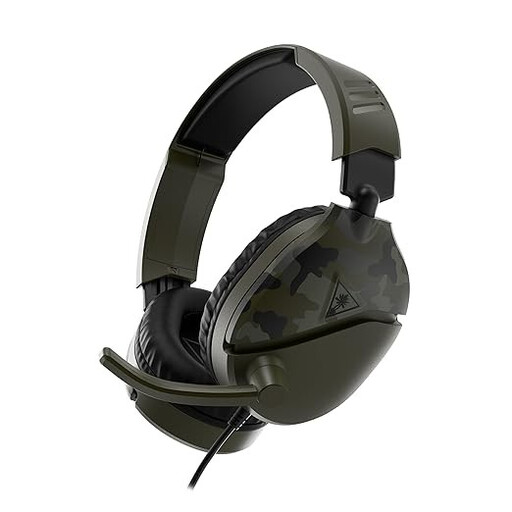
Turtle Beach Recon 70, Green Camo
The microphone can be lowered in front of your mouth and flipped up to mute it.
Wired via 3.5 mm; the product information lists compatibility with PC, PS5, Switch 2 and Xbox Series X|S.
View at Joybuy
 No image available
Logitech PC 960 USB headset
The USB connection and adjustable microphone boom suit a desktop setup where you want to adjust the microphone position.
The product description lists stereo sound, inline controls and a mute indicator.
View at Joybuy
 No image available
Logitech H340 USB headset, black
The USB connection is an option for recording on a computer with a compatible USB port.
The description lists an adjustable microphone, stereo sound and an adjustable headband.
View at Joybuy
 No image available
Razer BlackShark V2 X 7.1, black
The product information lists a cardioid microphone and recommends positioning it about 1–2 inches from your mouth during use.
Wired via 3.5 mm; the description lists volume control and a mute button.
View at Joybuy
Frequently asked questions
How do you set up a headset for a pronunciation exercise?
Select the headset microphone as the input and the headset as the output in your recording software. Position the microphone boom near the corner of your mouth, make a short test recording and check the meter. For normal speech, Audacity recommends peaks between −18 dB and −6 dB and warns that clipping at 0 dB can’t be repaired afterwards.
Can you connect the Audio-Technica BPHS1 directly to a laptop?
Not as a USB headset: the BPHS1 has an XLR microphone connection and a separate 6.3mm headphone connection. Audacity says that an XLR microphone requires an audio interface to record on a computer.
What should you check with Bluetooth if you want to record and listen at the same time?
Check that both your computer and headset support it. For stereo playback while the microphone is active, Microsoft lists requirements including Windows 11 version 24H2 or later and built-in Bluetooth LE support; without the necessary support, playback may be mono.
What cooling-off period and guarantee apply to online purchases in the Netherlands?
According to the Dutch government, distance purchases from a business often come with a 14-day cooling-off period, subject to exceptions depending on the specific purchase. You’re also entitled to a product that is fit for purpose; the Dutch government says there is no fixed statutory guarantee period in the Netherlands.


