What should you look for when choosing?
First decide whether you want to serve the portions in advance or cut them yourself. Then check which label suits your guests’ needs.
| What to consider |
What to check |
Who it matters to |
| Serving portions |
Check the number of pieces, the weight per piece and whether they’re individually wrapped. |
If everyone needs to be able to pick up a small piece, I don’t want to have to cut it during the party. Around 45% of consumers put portion convenience first. |
| Ingredients and allergens |
Read the ingredients, allergen information and nutritional values for the version you’ve chosen. |
If guests avoid certain ingredients, I want to know exactly what’s in their piece before I serve it. For around 33% of consumers, this check matters most. |
| Enough for the group |
Compare the number of portions available and decide whether you can portion it yourself. |
For a larger table, I want to be able to adjust the quantity, even if that means cutting it myself. Around 22% of consumers value this flexibility most. |
Brands to compare
These brands offer examples of different pack formats. Always compare the specific version rather than relying on the brand name alone.
Peijnenburg
Worth considering if you want to compare individually wrapped Dutch breakfast cake with mini formats.
- Peijnenburg describes an original 10-pack containing ten individually wrapped slices of 28 g each.
- Jumbo no longer listed Parelkandij Mini’s 170 g in its online range; check availability for the version you want.
Snelle Jelle
Worth considering if you want to compare bars with smaller pieces of Dutch breakfast cake.
- PLUS lists Snelle Jelle versions in packs of four, five and nine.
- Check the weight per bar and the label for your chosen version before serving it as a small taster portion.
Bolletje
An example of sliced Dutch breakfast cake for anyone who wants to put together a serving plate.
- PLUS describes a 500 g pack of sliced original Dutch breakfast cake.
- For this version, PLUS lists rye, wheat and lupin as allergens present, and nuts as a possible allergen; check the current label.
Koek & Bakker
A pre-sliced option if you want to serve the pieces yourself.
- ALDI describes a 485 g sliced Koek & Bakker Zero version.
- The pack doesn’t contain individually wrapped mini portions, so you can choose how large to serve the pieces. Be sure to read the label.
Tastino
A brand to look at if you want to portion a larger Dutch breakfast cake.
- Lidl described Tastino Dutch breakfast cake in packs of 465–550 g.
- Check the current size and availability before assuming this version will suit your guest list.
Dutch breakfast cake on Joybuy
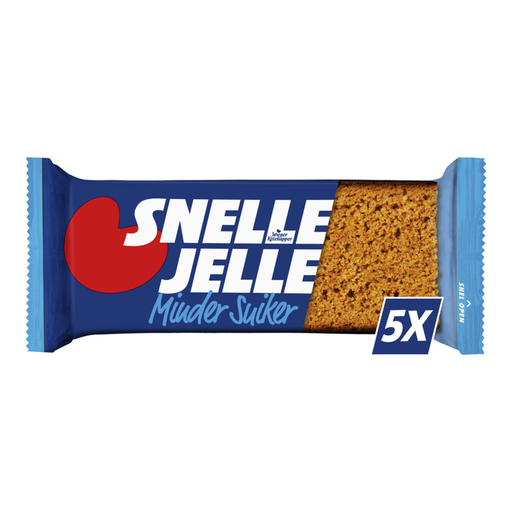
This Dutch breakfast cake bar is an option if you don’t want to cut a whole cake. Check whether the portion size works for a table with several snacks; the product name doesn’t confirm that it’s a mini format.
 No image available
Snelle Jelle Breakfast Cake Less Sugar-Free, 250 g
A Dutch breakfast cake bar to consider if you don’t want to cut a whole cake when serving. The product name lists a 250 g pack; check the packaging for the weight per bar, ingredients, allergens and nutritional information. Don’t assume from the version name that the bar is sugar-free.
View on Joybuy
Frequently asked questions
Does mini Dutch breakfast cake automatically mean a smaller portion?
No, check the weight per piece. Peijnenburg lists slices weighing 28 g each in its original 10-pack, while the Parelkandij Mini’s described by Jumbo weigh around 14 g each. Choose a size that works alongside your other snacks, and check that the version is available.
Should I read the label if I’m serving Dutch breakfast cake to guests with allergies?
Yes, check the label for the exact version you’re serving. The Netherlands Food and Consumer Product Safety Authority sets out the mandatory allergen information required on packaged foods. Ingredients and any warnings can vary between Dutch breakfast cakes. Keep the packaging available for guests who want to check the information themselves.
Is ordinary Dutch breakfast cake suitable for someone avoiding gluten?
Don’t assume so without checking the label: standard versions may contain rye or wheat. If you need gluten-free food, only choose a product clearly labelled gluten-free, and check the rest of the allergen information on the pack too.
Does every Dutch breakfast cake contain iodised baker’s salt?
No, this doesn’t follow from the Dutch rules on iodine compounds in bakery products. The Netherlands Food and Consumer Product Safety Authority explains when these may be present through baker’s salt, not which ingredients every Dutch breakfast cake contains. Check the ingredients list for the specific version.


