
Stocking up and want thick slices?
With an unsliced loaf of Dutch breakfast cake, you decide how thick to cut each slice. It’s a good choice if a more substantial slice matters more to you than being able to grab a ready-made portion.


If you want to cut thicker slices of Dutch breakfast cake from your store cupboard, choose an unsliced loaf so you can decide how thick to cut them. Pre-sliced cake saves you the effort, and individually wrapped portions are easy to take with you. However, a portion’s weight doesn’t prove that the slice is physically thicker.
With an unsliced loaf of Dutch breakfast cake, you decide how thick to cut each slice. It’s a good choice if a more substantial slice matters more to you than being able to grab a ready-made portion.
Pre-sliced Dutch breakfast cake is easy to share without any cutting. When stocking up, check how many slices are in a pack and how to store it after opening.
If ingredients, sugars or fibre affect your choice, compare the nutritional information for the specific varieties rather than looking at pack size alone.
First decide whether you want to choose the thickness of each slice yourself or simply grab portions quickly. Then compare the pack sizes and nutritional information of the varieties that meet your needs.
| What to consider | What to check before buying | Who it matters to |
|---|---|---|
| Choose the slice thickness yourself | Check whether the cake is unsliced, and consider whether you can cut it into slices of your preferred thickness at home. | I want to cut a thicker slice for a more substantial snack, even if it takes more effort. For around 36% of consumers, being able to control slice thickness comes first. |
| Pack size for stocking up | Compare the amount in each pack and choose a size you can finish after opening and store according to the label. | When I stock up on several packs, I want an amount that suits how much I use. For around 29% of consumers, pack size is the main consideration. |
| Nutritional information | Compare sugars and fibre on the same basis, such as per 100 g, and read the ingredients list too. | Before stocking up, I want to know what ingredients and nutritional values a variety contains. For around 21% of consumers, this information is the main consideration. |
| Portions and storage | Check whether the cake is sliced or individually wrapped, and follow the storage instructions after opening. | I want to grab a slice quickly or take a portion with me, without having to cut it each time. Around 14% of consumers put portion convenience first. |
Peijnenburg lists 49 g portions for Dubbel Lekker. That weight doesn’t tell you how thick a portion is physically.
If a thick slice is essential, choose an unsliced loaf of Dutch breakfast cake so you can cut your own. For pre-sliced cake, only assume a particular thickness if it’s stated for that specific variety.
You can’t assume a product contains iodised baker’s salt just because it’s Dutch breakfast cake.
If this ingredient matters to your choice, check the ingredients list on the specific pack.
The range includes both sliced Dutch breakfast cake and individually wrapped portions.
The own-brand range includes sliced and unsliced Dutch breakfast cake, so you can compare pack size and the effort involved in cutting it yourself.
The own-brand range offers several pack formats for anyone looking to stock up.
The own-brand range gives you the choice of grabbing a slice straight away or cutting your own.
This ALDI own brand has pre-sliced varieties of Dutch breakfast cake.
This unsliced Dutch breakfast cake is a good match if you want to cut slices to your preferred thickness from a loaf in your store cupboard.
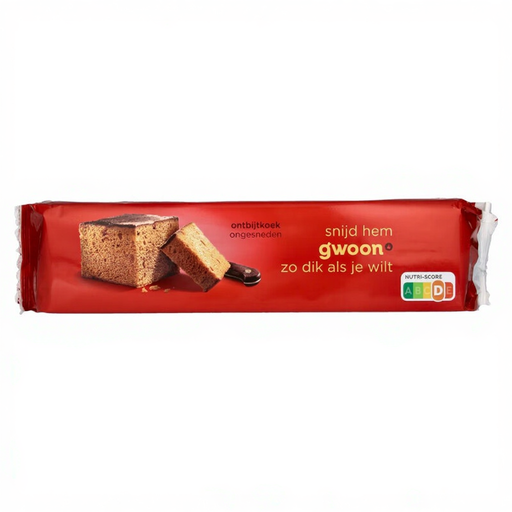 Image unavailable
For anyone who wants to choose the slice thickness themselves and doesn’t mind doing the cutting.
Unsliced 550 g pack. Check the current ingredients and allergen information on the pack, especially if these affect your choice.
Choose an unsliced loaf if you want to decide how thick to cut each slice. For pre-sliced cake, the number of slices and the portion weight don’t prove that they have a particular physical thickness.
Follow the instructions on the packaging for the variety you’ve chosen. The Peijnenburg and PLUS products reviewed recommend storing the cake in a cool, dry place; Peijnenburg recommends keeping it in a sealed tin or container.
Don’t assume that it does. The Netherlands Food and Consumer Product Safety Authority describes adding iodised baker’s salt to bakery products as an option. If this matters to your choice, check the ingredients list for the specific Dutch breakfast cake.
No. Rye is a gluten-containing grain. Check the latest ingredients and allergen information for each variety, and don’t rely on the product name alone.