Who is this for?

Anyone comparing sugar claims

You want to know whether a Dutch breakfast cake contains no added sugars, has less sugar than another variety or is actually labelled sugar-free. So, as well as checking the front of the pack, you read the ‘of which sugars’ figure and the ingredients list.

Anyone organising picnic portions

You want to take Dutch breakfast cake with you and hand it out without having to slice it on the spot. So you’re comparing bars with a large pre-sliced loaf that you’ll need to pack yourself.

Anyone who needs to check ingredients carefully

You check for rye, gluten, polyols or xylitol if these ingredients matter to you or the people you’re with. If you’re bringing a dog, keep any Dutch breakfast cake containing xylitol out of its reach.

What should you look for when choosing?

First, decide which sugar claim you’re looking for. Then choose between bars and a sliced loaf, and check the ingredients that matter for your picnic.

What to consider What to check Who it matters to
Sugar claim Compare the claim with the ‘of which sugars’ figures per 100 g and per portion, and read the ingredients list. If I want to choose a lower-sugar option, I want to know what’s behind ‘zero’ or ‘less sugar’. Around 42% of consumers put checking sugar content first.
Taking it along and sharing Check whether it comes as bars or a sliced loaf, and whether you’ll need to pack the portions yourself. For a picnic with several people, I want to hand out portions without having to slice them in the park. Convenience is the top priority for around 33% of consumers.
Ingredients Read the ingredients and allergen information, including any mention of rye, gluten, xylitol and other polyols. If the ingredients matter to me or the people I’m with, I read the label before taking the loaf along. Around 25% of consumers put this check first.

Common mistakes

  • Reading ‘zero’ as ‘sugar-free’

    Albert Heijn lists 0 g of added sugars for AH Ontbijtkoek zero, but also 4.9 g of sugars per 100 g. So the product name doesn’t tell you how much sugar the cake contains in total.

    Check the ‘of which sugars’ figure per 100 g on the packaging, and look at the stated portion size.

  • Confusing ‘less sugar’ with ‘no added sugars’

    According to PLUS, Snelle Jelle Minder Suiker contains 30% less sugar than regular spiced cake, but still has 24 g of sugars per 100 g. The ingredients list includes glucose-fructose syrup.

    Don’t choose this variety based on the relative claim if you’re specifically looking for a cake with no added sugars.

  • Only checking for rye and xylitol after buying

    The Peijnenburg Volkoren zonder toegevoegde suikers described by Jumbo contains rye and xylitol. The product information warns that excessive consumption may have a laxative effect and states that xylitol is not suitable for animals.

    Check the ingredients and allergen information before buying. Keep any cake containing xylitol out of pets’ reach during your picnic.

  • Assuming every Dutch breakfast cake contains baker’s salt

    The Warenwetbesluit defines baker’s salt as iodised table salt used in bread and other bakery products. This doesn’t mean that a particular Dutch breakfast cake contains baker’s salt.

    Check the ingredients on the packaging of the specific product.

Brands to consider

Peijnenburg

Jumbo describes a sliced wholemeal Dutch breakfast cake with no added sugars.

  • The variety mentioned comes in 12 slices and lists 17 g of fibre and 4.9 g of sugars per 100 g.
  • The same variety lists rye, xylitol and 24 g of polyols per 100 g; ‘no added sugars’ doesn’t mean sugar-free here.

Albert Heijn

AH Ontbijtkoek zero is a 485 g sliced own-brand variety.

  • Albert Heijn lists 0 g of added sugars per 100 g for this variety.
  • The nutritional information also lists 4.9 g of sugars and 22 g of polyols per 100 g.

PLUS

PLUS Ontbijtkoek Zero is a 485 g sliced own-brand variety.

  • PLUS lists 0 g of added sugars and 15.6 g of fibre per 100 g.
  • The same nutritional information lists 4.9 g of sugars and 21.7 g of polyols per 100 g.

Koek & Bakker

ALDI describes Koek & Bakker Ontbijtkoek Zero as a pre-sliced 485 g pack.

  • ALDI labels this variety ‘no added sugars’.
  • Check the pack label for the amount of sugars present, the ingredients and allergen information.

Snelle Jelle

PLUS describes Snelle Jelle Minder Suiker as Dutch breakfast cake in a pack of four.

  • The individual cakes are an alternative if you want to take portions with you.
  • PLUS lists 24 g of sugars per 100 g and glucose-fructose syrup; this variety does not have no added sugars.

Lidl

Lidl describes its less-sugar Dutch breakfast cake as a variety in its Koekrepen range, with six bars per pack.

  • The bar format makes it easy to portion out snacks for your picnic in advance.
  • Check the ingredients, allergen information and nutritional details on the pack before comparing this variety with other Dutch breakfast cakes.

Dutch breakfast cake on Joybuy

This variety of Dutch breakfast cake may suit you if you’re looking for a 250 g pack for your picnic. When choosing, check what the sugar claim in the product name means for the nutritional information on the pack.
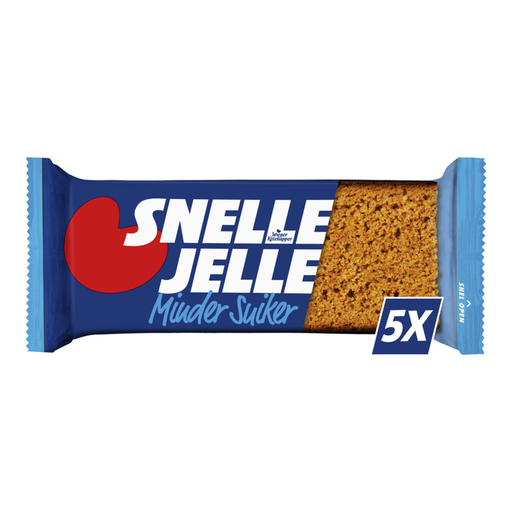
Snelle Jelle Breakfast Cake, Less Sugar variety, 250 g

Snelle Jelle Breakfast Cake, Less Sugar variety, 250 g

If you want to take portions of Dutch breakfast cake on a picnic, check how this 250 g pack is divided and wrapped.

The variety name doesn’t confirm that the cake is sugar-free. Compare the ‘of which sugars’ figure with its corresponding unit, and read the ingredients and allergen information on the pack.

View on Joybuy

Frequently asked questions

Is zero Dutch breakfast cake automatically sugar-free?

No. Albert Heijn lists 4.9 g of sugars per 100 g for AH Ontbijtkoek zero, alongside 0 g of added sugars. So check the nutritional information rather than relying on the product name alone.

What’s the difference between ‘no added sugars’ and ‘less sugar’?

‘No added sugars’ doesn’t rule out sugars being present; ‘less sugar’ compares a product with another product. PLUS states that Snelle Jelle Minder Suiker has 30% less sugar than regular spiced cake, as well as 24 g of sugars per 100 g.

Can my dog eat Dutch breakfast cake containing xylitol on a picnic?

No, don’t give your dog Dutch breakfast cake containing xylitol. The product information for Peijnenburg zonder toegevoegde suikers warns that xylitol is not suitable for animals and advises contacting a vet immediately if it is ingested.

How should I take an opened, sliced Dutch breakfast cake with me?

Pack the slices in a well-sealed tin or bag to protect them. For its zero variety, Albert Heijn recommends storing it in a cool, dark and dry place. Also check the storage instructions on the pack you’re taking with you.

Does every Dutch breakfast cake contain iodised baker’s salt?

You can’t assume this is the case for every Dutch breakfast cake. The Warenwetbesluit defines baker’s salt as iodised table salt used in bread and other bakery products, but that doesn’t confirm the ingredients of any particular Dutch breakfast cake. Check the packaging to find out.
