
If you want to cut thick slices yourself
With an unsliced Dutch breakfast cake, you can choose how thick to cut the slices when getting it ready for the match. For example, Jumbo lists an unsliced plain Peijnenburg variant.


Want to serve thick slices of Dutch breakfast cake at an Oranje match? Choose a cake that’s explicitly labelled unsliced, so you can decide how thick to cut each slice. Pre-sliced cake is more convenient to serve straight away, but an XL name or larger pack weight doesn’t mean the individual slices are thicker. Always check the packaging of the specific variant for ingredients, nutritional information and allergens.
With an unsliced Dutch breakfast cake, you can choose how thick to cut the slices when getting it ready for the match. For example, Jumbo lists an unsliced plain Peijnenburg variant.
You can put pre-sliced Dutch breakfast cake straight on the table. Peijnenburg and Koek & Bakker offer sliced variants, so the portions are already set.
If you’re choosing based on wholegrain ingredients, sugars, fibre or allergens, the packaging of the specific variant matters more than whether it’s sliced. ALDI’s range includes sliced wholegrain and Zero variants.
Choose this: if you want to decide how thick to cut the slices yourself before the match.
Bear in mind: you’ll need a knife and chopping board, and the portions may vary in size.
Choose this: if you want to serve and share the slices without any preparation.
Bear in mind: you can’t choose the slice thickness yourself; the XL label alone doesn’t tell you how thick the slices are either.
| What to consider | What to check when buying | Who it matters to |
|---|---|---|
| Choosing the slice thickness yourself | Look for ‘unsliced’ on the packaging; don’t assume the slices are thicker based on XL or the pack weight. | I want substantial slices to put on the table, so I’d rather cut the cake myself. For around 36% of consumers, being able to choose the slice thickness is the top priority. |
| Serving it straight away | Check whether the cake is sliced and how many slices are in the pack. | When the match starts, I don’t want to have to get a knife out. An estimated 29% of consumers say being able to serve it quickly is their main concern. |
| Nutritional information and ingredients | Compare the nutritional information per 100 g and per portion, as well as the ingredients and allergen information for the variant you’ve chosen. | I’d rather choose based on what’s in the cake and how much I’m serving than on whether it’s sliced. Around 21% of consumers give priority to checking the label. |
| How much you need for your group | Check the pack weight and, for sliced cake, the number of slices. | There’ll be several of us watching, so I want to work out how many portions I can serve. For around 14% of consumers, the quantity is the most important factor. |
Albert Heijn lists a Peijnenburg variant with XL in its name, but the stated pack size doesn’t tell you how thick each slice is.
If you want to choose the thickness yourself, opt for a cake that’s explicitly labelled unsliced. Judge a pre-sliced variant on how convenient it is to serve straight away, not just on its name.
Voedingscentrum gives 11.2 g of sugars for a 30 g slice of Dutch breakfast cake. This isn’t a product-specific figure for every variant or every slice you cut yourself.
Compare the nutritional information per 100 g on the packaging and consider the size of the portions you want to serve.
These terms don’t mean the same thing. They also tell you nothing about the thickness of a pre-sliced piece.
Check the sugars per 100 g, the ingredients and whether the specific pack is sliced or unsliced.
A general description such as Dutch breakfast cake doesn’t confirm which ingredients a particular product contains or whether baker’s salt has been used.
If ingredients or allergens matter to your choice, read the current label on the pack. If anything is unclear, ask the manufacturer or retailer for product information.
Peijnenburg sells both sliced and unsliced Dutch breakfast cake. Its unsliced plain variant is a good choice if you want to decide the slice thickness yourself.
The range includes sliced own-brand Dutch breakfast cake and a sliced Peijnenburg variant with XL in its name.
Jumbo lists both sliced and unsliced Dutch breakfast cake, including an unsliced plain Peijnenburg variant.
ALDI lists a sliced wholegrain Dutch breakfast cake and a sliced Zero variant from Koek & Bakker.
Lidl lists, among other products, unsliced plain Dutch breakfast cake under the Tastino brand.
This unsliced Dutch breakfast cake is a good choice if you want to decide the slice thickness yourself before the match. Just allow time to cut it before serving.
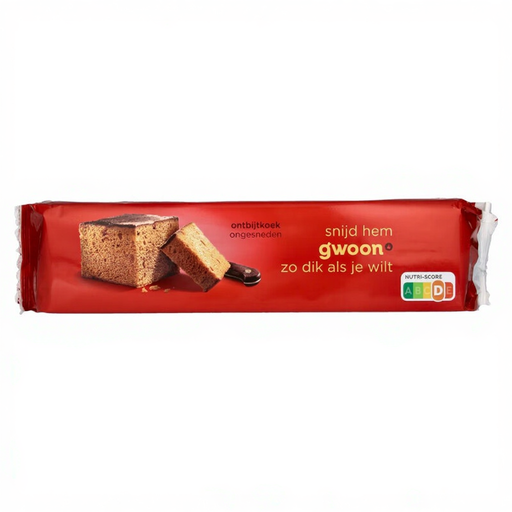 Image unavailable
For anyone who wants to cut slices for the match and choose how thick they are.
Unsliced Dutch breakfast cake in a 550 g pack; you’ll need to cut your own portions.
Choose a Dutch breakfast cake that’s explicitly labelled unsliced if you want to decide the slice thickness yourself. You can cut it into the portions you want before the match; with a pre-sliced variant, the portions are already set.
No, the XL name alone doesn’t confirm that the slices are thicker. Albert Heijn lists Peijnenburg plain sliced XL with a pack weight of 455 g; don’t judge the individual slices by the total pack weight.
No, they’re different terms. Check the packaging of your chosen Dutch breakfast cake to see how much sugar is listed per 100 g, and compare portions on the same basis.
Check the ingredients and allergen information on the current pack of the variant you want to serve. Peijnenburg lists rye flour in its plain sliced Dutch breakfast cake; don’t assume this applies to every other variant.
Don’t assume this is the case for a particular Dutch breakfast cake. Voedingscentrum says that even for bread, bakers aren’t required to use baker’s salt. So check the ingredients of the specific cake rather than assuming it contains iodine based on its product category.