Who should consider pack size?

Small households that enjoy coffee occasionally

If you only have a slice of Dutch breakfast cake with coffee now and then, the main thing to consider is how much of an opened pack you’ll get through in time. A smaller pack or individually wrapped portions may be worth considering.

People comparing nutritional information

If you’re choosing a variant based on its sugar, fibre or wholegrain ingredients, the full nutritional information is more useful than the wording on the front of the pack alone. Check which sweeteners have been used too.

People with an allergy or dietary requirement

If you need to avoid gluten, milk or lupin, the specific pack must meet your requirements. According to PLUS product information, a Peijnenburg gluten-free variant that was checked contains milk and lupin, so ‘gluten-free’ says nothing about those other allergens.

What should you look for when choosing?

First, think about how often you eat Dutch breakfast cake, then compare packs by weight and portion size. Always check the label on the specific variant for dietary preferences and allergens.

What to consider What to check Most relevant for
Small pack or individual portions Compare the weight, the number of slices and whether portions are individually wrapped. I only have a slice with coffee now and then, and don’t want the rest of an opened pack to go to waste. For around 36% of consumers, portion size is the top priority.
Nutritional information Check the sugar, fibre and salt per 100 g; for your own slice, also consider the portion size and ingredients. If I’m considering a wholemeal variant or one with no added sugars, I want to know what’s actually in it. This nutritional information matters most to around 29% of consumers.
Regular use Compare a medium-sized sliced pack with a larger one, and check the storage instructions after opening. I eat Dutch breakfast cake several times a week, so I could consider a larger pack without much going to waste. How quickly it will be used is the deciding factor for around 21% of consumers.
Allergens and dietary requirements Check the current ingredients and allergen information, even for a gluten-free variant. If I need to avoid certain ingredients, a suitable recipe matters more than the pack size. For around 14% of consumers, this is the main requirement.

Common mistakes

  • Assuming a small pack will automatically get used up

    Even with a smaller pack, the risk of waste depends on how often you eat Dutch breakfast cake and how you store the opened pack.

    Choose based on how much you expect to eat and follow the storage instructions on the pack.

  • Assuming ‘no added sugars’ means ‘sugar-free’

    The Peijnenburg wholemeal variant with no added sugars listed by PLUS still contains sugars and is sweetened with xylitol.

    Check both the sugar content in the nutritional information and the ingredients list. Keep products containing xylitol out of pets’ reach.

  • Assuming gluten-free means free from other allergens too

    The gluten-free Peijnenburg breakfast cake listed by PLUS contains milk and lupin.

    Check the allergen information on the current pack, including any warnings about cross-contamination.

  • Expecting every Dutch breakfast cake to contain iodised baker’s salt

    In the Netherlands, the Netherlands Food and Consumer Product Safety Authority allows iodine compounds in bakery products through baker’s salt containing a maximum of 65 mg of iodine per kg of salt. According to the Netherlands Nutrition Centre, the use of baker’s salt is not compulsory.

    Don’t assume a specific Dutch breakfast cake contains iodised baker’s salt; check the label or ask the manufacturer about its ingredients.

Brands compared

Peijnenburg

Jumbo lists Peijnenburg Dutch breakfast cake in several formats, including sliced packs of 265 g and 345 g, as well as individually wrapped portions of 10 × 28 g.

  • The packs listed offer different ways to serve a slice with coffee.
  • Ingredients, nutritional information and allergens vary by variant, so compare the specific packs.

Jumbo

Jumbo’s online range shows several pack formats of Peijnenburg Dutch breakfast cake.

  • Weight and portion size are useful points of comparison across the variants shown.
  • When choosing, check the latest product information and which variant is available to you.

PLUS

PLUS lists Peijnenburg and own-brand Dutch breakfast cake in several formats, including sliced and unsliced packs.

  • A 345 g sliced Peijnenburg pack and larger PLUS packs make it possible to compare sizes.
  • Ingredients and nutritional information apply to each individual variant, so check the current label.

ALDI

ALDI lists sliced Koek & Bakker Dutch breakfast cake in zero and wholemeal variants, both weighing 485 g.

  • Both variants listed are pre-sliced.
  • If you only eat it occasionally, think carefully about how much of a 485 g pack you’ll get through.

Lidl

A Lidl listing for Tastino Dutch breakfast cake gave pack sizes of 465 to 550 g.

  • The listed weight gives you a point of comparison for larger packs.
  • The listing was for an in-store promotion running from 28 September to 4 October 2026; check the current range if you’re looking for this variant.

Dutch breakfast cake on Joybuy

This 485 g sliced pack is best suited to people who eat Dutch breakfast cake regularly. If you only have a slice with coffee now and then, consider whether you’ll get through a pack this size in time.
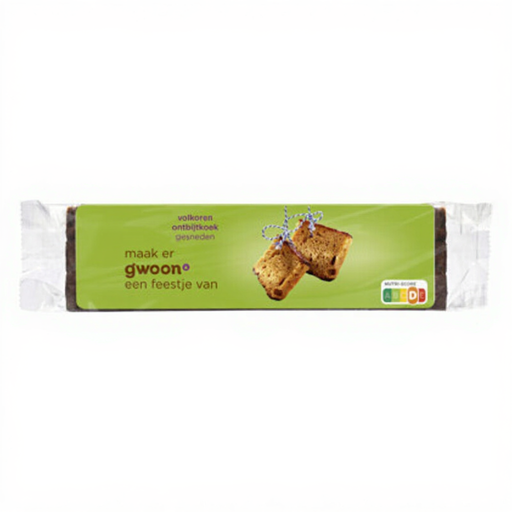
g'woon wholemeal Dutch breakfast cake, sliced, 485 g

g'woon wholemeal Dutch breakfast cake, sliced, 485 g

A sliced pack for anyone who regularly serves slices of Dutch breakfast cake. If portion size matters to you, check how the pack is divided up, and see whether the nutritional information on the label is given per 100 g or per portion.

View on Joybuy

Frequently asked questions

Is ‘half loaf’ a standard size for Dutch breakfast cake?

No, the term doesn’t tell you how much Dutch breakfast cake is in a pack. Compare the weight and the number of slices or individual portions. For example, Jumbo and PLUS range listings show packs of 265 g, 280 g and 345 g.

When are individually wrapped portions useful?

Individually wrapped portions are a good fit if you only have one slice with coffee now and then, as you don’t have to open the whole pack at once. Check how many portions the pack contains and whether you’ll use them all.

Is Dutch breakfast cake with no added sugars also sugar-free?

No. According to the product information, the Peijnenburg wholemeal variant with no added sugars listed by PLUS contains 4.9 g of sugars per 100 g and is sweetened with xylitol. Check the nutritional information and ingredients on the pack you choose.

Is iodised baker’s salt compulsory in Dutch breakfast cake in the Netherlands?

No. The Netherlands Food and Consumer Product Safety Authority says iodine compounds may be added to bakery products through baker’s salt containing a maximum of 65 mg of iodine per kg of salt; the Netherlands Nutrition Centre states that using baker’s salt is not compulsory. For a specific Dutch breakfast cake, check the label or ask the manufacturer about its ingredients.

How should I store an opened pack of Dutch breakfast cake?

Follow the storage instructions on the pack for your chosen variant. For a Peijnenburg wholemeal variant, PLUS recommends storing it in a cool, dry, dark place, for example in a sealed tin or container.
