Choose a pack size that matches the amount of Dutch breakfast cake your Christmas recipe calls for: around 250–350 g may suit a small baking project, if the product you want is available. A larger cake is only worth choosing if you’ll use the rest, too. Choose an unsliced cake if you want to make your own cubes or crumbs, or individually wrapped slices if you’d like to keep portions separate. Always check the ingredients and allergen information on the packaging.
Who is this choice for?
Small households baking for one recipe
If you only need part of a cake, compare the net weight with the amount your recipe calls for before choosing a pack. A smaller pack only helps you avoid leftovers if its shape and quantity work for your needs, too.
Bakers who want to slice the cake themselves
An unsliced cake gives you more freedom than pre-portioned slices when you want to make cubes, crumbs or slices of a particular thickness. For example, Peijnenburg lists an unsliced 345 g plain cake.
Shoppers comparing labels
Ingredients, allergens and nutritional information vary between products. Check the packaging of the exact cake you’re buying, even if you’ve bought a product from the same brand before.
What should you look for?
Start with the amount your recipe needs, then decide whether you’ll need to slice it yourself. Finally, check that the product meets your ingredient requirements. A smaller pack doesn’t automatically mean the cake will be easy to work with.
| What to consider |
What to check before buying |
Who it matters to |
| Quantity and leftovers |
Compare the net weight with the number of grams in your recipe, and think about whether you’ll use any leftovers. |
I’m making one small recipe and don’t want a large piece left over; around 42% of consumers prioritise a suitable quantity. |
| Cut and shape |
Work out whether you need whole slices, your own cubes or crumbs, then choose a sliced or unsliced cake to suit. |
I want to choose the shape for my topping or filling; ease of preparation is the top priority for around 33% of consumers. |
| Label and ingredients |
Read the ingredients, allergen information and nutritional details on the current packaging for the product you’ve chosen. |
I want to know which ingredients and allergens are in this particular cake; around 25% of consumers prioritise checking the label. |
Common mistakes
-
Assuming ‘half a Dutch breakfast cake’ is a standard product size
A small pack doesn’t have the same weight everywhere. Jumbo lists a 250 g ginger breakfast cake, but notes that this product is no longer in its online range. Peijnenburg lists an unsliced 345 g plain cake.
Note down how many grams your recipe needs and check what’s currently available before adding a particular size to your shopping list.
If the size you planned to buy isn’t available, you may need to adapt your recipe or look again for a suitable pack.
-
Assuming every Dutch breakfast cake contains iodine
Information about baker’s salt doesn’t prove that it’s used in every Dutch breakfast cake. The Netherlands Nutrition Centre discusses bread as a source of iodine; that doesn’t mean Dutch breakfast cake plays the same role.
Check the ingredients on the packaging of the specific cake, or ask the manufacturer what type of salt it uses.
-
Choosing based on flavour or weight alone
Dutch breakfast cake varieties may list different ingredients and allergens. A claim about sugar or wholemeal content also doesn’t tell you everything in the nutritional information.
When you buy, read the ingredients list, allergen statement and nutritional information for the exact product, preferably on the packaging itself.
Brands and ranges to consider
Peijnenburg
Peijnenburg lists an unsliced 345 g plain cake. Jumbo also lists a Peijnenburg 10-pack, with ten individually wrapped 28 g slices.
- With the unsliced cake, you can cut the pieces you need for your recipe; the individual slices are already portioned.
- Check what shape your recipe needs: individual slices give you less freedom to cut larger pieces yourself.
Jumbo
Jumbo lists its own-brand 250 g ginger breakfast cake, but notes that this product is no longer in its online range.
- The stated weight gives you an idea of how a smaller pack compares with the amount in a recipe.
- Don’t plan a baking recipe around this particular cake without checking that it’s currently available.
Albert Heijn
Albert Heijn lists its own-brand 600 g Dutch breakfast cake and also provides product information for a pearl sugar variety.
- At 600 g, it’s a useful point of comparison if you’re making more than one recipe.
- The pearl sugar variety lists rye and wheat gluten, and possible traces of milk and nuts; check the label on the pack you buy.
Koek & Bakker
ALDI Netherlands lists an unsliced 465 g pearl sugar Dutch breakfast cake in this range, as well as sliced zero and wholemeal varieties weighing 485 g.
- The listed varieties differ in how they’re sliced and described, so you can compare these features separately.
- At 465 or 485 g, these packs are larger than one weighing around 250–350 g. For the zero variety, read the full nutritional information rather than relying on the name alone.
PLUS
Here, PLUS is a retailer to consider, rather than a separately identified Dutch breakfast cake brand. Its online category lists Peijnenburg Naturel Gesneden (sliced), weighing 345 g.
- The listed pack offers a sliced 345 g option to compare with your recipe.
- Check the range at the shop where you do your food shopping before planning to use this variety.
Dutch breakfast cake products at Joybuy
These two products show the difference between a 250 g pack of individual bars and a larger, unsliced cake. Compare both the quantity and shape with your Christmas recipe; neither is automatically right for every bake.
 No image available
Snelle Jelle Dutch breakfast cake bars, 250 g
The 250 g pack may suit a small baking project if you want to use individual portions. The bars aren’t an unsliced cake that you can cut into larger pieces yourself, so check that their shape works for your recipe.
Check the sugar content per 100 g on the current label rather than relying on the sugar claim in the product title.
View at Joybuy
 No image available
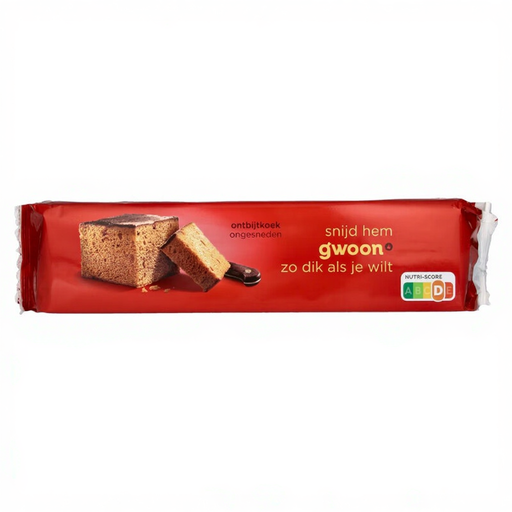
g'woon unsliced Dutch breakfast cake, 550 g
The unsliced cake is a good fit for a recipe where you want to cut your own slices or cubes. However, if you only need a small amount, you’ll need a plan for the rest of the 550 g pack.
Check the ingredients and allergen information on the current packaging: the product information available gives conflicting details about these.
View at Joybuy
Frequently asked questions
Is unsliced Dutch breakfast cake better for Christmas baking?
Unsliced Dutch breakfast cake is handy when you want to choose the thickness or shape of the pieces yourself. If your recipe only needs a few slices of a set size, individual portions may be more practical. Peijnenburg lists both an unsliced 345 g cake and a 10-pack of 28 g slices.
Can I assume Dutch breakfast cake containing rye or wheat is gluten-free?
No—rye and wheat contain gluten. Jumbo’s product information for its ginger breakfast cake lists rye, wheat and gluten, while Albert Heijn’s pearl sugar variety lists rye and wheat gluten. Always check the label on the exact variety.
Is Dutch breakfast cake an equivalent source of iodine to bread?
You can’t assume that just because baker’s salt is used in baked goods. The Netherlands Nutrition Centre describes bread as a source of iodine, but that doesn’t tell you how much iodine a particular Dutch breakfast cake contains. Check the product information or ask the manufacturer if this matters to you.
How should I store any Dutch breakfast cake left over after baking?
Follow the storage instructions on the packaging of the variety you’ve chosen, especially once it’s been opened. Before buying, think about how much you’d like to keep for another baking session or another planned use.


