Who is this relevant to?

Anyone who wants to serve without slicing

If several people are joining you for Sunday breakfast, it’s useful to check the number of slices and the pack size in advance. Once the pack is open, it’s also worth considering how you’ll store what’s left.

Anyone comparing sugar and fibre

Plain Dutch breakfast cake and a wholemeal version can differ considerably. Compare the nutritional values per 100 g and per portion; for a no-added-sugar version, check which sweeteners it contains too.

Households keeping an eye on pack size

A large pack is only practical if the number of slices suits how many people are eating and how much you’ll have left after breakfast. So compare the weight and, where stated, the number of portions.

What should you look for when choosing?

First decide whether pre-sliced portions and a suitable pack size are enough, or whether the nutritional information or a particular ingredient will determine your choice. Then compare the specific versions, rather than relying on the words on the front of the pack.

What to consider What to check before buying Who it matters most to
Nutritional value Compare sugar and fibre per 100 g and per portion; check whether the version in question is wholemeal. If you regularly serve Dutch breakfast cake, you’ll want to know how a slice fits in with the rest of breakfast. For around 33% of consumers, sugar and fibre are the most important factors in this choice.
Pack size Check the weight and the stated number of slices or portions. If you intend to use one pack for several breakfasts, you won’t want to have lots of cake left over. For around 27% of consumers, a suitable pack size comes first.
Ease of serving Check whether the Dutch breakfast cake is pre-sliced and how many slices the pack contains. When several people are eating breakfast together, you’ll want to serve the slices straight away. For around 27% of consumers, this convenience is the top priority.
Ingredients Read the latest allergen information for rye and other cereals containing gluten; check the sweeteners in sweetened versions too. If you need to avoid an ingredient, the label will determine whether a particular cake is suitable. For around 13% of consumers, this check is decisive.

Common mistakes

  • Choosing based only on ‘sliced’

    Pre-sliced doesn’t tell you how many slices you’ll get. Jumbo lists 12 slices for one 345 g pack of Peijnenburg plain Dutch breakfast cake and 18 slices for a 550 g pack.

    Think about how many people are eating, then compare the number of slices and the pack size.

  • Assuming ‘no added sugar’ means ‘no sweeteners’

    The Peijnenburg wholemeal version with no added sugar shown by Albert Heijn contains xylitol and lists 24 g of polyols per 100 g. The product information warns that excessive consumption may have a laxative effect.

    Read the ingredients list and nutritional information for the version you want to buy.

  • Checking for rye only after buying

    The plain and wholemeal examples reviewed list rye. If you need to follow a gluten-free diet, you can’t determine whether a product is suitable from the words ‘plain’ or ‘wholemeal’ alone.

    Check the allergen information on the current packaging before buying.

  • Assuming all Dutch breakfast cake contains iodised baker’s salt

    The Netherlands Food and Consumer Product Safety Authority explains that iodine compounds may be present in bread, bread substitutes and other bakery products through the addition of baker’s salt, with a maximum of 65 mg of iodine per kg of salt. This isn’t a requirement for every Dutch breakfast cake.

    Check the ingredients of the specific product rather than assuming it contains baker’s salt because of its product category.

Brands to consider

Peijnenburg

The range reviewed includes sliced plain Dutch breakfast cake and a sliced wholemeal version with no added sugar.

  • Jumbo lists 12 slices for one 345 g pack of plain Dutch breakfast cake and 18 slices for a 550 g pack.
  • The wholemeal version shown by Albert Heijn lists 17 g of fibre per 100 g, but also contains xylitol; check that this is the version you want.

Albert Heijn

The own-brand range includes a 485 g sliced plain Dutch breakfast cake.

  • The product information gives a portion size of 30 g, so you can check the values per portion.
  • The product page lists rye flour and 36 g of added sugars per 100 g; check the current packaging if the ingredients matter to your choice.

Jumbo

Jumbo lists a 475 g own-brand sliced plain Dutch breakfast cake and a 280 g wholemeal Dutch breakfast cake.

  • The two pack sizes give you a useful guide to the size you’re looking for.
  • Check the ingredients and nutritional information for your chosen version separately.

PLUS

PLUS lists a 485 g own-brand sliced plain Dutch breakfast cake.

  • The product type and pack weight are stated.
  • PLUS says that ingredients, nutritional values and allergen information may change; check the packaging for the latest details.

Koek & Bakker

ALDI lists a 485 g pre-sliced wholemeal Dutch breakfast cake under this brand, as well as a sliced zero version with no added sugar.

  • The wholemeal version is pre-sliced and the pack weight is stated.
  • Don’t assume the wholemeal and zero versions have the same ingredients or nutritional values; check the label on the one you choose.

Tastino

Lidl’s Dutch breakfast cake range includes a sliced wholemeal version.

  • If you’re looking for sliced wholemeal Dutch breakfast cake, you can compare this version with plain on the label.
  • Check the ingredients, allergens and nutritional values on the packaging for this specific version.

Sliced Dutch breakfast cake on Joybuy

This sliced wholemeal Dutch breakfast cake suits anyone looking for slices they can serve straight away at Sunday breakfast. Compare the label with your preferences for ingredients and nutritional value.
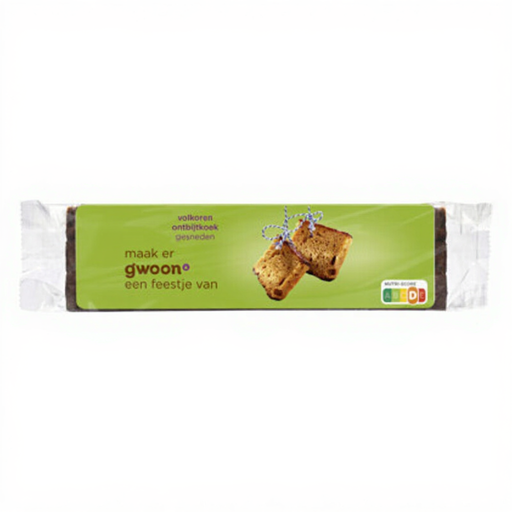
g'woon sliced wholemeal Dutch breakfast cake, 485 g

g'woon sliced wholemeal Dutch breakfast cake, 485 g

A pre-sliced option for anyone who wants to serve slices straight away at Sunday breakfast.

485 g pack. If you’re planning portions, check the packaging to see how many slices it contains.

If you need to avoid rye or gluten, it’s important to check the current label: the available product information gives conflicting details about rye and allergens.

View on Joybuy

Frequently asked questions

Is Dutch breakfast cake a complete breakfast on its own?

Not on its own. The Netherlands Nutrition Centre lists options from the Wheel of Five for breakfast, including wholemeal bread with toppings, yoghurt with fruit and porridge. So consider what else you’re serving alongside the Dutch breakfast cake.

Does Dutch breakfast cake with no added sugar also contain no sweeteners?

You can’t tell from that claim alone. The Peijnenburg wholemeal version shown by Albert Heijn contains xylitol and lists 24 g of polyols per 100 g; the product information warns that excessive consumption may have a laxative effect. So check the ingredients list for the version you choose.

Can I choose sliced Dutch breakfast cake if I need to avoid gluten?

Not without checking the label of the specific product. The plain and wholemeal examples reviewed list rye; if you need to follow a gluten-free diet, only choose a product whose current labelling confirms that it meets your requirements.

Does all Dutch breakfast cake have to contain iodised baker’s salt?

No. The Netherlands Food and Consumer Product Safety Authority describes the permitted use of baker’s salt in bread, bread substitutes and other bakery products, with a maximum of 65 mg of iodine per kg of salt. This isn’t a general requirement for every Dutch breakfast cake. Check the ingredients of the product you choose.

How should I store an opened pack of Dutch breakfast cake?

Follow the storage instructions on the packaging and seal the opened pack well. For the Peijnenburg Dutch breakfast cake reviewed, Jumbo recommends storing it in a cool, dry, dark place; it also suggests keeping the cake in a sealed tin to help it stay soft.
